About this place
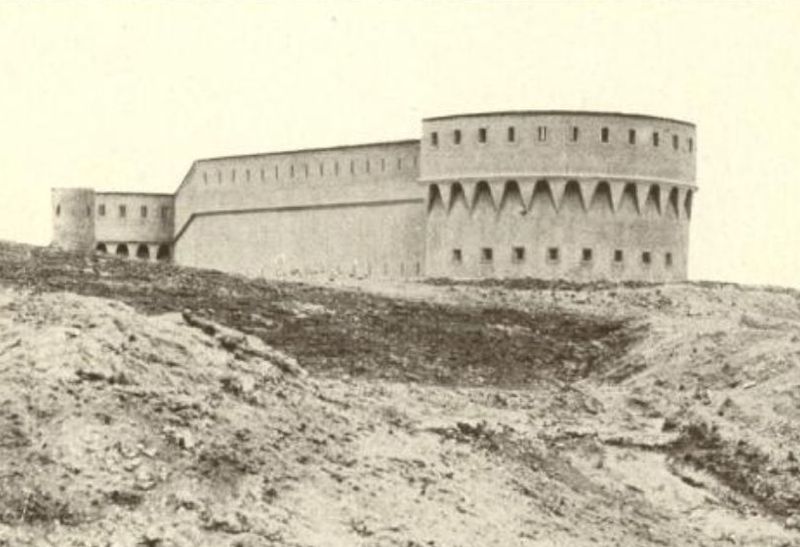
Fortín de Reina Regente is a small 19th-century fortification on the outskirts of Melilla, the Spanish enclave on the north coast of Africa. The structure sits on rising ground above the Río de Oro valley, in the Cañada de la Muerte area, and still carries a stark, defensive look — though it was never built to fight as a full artillery fort.
Why "fortín" and not "fuerte"?
Spanish military terminology draws a clear line between a fuerte (a fort capable of mounting artillery) and a fortín — a smaller outpost deliberately left without that capability. Reina Regente falls into the second category: its job was to watch the terrain and cover a stretch of the defensive line, not to fire heavy guns. That's why it's a noticeably more modest structure than the neighboring Fuerte de Cabrerizas Altas.
When and why was it built?
The fortification went up between 1894 and 1895, right after the so-called Margallo War (the Melilla War of 1893–1894), a conflict that pushed Spain to urgently reinforce the city's defenses. Reina Regente, together with several other forts and fortines, formed part of the outer defensive ring around Melilla (the so-called quinto recinto), guarding the landward approach and controlling access from the Río de Oro valley and the Arroyo de Farhana stream.
What will you actually see?
The building stands out for its neo-medieval architectural style, an unusual choice for a Spanish colonial-era fortification. The walls are built from local stone, while the arches and structural details are solid brick — a material contrast that's still clearly visible today. The fortín is bordered by a road leading toward the Tercio Gran Capitán barracks and the Cabrerizas area, with views over the Cañada de la Muerte neighborhood. There's no elaborate interior to explore — this was an observation and defense point, not a residence or a barracks — but the layout of the walls and its position on the terrain still tell you a lot about how Spain built military architecture at the end of the 19th century.
How to get there, and when to go?
The fortín sits on the edge of Melilla, away from the tourist center and close to military land, which is worth keeping in mind when planning a visit — the usual caution for this kind of site applies. A car or taxi from the city center is the practical way in; it's not on a regular tourist transport route. Melilla's climate stays mild year-round, so a visit works in most seasons, though spring and autumn offer the most comfortable conditions by avoiding the summer heat.
Status and significance
Fortín de Reina Regente is listed as a heritage site of local cultural interest, reflecting its value as a surviving piece of Melilla's colonial-era defensive history. Alongside the nearby forts, it forms part of a coherent set of structures that illustrate Spain's strategy for securing the borders of its North African enclave at the turn of the 20th century.
Frequently asked questions
What's the difference between a fortín and a fuerte? A fortín is a smaller defensive outpost without the capacity to mount artillery, unlike a fuerte, which could hold heavy guns. Reina Regente served an observation and cover role within Melilla's wider fortification system.
When was this fortification built? It was constructed between 1894 and 1895, as part of the effort to strengthen Melilla's defenses following the Margallo War of 1893–1894.
Can visitors go inside the fortín? The site is historic and sits in an area with restricted access due to its proximity to military land, so it's worth checking current access rules locally before visiting.
What else is worth seeing nearby? Fuerte de Cabrerizas Altas and other parts of Melilla's outer defensive ring are close by, making it easy to combine a visit into a single route focused on the city's fortification history.
Nearby places

Earn badges for the places you visit
Download NextOnTrip, discover new places and check off your trails.