About this place
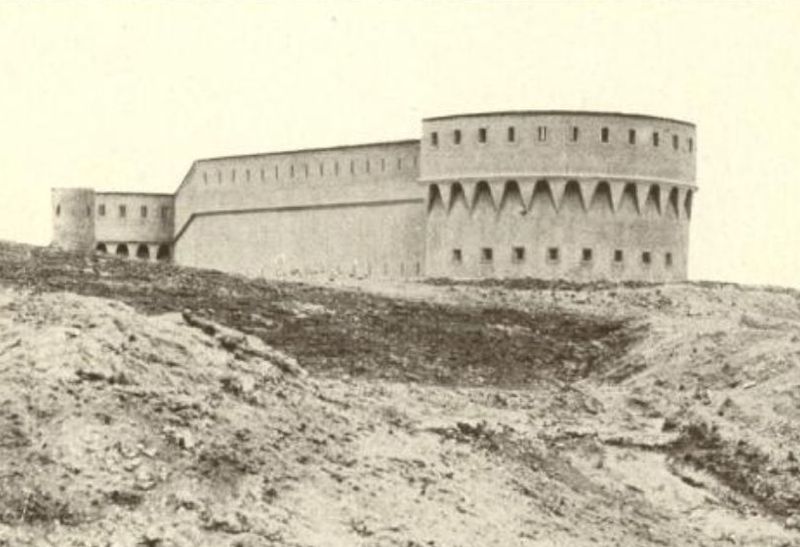
Fort of Rostrogordo is a 19th-century military stronghold in Melilla, the Spanish exclave on the northern coast of Africa, standing roughly 3 km north of the city's historic center.
Where did the fort come from?
The idea of building a watchtower on this site dates back to 1867, proposed by engineer Francisco Roldán, but the fort itself wasn't built until 1888–1890. Military engineers Eligio Souza and Fernández de la Maza directed the construction, which aimed to defend Melilla against attacks from Rif tribes that regularly threatened the Spanish enclave at the time.
What does the architecture look like?
Rostrogordo follows a trapezoidal layout built around an interior courtyard, with garrison rooms arranged along its perimeter. A distinctive feature is the ramp leading up to the battery positions on the upper level, from which soldiers could monitor the surrounding hills and respond to threats. This layout is typical of late-19th-century Spanish military architecture designed to protect colonial outposts in North Africa.
A prison and a darker chapter
The fort wasn't purely defensive — over time it was converted into a military prison. Its most famous inmate was Abd el-Krim, leader of the Rif resistance movement, held here in August 1917. He attempted to escape by jumping from the fort's walls, breaking his left leg in the fall — an injury that left him limping for the rest of his life.
A far grimmer chapter unfolded during the Spanish Civil War and the years that followed. Executions were carried out at a shooting range near the fort, with estimates putting the number at around 291. That history makes Rostrogordo a site of memory as much as a piece of military architecture.
What can you see today?
After years of neglect, the fort was restored and now sits within a recreational and sports park known locally as El Fuerte. Visitors can walk the grounds of the old stronghold, see the surviving walls, courtyard, and remnants of the artillery positions, while also enjoying the surrounding greenery and sports facilities. The fort holds protected status under Spanish heritage law (Bien de Interés Cultural), which safeguards its historical fabric.
How do you get there?
The fort sits a few kilometers from Melilla's city center, so a car or taxi is the most convenient way to reach it — local public transport also serves this part of the city. It's worth combining a visit with a walk through the surrounding green space, since the area now functions as a city park rather than a purely historical site.
When's the best time to visit?
Because the fort and its surrounding park are largely open and exposed, spring or autumn make for the most pleasant visits, when Melilla's temperatures are milder than in the height of summer. Summer afternoons can get hot enough to make a longer walk along the walls uncomfortable.
Frequently asked questions
Can you visit Fort Rostrogordo on your own? Yes, the site is freely accessible as part of a public recreational park, so you can walk around without a guide.
Who was the fort's most famous prisoner? Abd el-Krim, leader of the Rif uprising, was held here in 1917 and broke his leg during an escape attempt.
Does the fort carry historical significance beyond its military role? Yes, during and after the Spanish Civil War it served as a prison, and numerous executions took place nearby, making it a site of memory as well as architecture.
Is there anything else to see near the fort? Yes, it's surrounded by the El Fuerte sports and recreation park, popular with Melilla locals for walks and outdoor activities.
Nearby places

Earn badges for the places you visit
Download NextOnTrip, discover new places and check off your trails.