About this place
Forte de São Sebastião in Castro Marim is a 17th-century fortress in the far southeast of Portugal, in the Algarve, close to the Spanish border. It is regarded as the best-preserved example of the town's mid-1600s defensive overhaul and has been a National Monument since 2012.
Where is the fort in Castro Marim?
The fort stands on Cabeço hill, south of Monte do Castelo, the rise crowned by the town's medieval castle. It lies in Castro Marim municipality, Faro District, near the Guadiana River, which forms the boundary between Portugal and Spain. The coordinates are roughly 37.217° N, 7.443° W.
Why was it built?
Work began in April 1641 under King John IV, during the War of Restoration of Portuguese Independence, when the country was reasserting itself after its union with Spain. The Guadiana frontier was a sensitive stretch, so the settlement's defences were modernised. The old medieval castle no longer suited the demands of artillery warfare, and a modern fortification was raised beside it. Construction was completed in 1658, turning Castro Marim into the most important military stronghold in the Algarve at the time.
A hermitage dedicated to Saint Sebastian previously occupied the hill. It was demolished during the works, but the saint gave the fort its name.
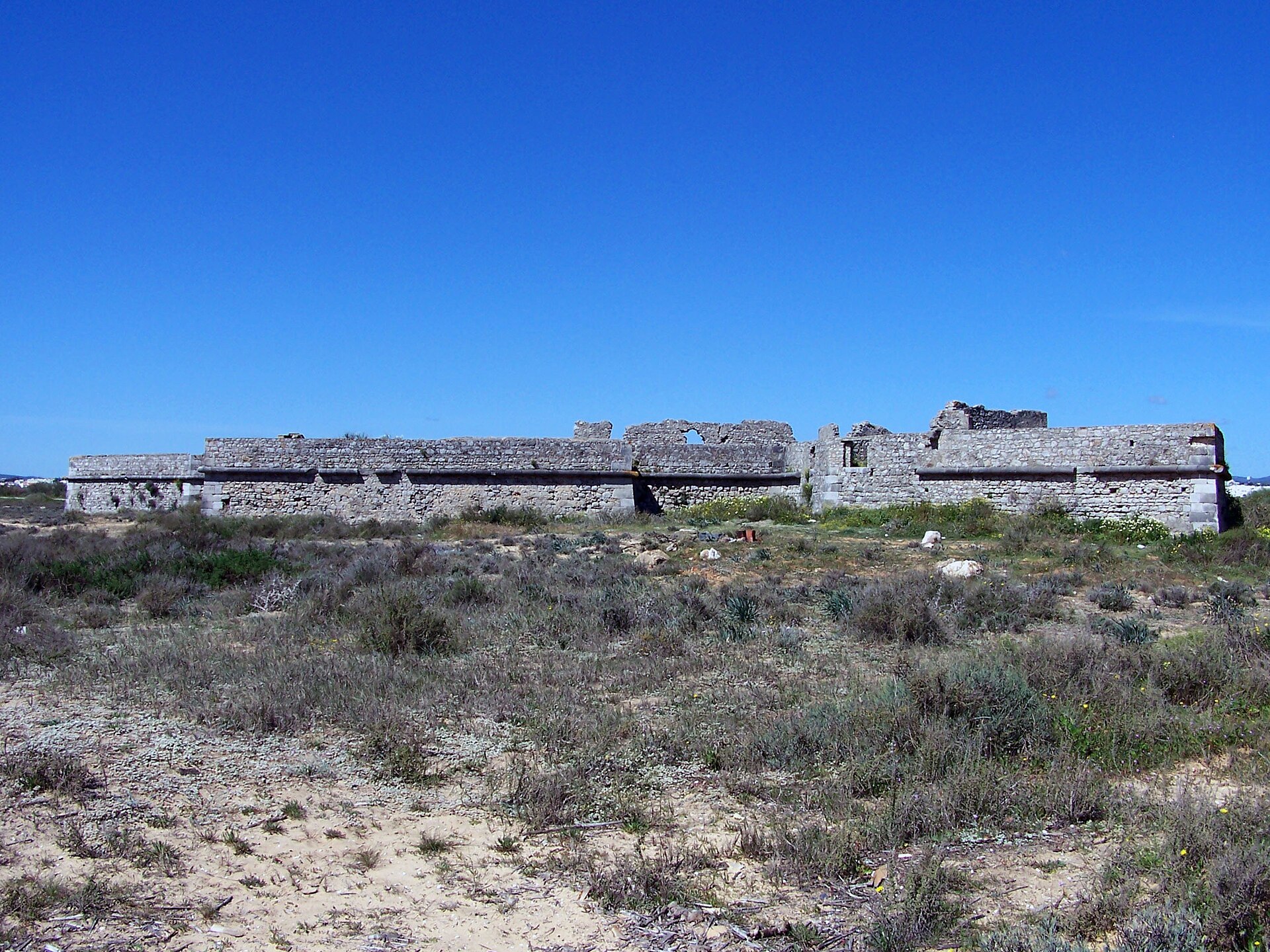
What does the fortress look like?
The plan follows the shape of the hill, so the walls form an irregular enclosure. Five bastions project from it. The main gate faces north, towards the town and the castle. The fort was part of a wider system: the area's defence relied on the castle, Forte de São Sebastião and the Revelim of Santo António.
Protection and restoration
In 2004 the municipality began a comprehensive reconstruction and consolidation project for the fort and its walls, aimed at preserving the monument's authenticity and integrity. In 2012 it was classified as a National Monument.
Is Forte de São Sebastião worth visiting?
Yes, if you enjoy military history or want a quieter alternative to the Algarve's beach resorts. It pairs well with the castle hill, since the two sites are a short walk apart. The walls give views over the Castro Marim area, and the bastion layout shows how 17th-century engineers combined the terrain with modern fortification design.
Frequently asked questions
When was the fort in Castro Marim built? Work started in 1641 and finished in 1658.
Who ordered it? King John IV, during the War of Restoration of Portuguese Independence.
How many bastions does it have? Five, set within an irregular wall that follows the hill.
Is the fort a protected monument? Yes, it has been a National Monument since 2012.
Where does the name come from? From a hermitage of Saint Sebastian that stood on the hill until it was demolished for the fortifications.
Is it the same as the fort in the Azores? No. A fort with the same name exists in Angra do Heroísmo on Terceira Island, but it is a completely different site.
Nearby places

Earn badges for the places you visit
Download NextOnTrip, discover new places and check off your trails.