About this place
Fontaine-les-Blanches Abbey is a former Cistercian monastery in the commune of Autrèche, in the Indre-et-Loire department of France's Centre-Val de Loire region. Most of the site is now private property, so it is not a regularly open visitor attraction, but the surviving fragments still draw travelers interested in medieval monastic architecture and the religious history of the Touraine countryside.
Where does the name "les Blanches" come from?
The name does not describe the color of the stone or the surrounding fields - it refers to the monks' habits. The community began as a small group living in the woods around a chapel, wearing the grey habit typical of Benedictine monks. Once the house joined the Cistercian order, the monks switched to the white habit associated with Cîteaux, and that change of clothing gave the abbey its lasting nickname.
How was the abbey founded?
The community traces back to around 1125, when a handful of monks settled in the forest around a chapel. The settlement gained the status of an abbey in 1134, when Odo, abbot of Savigny, and Hildebert of Lavardin placed it under the rule of Cîteaux, making Fontaine-les-Blanches a daughter house of the abbey of Savigny. Full integration into the Cistercian order followed at the chapter of 1147, the moment the monks formally exchanged their grey Benedictine habits for the white Cistercian ones.
What happened to the abbey after the Revolution?
During the French Revolution the abbey's property was confiscated and sold as a national asset, and much of the monastic complex was demolished. On 28 May 1792 the estate was bought by Guillaume Dubaut, a former royal advisor and tax collector for the Tours "election" district, who paid 19,200 livres for it.
What can still be seen today?
Only a handful of elements survive from the original monastery. The north gateway dates from the 16th century, while the abbatial residence - largely rebuilt in the 17th century - still contains a ground-floor hall from the 13th century and a room with visible traces of 14th-century wall painting. A separate square pavilion from the 13th century was built over stacked dungeon chambers spread across three levels, connected to one another by trapdoors.
The remaining structures have been listed as a French historic monument (monument historique) since 14 September 1949.
Can visitors tour the abbey?
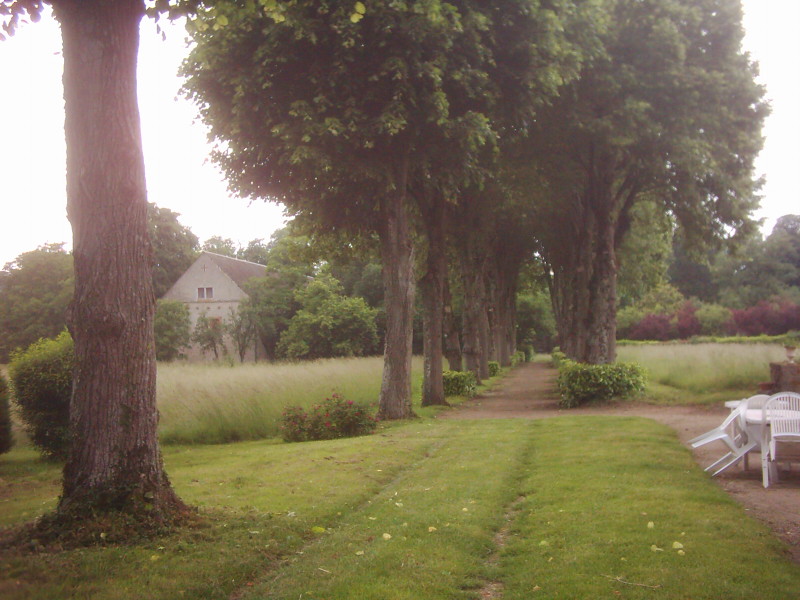
The grounds and buildings belong to a private owner, so there is no organized visiting schedule or public access to the interior. Travelers exploring Touraine can still appreciate the setting from outside - a quiet rural corner of Autrèche that holds one of the region's lesser-known traces of medieval monastic life along the Loire.
Where exactly is it located?
The abbey lies within the commune of Autrèche, in the Indre-et-Loire department, in the Centre-Val de Loire region of France. Its geographic coordinates are approximately 47.4978 N, 0.998889 E.
Frequently asked questions
Who founded Fontaine-les-Blanches Abbey? A small group of monks began the community around 1125, settling in the woods around a chapel. It was granted abbey status in 1134 by Odo, abbot of Savigny, and Hildebert of Lavardin.
Why is it called the "White" abbey? The nickname comes from the white Cistercian habit the monks adopted after the community formally joined the Order of Cîteaux at the 1147 chapter, replacing their earlier grey Benedictine dress.
What remains of the original monastic buildings? Surviving elements include a 16th-century north gateway, the abbatial residence with a 13th-century hall and 14th-century painted decoration, and a 13th-century square pavilion built above stacked dungeon chambers.
Is the abbey open to visitors? No. The site is privately owned, and there is no regular public access or visiting schedule for the buildings.
When was the site protected as a historic monument? The abbey has been listed as a monument historique in France since 14 September 1949.
Nearby places

Earn badges for the places you visit
Download NextOnTrip, discover new places and check off your trails.