About this place
The Església vella de Santa Maria de Merola is a Romanesque church ruin in the hamlet of Merola, part of the municipality of Puig-reig, in the Berguedà region of Catalonia. Only fragments of its walls remain, yet the site carries more historical weight than its ruined state might suggest.
Where exactly is this ruin located?
The church stands within the old settlement of Merola, administratively part of Puig-reig in Berguedà — a hilly area of central Catalonia north of Barcelona. The landscape is typical of the region's Romanesque heritage: scattered rural parishes, many of which survive today only as ruins standing among fields and woodland.
How far back does its history go?
The earliest written record of the church dates to 1050, placing its origins firmly in the Romanesque period. In the Middle Ages the area fell under the diocese of La Seu d'Urgell and the county of Berga, structures that shaped the ecclesiastical and civil map of this part of the Pyrenees and Pre-Pyrenees for centuries. The building served as the parish church for the whole Vall de Merola (Merola valley) and answered to the nearby monastery of Santa Maria de Serrateix, one of the region's more prominent monastic centers.
Why did the parish move elsewhere?
The church remained in continuous use until the early 16th century. By then, however, the building was already in poor structural condition, and its location proved inconvenient for the valley's inhabitants, who were scattered across surrounding farmsteads. The decision was made to raise a new church at a site known as Torre de Merola. Construction of its replacement began on August 2, 1609, when the foundation stone was set, and the new building received its blessing on November 27, 1611. From that point on, the old church at Merola lost its religious function and gradually fell into ruin.
What has survived to the present day?
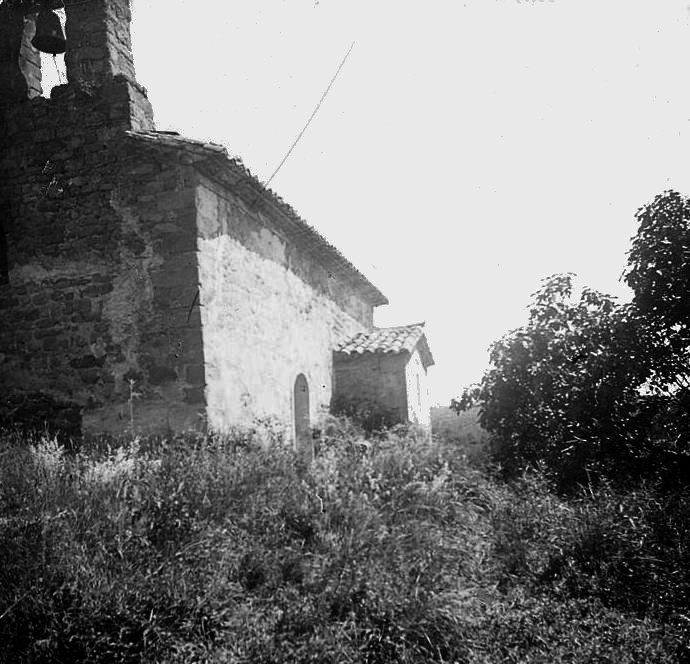
Despite the centuries, the basic layout of the original building can still be traced. It was a single-nave church covered by a barrel vault and closed off by a semicircular apse — a plan typical of small Romanesque rural churches in Catalonia. An adjoining room covered by a quarter-sphere vault (cul-de-four) also survives, along with a cross-shaped window on the western wall. The rest of the structure is too damaged for a full reconstruction of the original plan: many elements have been lost or are hard to identify with certainty. The ruin is listed in Catalonia's Inventory of Architectural Heritage, confirming its historical value even though this has not led to a restoration of the site.
Why does this place matter?
The Església vella de Santa Maria de Merola is not a dramatic tourist attraction in the conventional sense — it is a modest, partly eroded ruin set in the rural Catalan landscape. Its value lies elsewhere: it shows what religious life looked like for the scattered communities of the Merola valley in the Middle Ages, and why parishes eventually relocated their churches closer to where people actually lived, rather than keeping to an original site that had become impractical. It is a trace of a four-century-old decision that helped shape the settlement pattern still visible in this part of Berguedà.
Frequently Asked Questions
Where is the Església vella de Santa Maria de Merola located? In the hamlet of Merola, within the municipality of Puig-reig, in the Berguedà region of Catalonia.
How old is the church? It is first documented in 1050, which places its origins in the Romanesque period.
Why did the church become a ruin? In the early 17th century a new parish church was built at Torre de Merola, blessed in 1611, and the old building was abandoned and left to decay.
What can still be seen on site today? Remains of a single-nave building with a barrel vault, a semicircular apse, an adjoining room with a quarter-sphere vault, and a cross-shaped window on the western facade.
Was this church important to the surrounding area? Yes — for centuries it served as the parish church for the entire Vall de Merola and was linked to the monastery of Santa Maria de Serrateix.
Nearby places

Earn badges for the places you visit
Download NextOnTrip, discover new places and check off your trails.