About this place
Elisabeth Park is one of the largest and most notable public parks in Brussels, stretching across the boundary between the municipalities of Koekelberg and Ganshoren. Covering roughly 17 to 21 hectares, it forms a significant green lung on the western side of the city and draws both local residents and visitors on their way to the nearby basilica.
Where does the park's name come from?
The park is named in honour of Queen Elisabeth of Bavaria, the third Queen of the Belgians and wife of King Albert I. Naming the park after her fits into the wider tradition of commemorating members of the Belgian royal family in Brussels' urban spaces around the turn of the 20th century.
When was the park created and who designed it?
The creation of the park was decided by the municipal council of Koekelberg on 8 December 1868, based on plans drawn up by engineer and urbanist Victor Besme, who designed several major green spaces in Brussels during this period. Actual construction work only began in 1880, once the Société du quartier Léopold II, the body responsible for the project, had gathered the necessary funds. The park was finally completed in 1891, as part of a wider urban development project covering the Koekelberg district.
What gives the park its distinctive shape?
The layout of paths and lawns in Elisabeth Park was designed to evoke the monogram of King Leopold II, under whose reign the park was conceived. This was no coincidence: the whole composition was planned around a grand visual perspective running from the Koekelberg basilica along the wide Leopold II Boulevard. The park's tree-lined avenues open up one of the longest and most striking sightlines in all of Brussels, stretching from the basilica towards the Botanical Garden.
What can visitors find inside the park?
The park's most recognisable architectural feature is a music kiosk dating from 1841, made of finely wrought metalwork — a landmark within the park and a popular spot along its walking paths. Alongside the kiosk, the park also offers a playground, a sports field, a pavilion, and numerous benches, giving it an important recreational and social role for people living in the surrounding neighbourhoods.
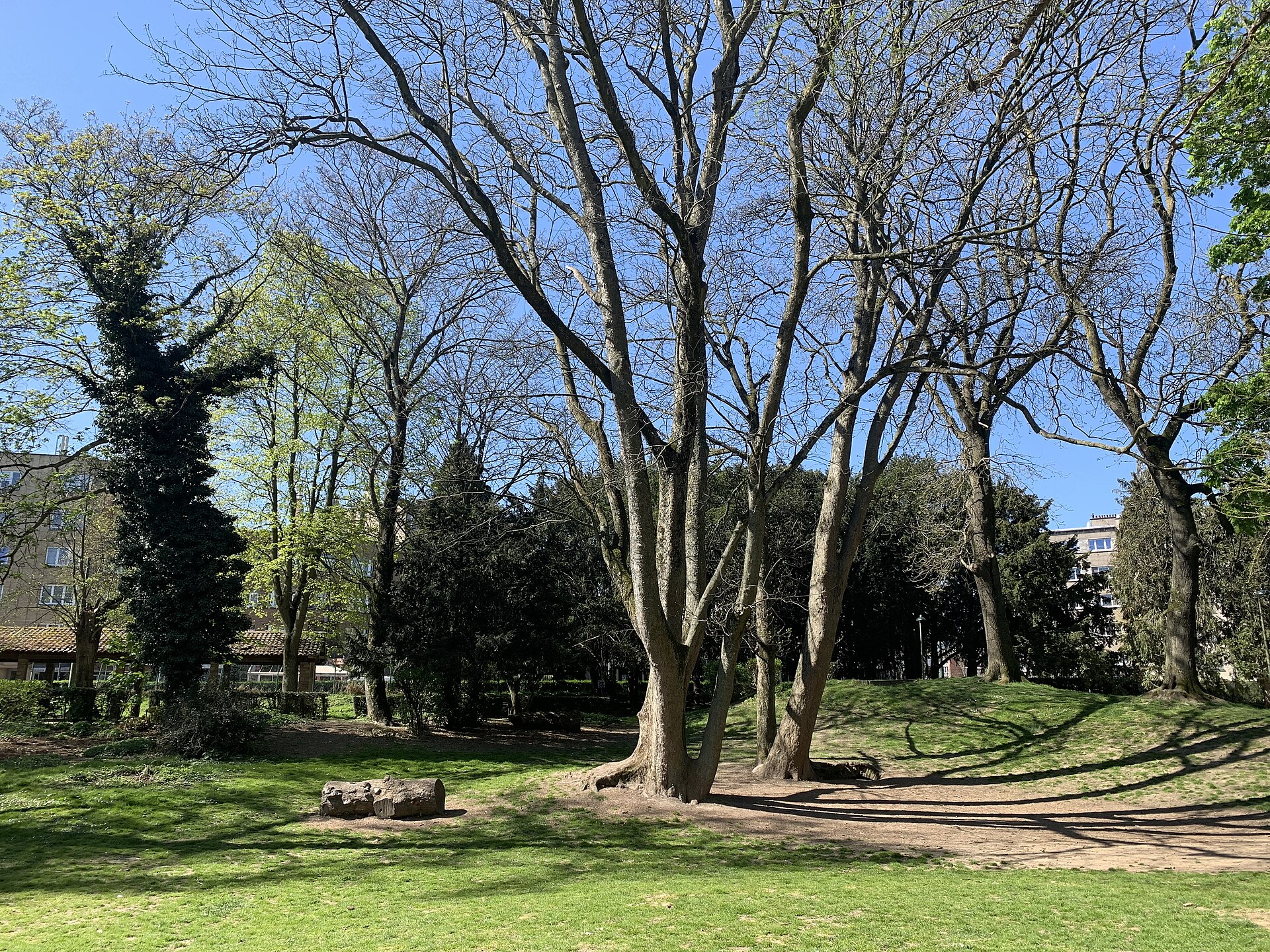
The park is also known for its rich tree collection: as many as 25 specimens growing on its grounds are listed among the Brussels-Capital Region's remarkable trees. Species found here include oaks, plane trees, and lindens, along with rarer varieties such as the American yellowwood (also known as the yellow horse chestnut). This wealth and diversity of mature trees gives the park real ecological value, in addition to its historical and urban-planning significance.
What else is worth seeing nearby?
The park's most striking backdrop is the National Basilica of the Sacred Heart on Koekelberg, one of the largest Catholic churches in the world. It is precisely from this basilica that the long visual axis mentioned above extends through the park towards Leopold II Boulevard.
Who is this park a good fit for?
Elisabeth Park suits visitors looking for a quiet walk among mature, historic trees as well as families with children, who can make use of the playground and sports field. Photography and architecture enthusiasts will appreciate the picturesque music kiosk and the dramatic view towards the basilica. The park also makes a natural resting point while exploring the western districts of Brussels.
Nearby places

Earn badges for the places you visit
Download NextOnTrip, discover new places and check off your trails.