Save this place and discover nearby attractions with NextOnTrip
In the app you can add it to your favorites, see what else is worth visiting nearby on the map, and earn a badge for your visit.
The app is available for iPhone and Android.
About this place
Dream Cave is a natural limestone cavern in the Derbyshire Dales, close to the town of Wirksworth and the village of Hopton in Derbyshire, England. Lead miners stumbled into it in 1822, and the animal bones inside it ended up in the hands of one of Britain's best-known early geologists. It remains a notable stop for anyone interested in Peak District mining and earth science, though the entrance lies on private land.
What is Dream Cave?
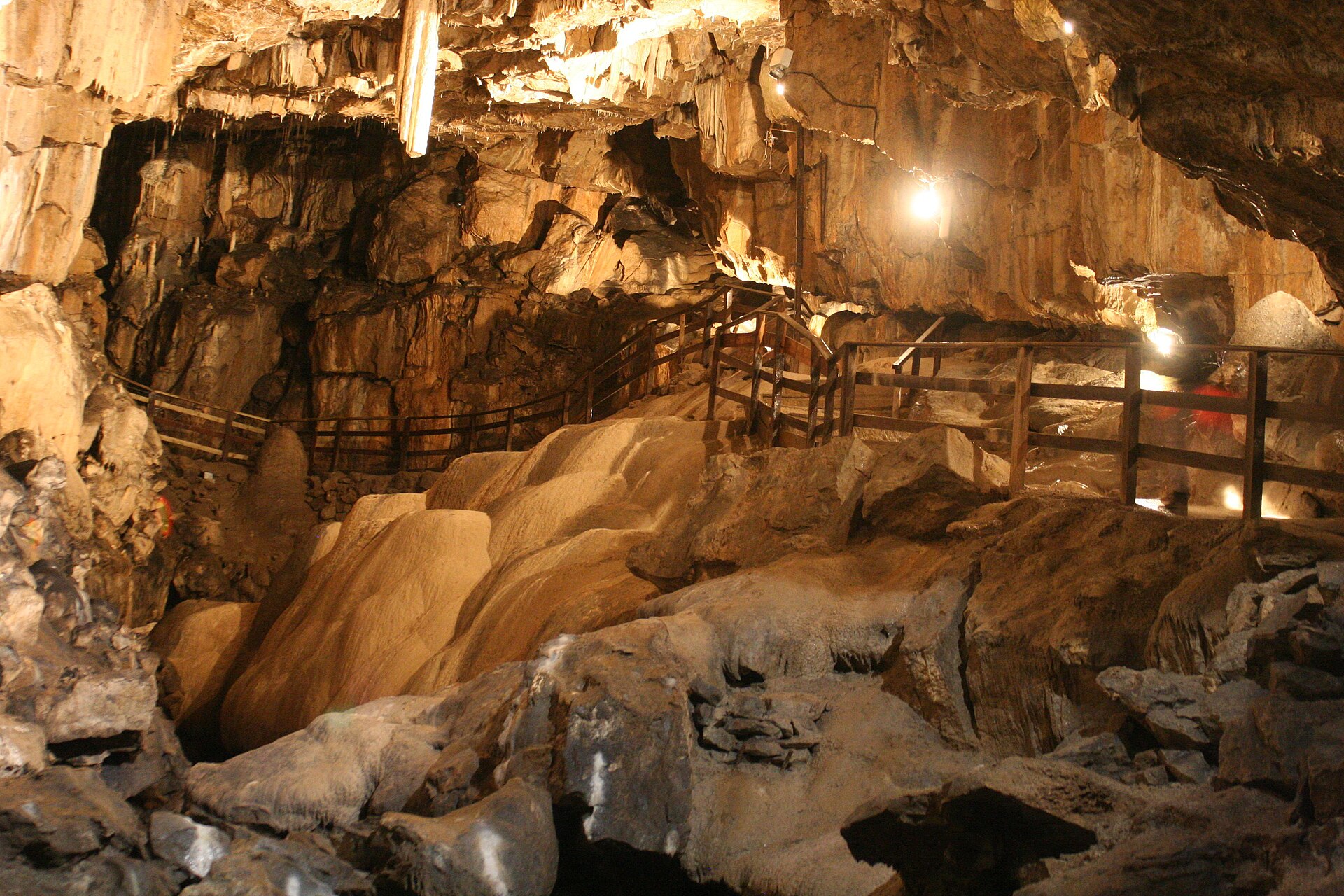
Also called Dream Hole or Dream Mine, the cave is a karst cavity that developed along a mineral vein in Lower Carboniferous limestone, part of the Monsal Dale Formation. It is roughly 15 metres deep and sits at about 240 metres above sea level. The entrance is a steep-sided fissure in a grassy mound, surrounded by fields scarred by centuries of lead workings.
The Derbyshire Historic Environment Record lists the site as "Dream Hole lead mine and cave" in Callow, about a mile west of Wirksworth on the way towards Hopton.
How was it discovered?
In December 1822, miners were sinking a new shaft to reach a rich lead vein in Dream Mine. About 18 metres down they unexpectedly broke through into a large natural chamber. Inside lay the bones of big mammals, including most of a woolly rhinoceros skeleton.
The geologist William Buckland acquired the remains, and they are now kept in Oxford. A print from 1822 showing a section through the cave and mine is held by the Wellcome Collection. The earliest known survey of the cave dates from 1823, and a modern one was made in 2016.
What can you see?
Almost all of the original sediment that filled the cave has been removed, so the layers that once recorded its history are no longer visible. The interest today lies in the story: a clear example of how nineteenth-century mining led to palaeontological finds. The surrounding landscape also shows what Derbyshire's lead-mining industry left behind, with humps and hollows from old workings across the fields.
The cave is rated at the lowest difficulty grade, but it is not set up for visitors.
How do you get there, and can you go in?
The cave lies about a mile west of Wirksworth and east of Carsington Water. Wirksworth is a small market town reached by car from Derby or Matlock, and footpaths between the fields make the area pleasant to explore on foot. Access to the cave itself is restricted because it is on private land. Do not enter without permission from the landowner or the caving body that manages access.
What else is nearby?
- Wirksworth, with its parish church and compact old-town streets.
- Carsington Water, popular with cyclists, sailors and walkers.
- Traces of lead mining scattered over the hills between Callow and Hopton.
- The edge of the Peak District, a short drive away.
When should you visit?
Spring and early autumn suit the area best, with long days and comfortable walking conditions. Paths can turn muddy after rain, so wear waterproof boots.
Frequently asked questions
Can you enter Dream Cave? It stands on private land, so open access is not possible. To see it, contact the landowner or a local caving club in advance.
When was Dream Cave discovered? In December 1822, while miners were deepening an exploratory shaft in the Dream Mine lead workings.
What was found inside? Bones of large mammals, including most of a woolly rhinoceros. William Buckland obtained them, and they are now in an Oxford museum.
Where exactly is it? In the hamlet of Callow, about a mile west of Wirksworth towards Hopton, in Derbyshire.
Nearby places

Earn badges for the places you visit
Download NextOnTrip, discover new places and check off your trails.