- Sacred Monuments
- Religious monuments
- Basilica
Dominican monastery (Jablonné v Podještědí)
About this place
The Dominican monastery in Jablonné v Podještědí is one of the oldest Dominican foundations in the present-day Czech Republic, closely tied to Saint Zdislava of Lemberk. At its heart stands the Minor Basilica of St. Lawrence and St. Zdislava, and the whole complex sits in the town of Jablonné v Podještědí, in the Liberec district in northern Bohemia.
When was the monastery founded, and by whom?
The monastery was established around the middle of the 13th century, its origins tied directly to Havel of Lemberk and his wife Zdislava, later canonized as a saint of the Catholic Church. Zdislava, who lived roughly between 1220 and 1252, was known in the region for caring for the sick and the poor, and after her death she was buried in the Church of St. Lawrence, around which the monastic complex grew. Clear evidence that the monastery was already well established comes from 1269, when a provincial chapter of the Bohemian-Polish Dominican province was held in Jablonné — a gathering of that rank required a fully functioning monastic house.
How did the monastery survive the Middle Ages?
The Hussite wars proved disastrous for the community. In 1425 both the monastery and the town of Jablonné were destroyed during the fighting. Recovery was slow: the first rebuilding, carried out in modest wood-and-clay construction, only began at the start of the 16th century. For decades afterward the monastery operated on a far smaller scale than before its destruction.
Where did the Baroque basilica come from?
The monastery's real transformation came in the Baroque era. Starting in 1683, with support from the owners of nearby estates — the Putz family of Mimoň and the Berka family of Lemberk — a thorough Baroque reconstruction of the whole complex began. Between 1699 and 1729 an imposing church was built to designs by the noted Austrian architect Johann Lucas von Hildebrandt, well known for numerous commissions across the Habsburg monarchy. This church, dedicated to St. Lawrence and St. Zdislava, remains the architectural centerpiece of the complex today.
What happened to the monastery in the modern era?
The monastery's later history mirrors the turbulent history of Central Europe. In 1786, under a decree issued by Emperor Joseph II as part of his Josephine church reforms, the monastery was dissolved and religious life in Jablonné came to a long halt. The Dominicans did not return until 1945, but their presence was forcibly cut short again in 1950 when the communist regime began suppressing religious orders across Czechoslovakia. The church's status was raised in 1996, when St. Lawrence and St. Zdislava was granted the title of minor basilica.
What is worth seeing on site?
Beneath the church lies the crypt of St. Zdislava, a pilgrimage site and one of the main reasons visitors and the faithful come to Jablonné v Podještědí. It remains the focal point of her cult, which has deep roots in the region.
Frequently asked questions
Who was St. Zdislava of Lemberk? A 13th-century noblewoman, wife of Havel of Lemberk and co-founder of the monastery, known for helping the sick and the poor; she was later canonized by the Catholic Church.
How old is the monastery in Jablonné? Its history goes back to roughly the mid-13th century — by 1269 it was already established enough to host a Dominican provincial chapter.
Is today's basilica the original medieval building? No — the church visible today is the result of a Baroque reconstruction carried out between 1699 and 1729 to designs by Johann Lucas von Hildebrandt, built after the destruction of the Hussite wars.
Are Dominicans still present at the monastery? The friars returned to Jablonné in 1945 after the monastery's earlier dissolution in 1786, though their activity was interrupted again by the communist authorities in 1950.
Nearby places
-

Basilica of St. Lawrence and St. Zdislava (Jablonné v Podještědí)
Jablonné v Podještědí
-
Church of Saint Sigismund
Stráž pod Ralskem
-
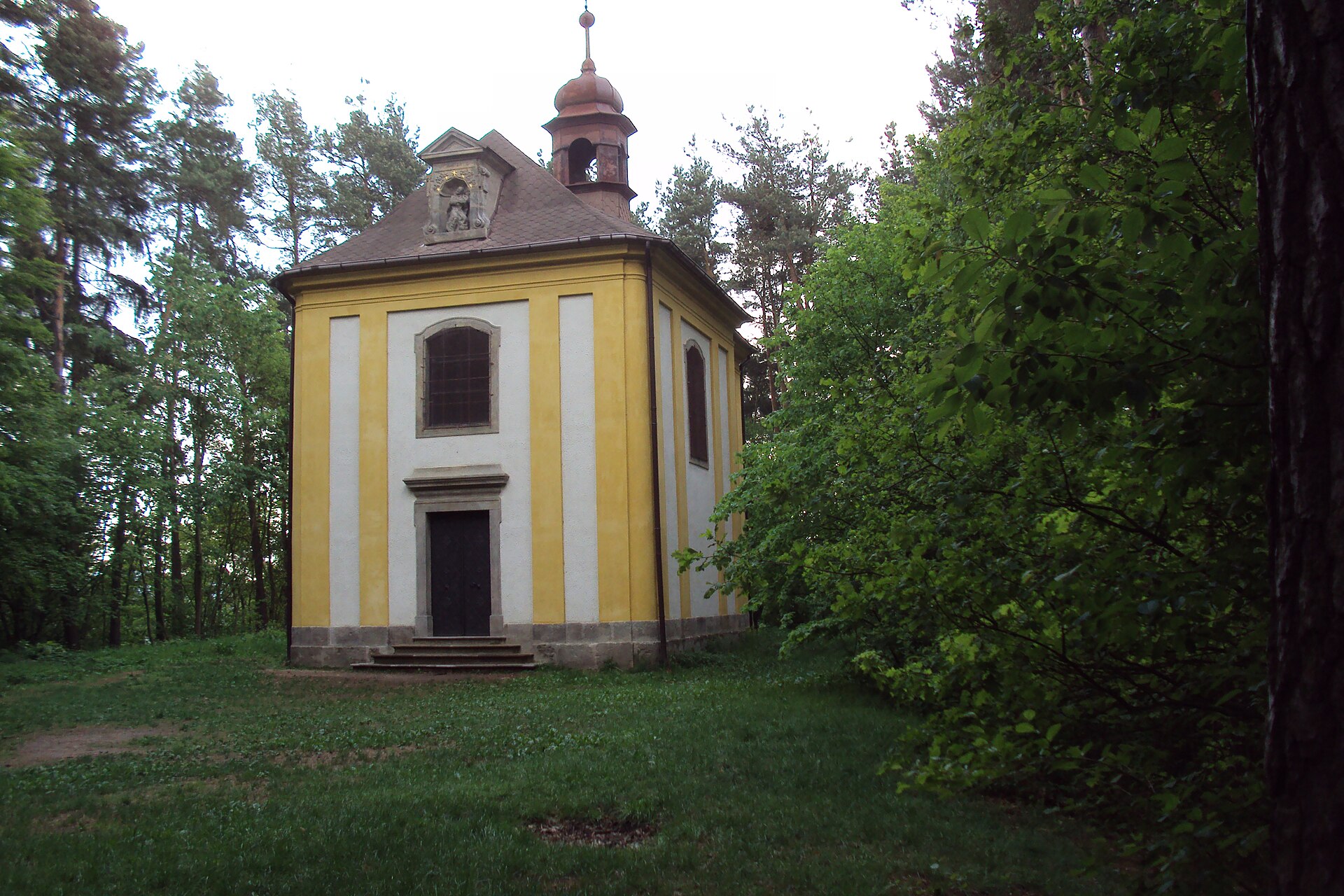
Chapel of Saint John of Nepomuk
Stráž pod Ralskem
-
Křížový vrch-Kalvárie
Cvikov
-
Church of Saint Elisabeth of Hungary
Cvikov
-
Church of Saints Fabian and Sebastian (Zákupy)
Božíkov
Earn badges for the places you visit
Download NextOnTrip, discover new places and check off your trails.