About this place
Rokoko Theatre is a small but historically rich stage tucked into the basement of the Rokoko palace right on Wenceslas Square in central Prague. Visitors strolling past the square's shopfronts could easily miss the entrance, yet behind it lies one of the more colorful chapters of Prague's twentieth-century cultural life.
When did the venue first open, and under what name?
The underground space was built together with the Rokoko palace itself in 1915, during the First World War. Rather than opening as a theatre in the modern sense, it began life as a cabaret venue — Kabaret Rokoko — under its first director Karel Hašler, a familiar name on Prague's music and cabaret scene at the time. The programme leaned on chansons, comic sketches and parody numbers, the standard fare of cabaret entertainment in that era.
How did the cabaret become a theatre?
A turning point came in December 1916, when writer, journalist and theatre figure Eduard Bass took over direction of the venue. Under his leadership, members of the celebrated cabaret troupe Červená sedma (the Red Seven) joined the Rokoko, lifting the artistic ambitions of what was staged in the palace basement. After that group departed in the early 1920s, the enterprise went through a rougher patch, but the hall itself endured — in 1923 it was formally reorganised as a drama theatre, laying the groundwork for the name still used today.
What happened in the second half of the twentieth century?
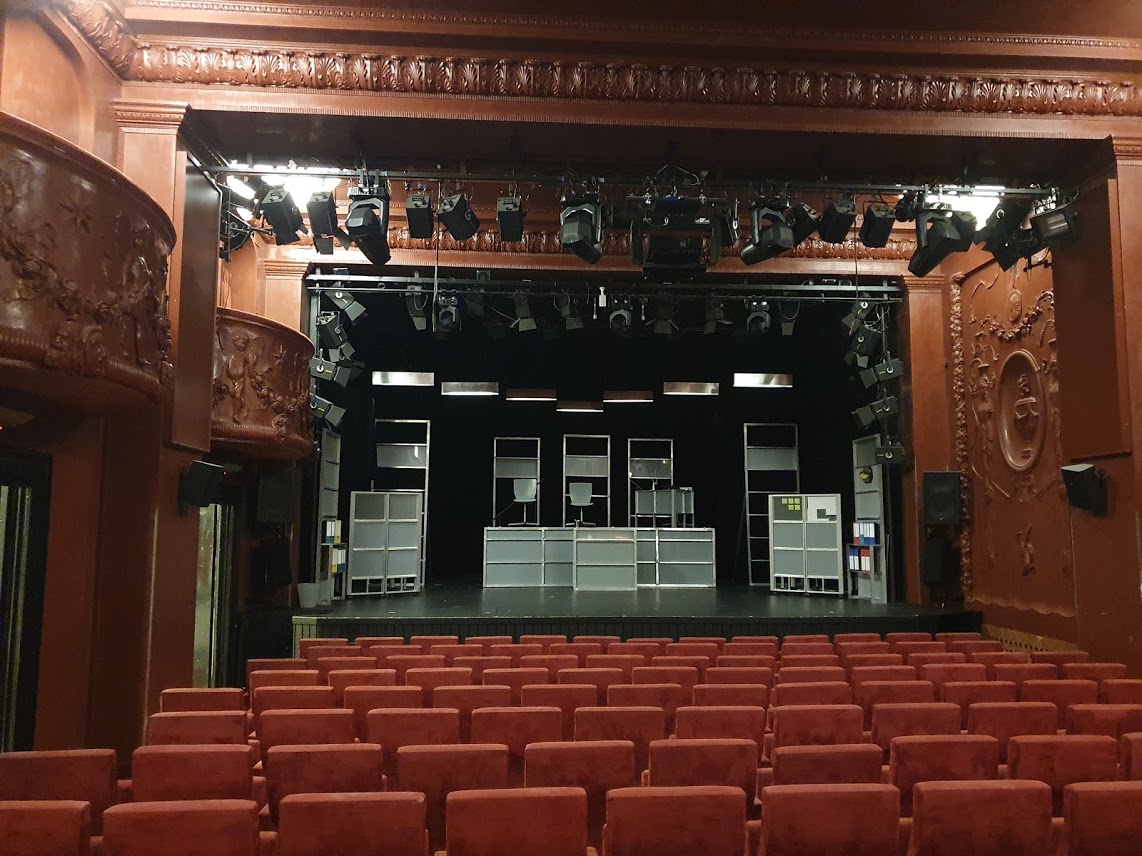
Another significant chapter opened on 1 March 1958, when director Darek Vostřel took charge of the theatre under its renewed identity, leading it until 1972. Between 1968 and 1970 the interior underwent a major reconstruction overseen by architect Luděk Hanf of the Regional Design Institute in Prague. That renovation shaped the auditorium as audiences still experience it today: an intimate space with direct, close contact between stage and seating, holding around 200 spectators.
What is the theatre's institutional status today?
In 1975 the Rokoko became part of the larger Prague City Theatres (Městská divadla pražská) organisation, which also grouped neighbouring venues. That structure was split apart following the political changes of 1989, but in 2005 the ABC and Rokoko theatres were reunited under a single management, an arrangement that continues today. As a result, the Rokoko now shares administration and part of its repertoire with the ABC Theatre while maintaining its own distinct artistic identity.
Why is the Rokoko Theatre worth a visit?
The intimacy of the hall — with close proximity between actors and audience and a modest capacity of roughly 200 seats — gives performances here a very different character from the grand, ceremonial theatre buildings elsewhere in Prague. It suits visitors who value closeness to the stage over monumental architecture, while still wanting a taste of a century-old theatrical tradition hidden literally beneath the pavement of the city's busiest square.
Frequently asked questions
Where exactly is the Rokoko Theatre located? In the basement of the eastern wing of the Rokoko palace on Wenceslas Square (Václavské náměstí), Prague 1.
How many seats does the auditorium have? Around 200, making it one of the more intimate stages in central Prague.
What is the theatre affiliated with today? Since 2005, the Rokoko Theatre and the ABC Theatre have operated as a single entity within Prague City Theatres.
Has the building's interior changed over the years? Yes — a major reconstruction took place between 1968 and 1970 under architect Luděk Hanf, largely defining the auditorium layout still in use today.
Nearby places

Earn badges for the places you visit
Download NextOnTrip, discover new places and check off your trails.