About this place
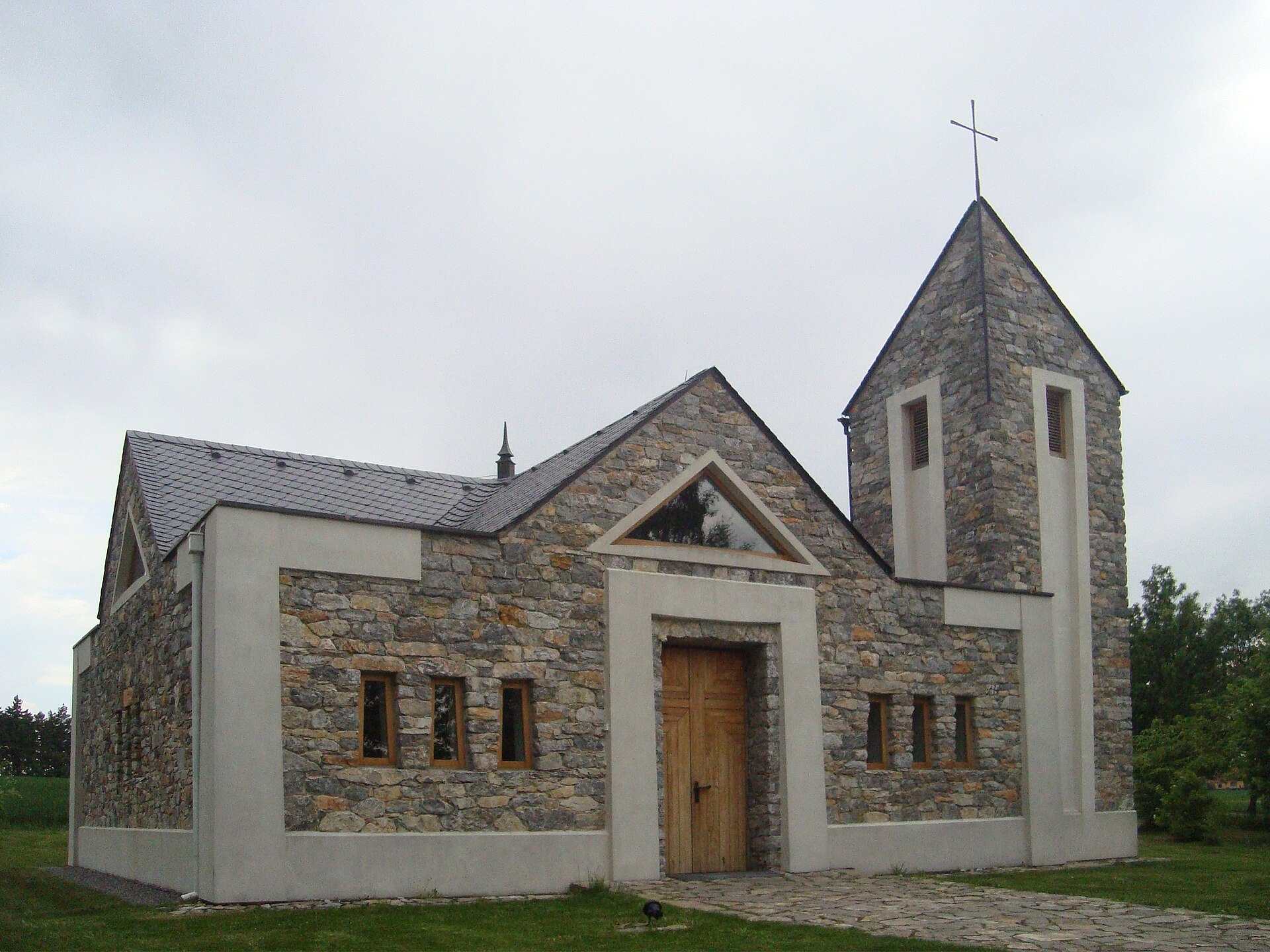
The Church of Saint Joseph in Senetářov is one of South Moravia's most unusual places of worship – a modernist building raised in the late 1960s, at the height of communist Czechoslovakia's pressure on the Catholic Church. It stands in the small village of Senetářov in the Blansko district, within the Jedovnice parish and the Blansko deanery of the Brno diocese.
Why was a new church built here at all?
Before the current building existed, villagers worshipped in a modest chapel dating to 1855, later enlarged. The push for a proper church gained urgency after 1944, when the village was forced to evacuate amid wartime upheaval in the surrounding Moravian Karst region. Communist authorities only granted a construction permit in 1968 — itself remarkable, since building new churches in Czechoslovakia at the time was almost unheard of.
How was it built, and why did consecration take twenty years?
Construction ran from 1968 to 1971, based on a design by Brno architect Ludvík Kolek (some sources also credit Otakar Vrabec as co-designer). The first Mass was celebrated on 11 July 1971, reportedly drawing as many as 15,000 believers from across Czechoslovakia, even though state security forces had cordoned off the area and blocked access roads — many pilgrims reached the site on foot through the forest. Formal consecration did not happen until 7 July 1991, after the fall of the communist regime, presided over by Bishop Vojtěch Cikrle. The occasion coincided with the blessing of a new organ, built by the firm Žloutek a Kubát.
What makes the architecture and interior distinctive?
The building's silhouette evokes a sail or a ship's hull — a deliberate symbol of the Church sailing forward with the faithful under the sign of the cross. Kolek drew on the work of Le Corbusier, applying a purist, brutalist vocabulary rarely seen in sacred architecture of that era in Czechoslovakia. Inside, stained-glass windows carry much of the symbolism: three panels beside the baptismal font represent the Spirit (fire), blood and water; seven further panels depict the seven sacraments; and two windows above the entrance evoke the end of the world and its renewal. The fourteen Stations of the Cross were created by Czech academic painter Mikuláš Medek. The main altar features a triptych dedicated to Creation, Redemption and Sanctification, while a relief of Saint Joseph is set above the pulpit on the central pillar. The tabernacle is decorated with motifs of broken bread and wheat.
How can visitors see the church, and who should visit?
The church now functions as a filial (subsidiary) building of the Jedovnice parish, so access is limited — the interior is typically open on Friday evenings around service times, and during some Sunday Masses each month. It is a rewarding stop for anyone interested in postwar modernist architecture or in the history of the Catholic Church under communism: a rare case of a church that was built not despite the system, but almost in defiance of its logic.
Frequently asked questions
Who designed the Church of Saint Joseph in Senetářov? Brno architect Ludvík Kolek designed the building, working in a modernist style influenced by Le Corbusier.
Why did consecration happen twenty years after construction? The church was built between 1968 and 1971 with communist-era permission, but a formal consecration was politically sensitive and only took place in 1991, after the regime change.
What does the building's shape represent? Its form resembles a sail or ship's hull, symbolizing the Church carrying the faithful forward under the sign of the cross.
When is the interior open to visitors? Usually on Friday evenings around service times, plus some Sunday Masses during the month.
Nearby places

Earn badges for the places you visit
Download NextOnTrip, discover new places and check off your trails.