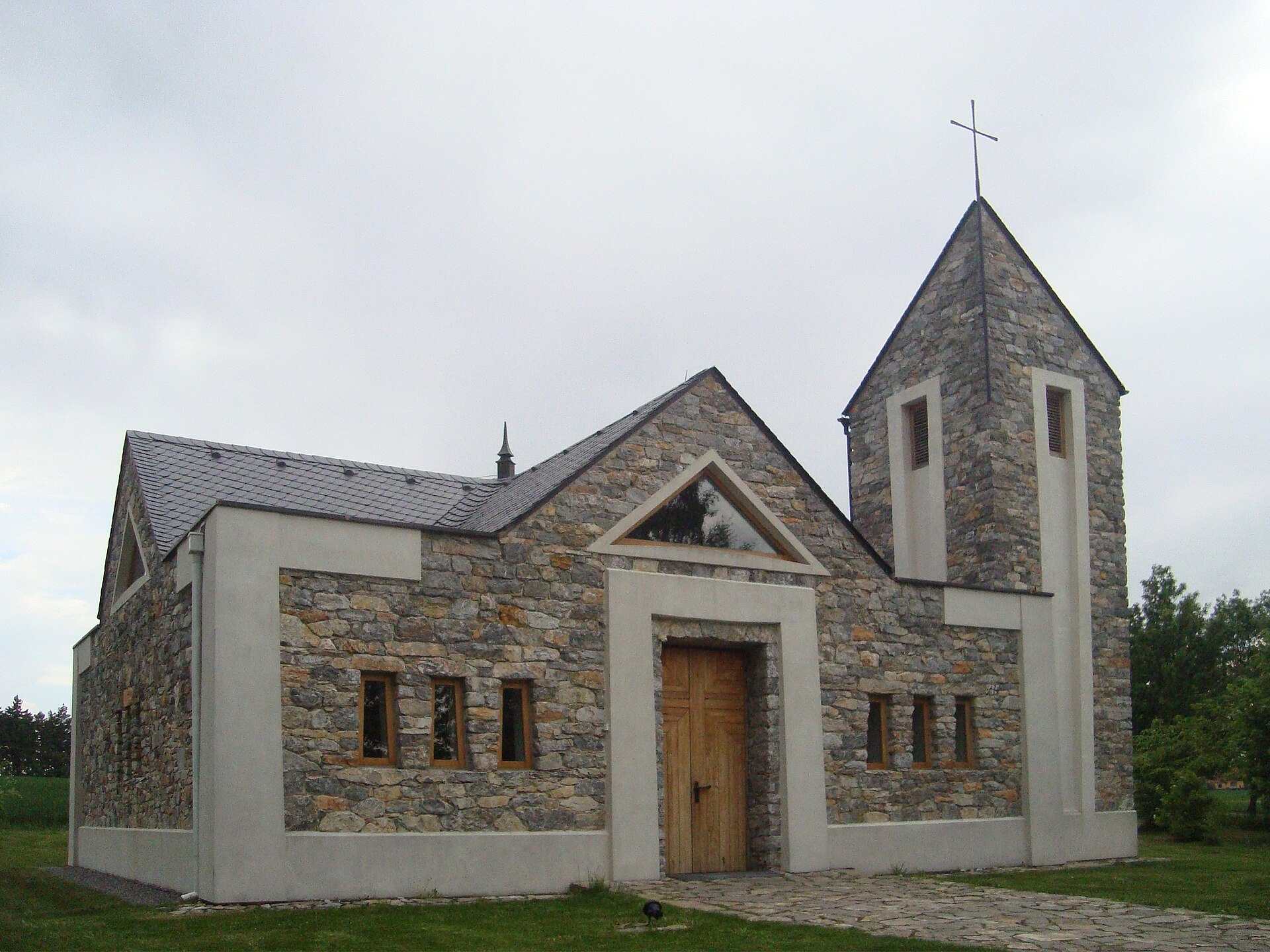
About this place
The Chapel of Saint Barbara is a modern place of worship in Rudice, a village in the Moravian Karst region of the Blansko district, about 20 km north of Brno. Although only built at the turn of the 21st century, it quickly became the spiritual heart of a village known for its caves, limestone cliffs, and centuries-old mining tradition.
How to get there?
Rudice lies within the protected landscape area of the Moravian Karst, close to the Macocha Abyss, one of the region's best-known natural attractions. The chapel stands on the western edge of the village and is most easily reached by car, roughly half an hour's drive from Brno. The area is also a popular starting point for hikers and cyclists exploring the caves and karst sinkholes scattered across the Moravian Karst.
Why Saint Barbara?
For centuries the residents of Rudice had no larger church of their own — apart from a small chapel of Saint Anthony, believers walked to services in nearby Jedovnice. The idea of building a proper chapel in the village dates back to the 1970s, championed by the long-serving Jedovnice parish priest, Father František Vavříček, though raising new religious buildings was practically impossible under communist rule. Things changed only after 1989, when Rudice's first post-revolution mayor, Svatopluk Nezval, pushed the project forward: the site was consecrated and the foundation stone laid on 24 June 1990. The choice of patron saint was deliberate — Saint Barbara is the patroness of miners and cave explorers, a fitting match for a village built on limestone and surrounded by the caves of the Moravian Karst.
What does the chapel look like?
Construction to a design by Brno architect Petra Vorlíčková began in 1999, and the finished building was dedicated with a mass on 21 September 2002. The chapel has a square floor plan, allowing flexible use of the interior space. Its walls follow a double-shell construction — an outer layer of stone and an inner layer of brick — while wood dominates the interior, giving the space a warm, rustic character rooted in local building tradition.
What happens at the chapel today?
The building belongs to the Roman Catholic Church and falls under the parish of Jedovnice, though it is also occasionally used by the Czechoslovak Hussite Church. Masses are held on Saturdays at 6 p.m., and the chapel also hosts weddings, Advent concerts, and other community events. Despite its relatively young age, it has become a genuine hub of religious and social life in Rudice.
When to visit?
Rudice and the surrounding Moravian Karst are best visited in spring and summer, when a stop at the chapel can easily be combined with exploring the nearby caves and the Macocha Abyss. If seeing the interior matters to you, it's worth checking mass times and event schedules in advance, since the chapel may be closed to visitors outside of services.
Frequently asked questions
When was the Chapel of Saint Barbara in Rudice built? Construction began in 1999 to a design by architect Petra Vorlíčková, and the chapel was formally dedicated with a mass on 21 September 2002.
Why is the chapel dedicated to Saint Barbara? Saint Barbara is the patroness of miners and cave explorers, reflecting Rudice's mining heritage and its location amid the caves of the Moravian Karst.
Which parish does the chapel belong to? It belongs to the Roman Catholic Church and is administered by the Roman Catholic parish of Jedovnice, though it is occasionally used by the Czechoslovak Hussite Church as well.
What materials was the chapel built from? The walls use a double-shell construction — stone on the outside and brick on the inside — with wood as the dominant material inside.
Nearby places

Earn badges for the places you visit
Download NextOnTrip, discover new places and check off your trails.