About this place
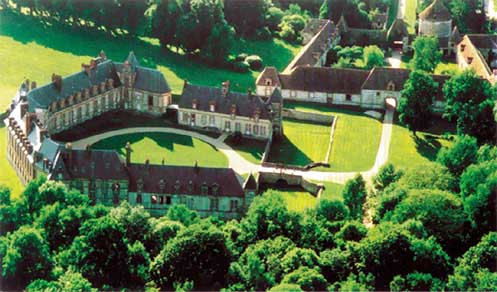
Château de Neuville stands in Gambais, a small village in the Yvelines department roughly 50 kilometres west of Paris, and has remained under private ownership for generations while occasionally opening its grounds for weddings, receptions and film shoots.
Who built the château, and in what style?
Construction dates to the 16th century, commissioned by Joachim de Bellengreville, who served as Grand Prévôt of the royal household under Henri IV — the officer in charge of security and policing at court. Architectural historians place the design in the "Henri III" idiom and attribute the layout to Jacques I Androuet du Cerceau, an architect who had previously worked for Catherine de' Medici and Henri III. That pedigree explains the symmetry and classical restraint that still define the estate today.
How did ownership pass down over the centuries?
The property's story is largely one of successive noble families. In 1672, the lands of Neuville, together with Gambais, were granted to Jean-Baptiste Vallot, brother of the royal physician. Less than twenty years later, in 1690, the estate was purchased by François de Nyert, first valet de chambre to Louis XIV and governor of both Limoges and the Louvre. It was under his successors, during the 1750s and 1760s, that the château underwent a major remodelling: two symmetrical wings and a pedimented central block were added, giving the building the classical silhouette it retains to this day.
What happened to the estate during the Revolution?
The Revolution struck hard at the next owner, Clément Charles François de L'Averdy, a senior finance official under Louis XV who had acquired the property in 1765. He was guillotined in 1793, and the château itself was seized and sold off as national property. In 1795 it was bought by the Marquis de Labriffe — and it is descendants of that family, together with the Jousseaume family, who still live there today.
Why did the château fall into disrepair, and how was it restored?
The 20th century was unkind to the estate. During the wars the building was successively occupied by German and then American troops, which hastened its decline and left it largely abandoned. The turning point came with a large-scale restoration launched in 1966, which brought the château back to life. Recognition of its historical value followed: in 1972 the château, its farm buildings and the entire estate were listed as a historic monument, and in 1995 protection was extended to cover the rest of the park.
What can visitors see at Neuville today?
Château de Neuville now balances its role as a private family home with occasional public life — weddings, private functions and audiovisual productions are hosted on site, giving visitors a chance to glimpse the interiors and grounds around such events. The sprawling park surrounding the building remains one of the estate's chief draws, popular with residents of the Yvelines region looking for a quiet, historically rich place to walk.
Frequently asked questions
Can you visit the château's interior on a regular basis? Neuville is still a private residence inhabited by descendants of the Labriffe and Jousseaume families, so access to the interior is limited and generally tied to organised events such as weddings or receptions rather than daily tours.
Who designed the building? The layout is attributed to Jacques I Androuet du Cerceau, an architect who had earlier worked for Catherine de' Medici and Henri III, which accounts for the estate's classical, symmetrical composition.
Why is it called "de Neuville" if it's located in Gambais? The name comes from the historic marquisate of Neuville, created in the 17th century, which is distinct from the name of the surrounding commune of Gambais where the estate actually sits.
Did the château suffer damage during the wars? Yes — in the 20th century it was occupied first by German and then American forces, which left it neglected for years. Its condition was only reversed by the restoration campaign begun in 1966.
Nearby places

Earn badges for the places you visit
Download NextOnTrip, discover new places and check off your trails.