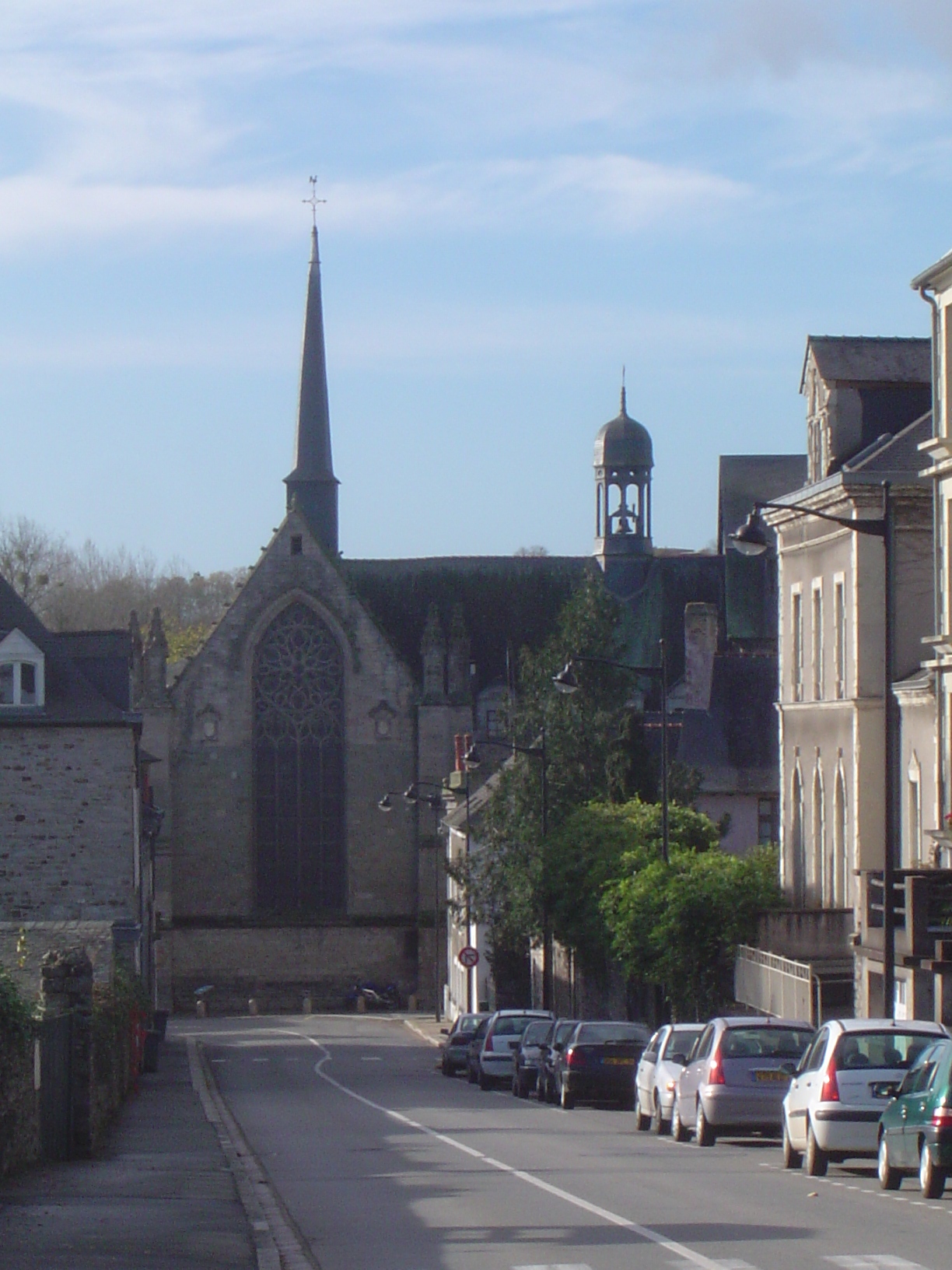
About this place
The Chapelle Saint-Nicolas de Vitré is a former hospital chapel turned sacred-art museum, standing in the old Rachapt quarter of Vitré, in the Ille-et-Vilaine department of Brittany. Its flamboyant Gothic architecture and rich collection of liturgical silverwork make it one of the more distinctive small museums in the region.
How old is the chapel, and why did it move?
The story begins in 1192, when Emma de Vitré founded a chapel dedicated to Saint Nicolas. By 1205 a hospice for the poor and sick had grown up around it. The original site did not last, though: in 1222, Baron André III de Vitré ordered the construction of new town ramparts, forcing the hospice to relocate to the bank of the Vilaine river, where the chapel still stands today. A small settlement called Rachapt quickly formed around the relocated hospice, already recorded under that name by 1227.
What explains the flamboyant Gothic style?
The building seen today largely dates from the turn of the 16th century, a period when Vitré grew wealthy on the cloth and linen trade. Robert de Grasmenil, a canon of Vitré and administrator of the hospital, had the church rebuilt, with the foundation act dated 21 July 1500. Built of slate and sandstone, the chapel displays the ornate tracery and stonework typical of flamboyant Gothic architecture, a style favored by prosperous Breton towns of the era. The building was listed as a historical monument in 1980.
Who were the Augustinian sisters?
In August 1655, five Augustinian sisters of Mercy arrived in Vitré and were formally admitted to run the hospital the following month, gaining the right to use the hospice chapel for worship. Construction of an adjoining convent began in 1657 on land purchased in the Rachapt quarter, and the sisters continued caring for patients there until 1974.
What is inside the chapel today?
In 1986 the chapel was converted into the Musée Saint-Nicolas, a museum of sacred art, and the display was expanded in 1997 into the former choir used by the Augustinian nuns. Visitors can see the tomb of Robert de Grasmenil, who died in 1500, a high altar dating from 1870, wall paintings from the 15th and 16th centuries, and a wrought-iron grille from the 17th century. The former nuns' choir now houses an exhibition tracing French religious silverwork and goldsmithing from the 17th to the 20th century, a collection significant enough to give the museum national reference status in its field.
When can you visit?
From 1 May to 30 September, the museum opens daily from 10am to 12:45pm and 2pm to 6pm. From 1 October to 30 April, hours shift to 10am-12:15pm and 2pm-5:30pm, and the museum is closed on Tuesdays. A standard ticket costs 4 euros, a reduced rate is 2.50 euros, and admission is free for visitors under 18 and for the unemployed.
Frequently asked questions
Where exactly is the Chapelle Saint-Nicolas located? In the historic Rachapt quarter of Vitré, beside the Vilaine river, in the Ille-et-Vilaine department of Brittany.
How old is the chapel? The founding dates to 1192, though the current flamboyant Gothic building results from a rebuilding completed in 1500.
What can visitors see inside? The Musée Saint-Nicolas, a museum of sacred art with a notable collection of French religious silverwork from the 17th to 20th centuries, plus medieval wall paintings and the tomb of Robert de Grasmenil.
Is the chapel a protected monument? Yes, it has been listed as a historical monument in France since 1980.
Nearby places

Earn badges for the places you visit
Download NextOnTrip, discover new places and check off your trails.