About this place
Chapelle de Villemartin is a ruined Romanesque chapel in Mouliets-et-Villemartin, a small commune in the Gironde department on the right bank of the Dordogne, in the Castillon-Pujols wine country. The site sits off the beaten path, surrounded by fields and vineyards, and today functions as an open-air window into the history of a medieval military order rather than an active place of worship.
How do you get to the ruins?
Mouliets-et-Villemartin lies at the heart of the Castillon-Côtes de Bordeaux area, a few kilometres from Castillon-la-Bataille and roughly 45 minutes by car from Bordeaux. A car is the most practical way in, along the country roads linking Castillon-la-Bataille with Pujols and Sainte-Colombe — this is quiet farmland with no tourist infrastructure beyond the monument itself. The ruins stand in open ground and can be visited free of charge year-round, since it's an unenclosed outdoor site rather than a building with fixed opening hours.
What will you see there?
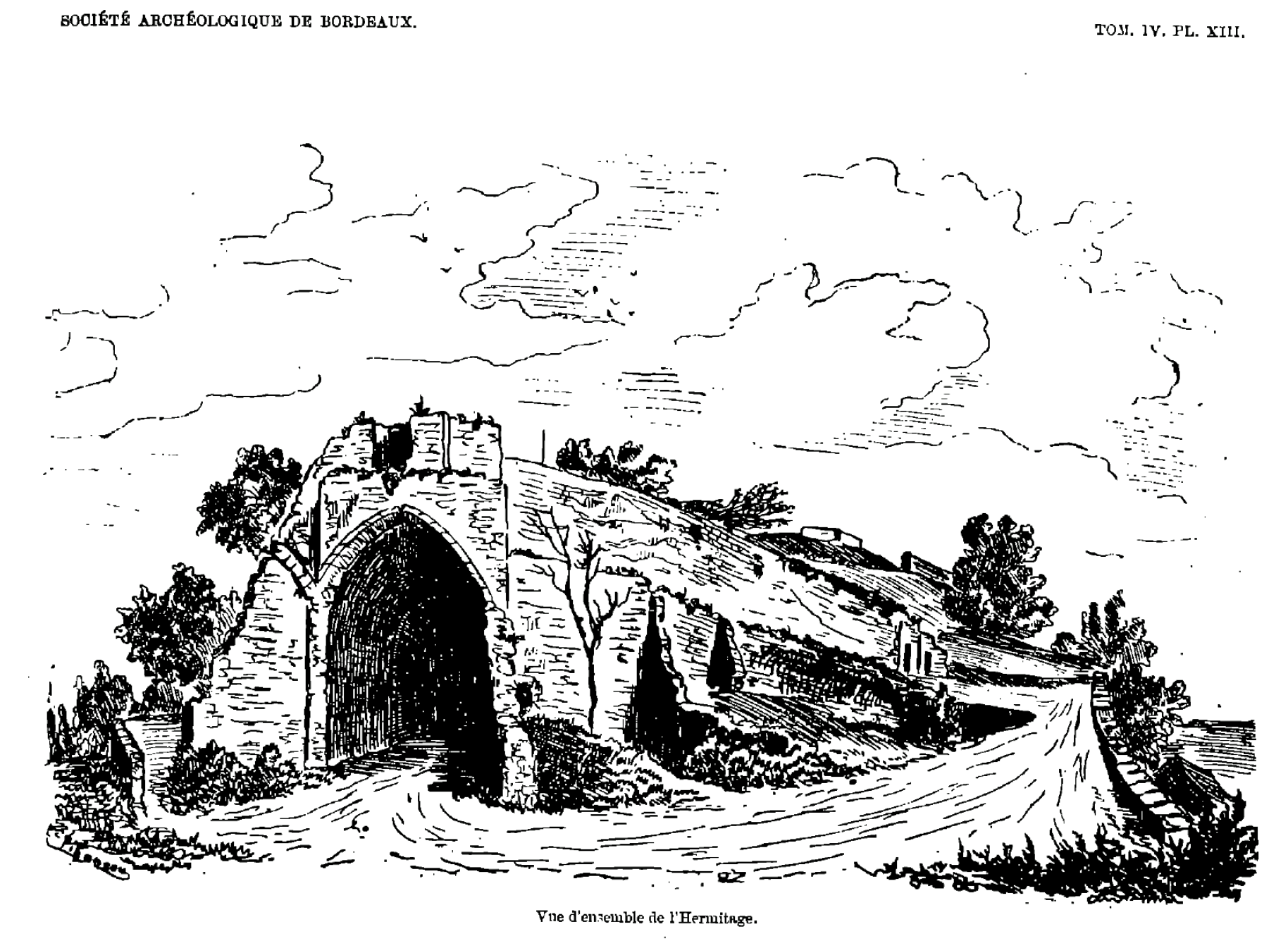
The surviving stonework shows the late-Romanesque style of the turn of the 12th and 13th centuries: heavy, sober masonry and the remains of the choir vaulting typical of religious architecture in this part of southwestern France at the time. The roof came down at the start of the 19th century, so the chapel today stands roofless — you can still trace the outline of the nave, the remaining wall sections, and carved architectural detail, but there is no covering overhead. The local municipality carried out a multi-year restoration campaign that halted the decay of the masonry, rebuilt the facades, and relaid the interior flooring, so the ruins are safe to walk through and easy to read even without a guide.
Why does this site matter historically?
The chapel was the seat of a commandery of the Knights Hospitaller — the Order of Saint John of Jerusalem. The Villemartin commandery grew rapidly from its earliest years, managing an extensive Hospitaller estate whose influence extended into the neighbouring parishes of Mouliets and Pujols. The estate suffered serious damage during the Wars of Religion in the 16th century. Records from the 17th and 18th centuries, drawn up by the commander based at Arcins, note that the chapel itself — unlike the order's other buildings, which had already vanished by then — was still standing and kept under a tiled roof. It eventually shared the same fate: its roof structure collapsed in the early 19th century. In 1920 the ruins were listed as a French historic monument, a step that halted further decay and paved the way for later conservation work.
When is the best time to visit?
Because this is an outdoor, unroofed site, spring and autumn are the most comfortable seasons, when the surrounding vineyards and fields are green and temperatures suit walking around on foot. Summer in the Bordeaux region can get hot, and there's no shade or shelter on site. It pairs well with a stop in nearby Castillon-la-Bataille or a tasting tour through the Castillon-Côtes de Bordeaux wine appellation.
Frequently asked questions
Can you go inside the chapel? Not in the traditional sense — it's a permanent roofless ruin. You can walk around and through the surviving walls and openings where the structure once stood, viewing the stonework up close.
Is there an entrance fee? No, the site is open access and free, with no ticket booth or on-site guide.
Which order did the chapel belong to? The Knights Hospitaller (Order of Saint John of Jerusalem), who ran a commandery here that administered estates across the surrounding parishes.
How long does a visit take? Most visitors need about 20–30 minutes to walk the ruins and read any information panels on site.
Nearby places

Earn badges for the places you visit
Download NextOnTrip, discover new places and check off your trails.