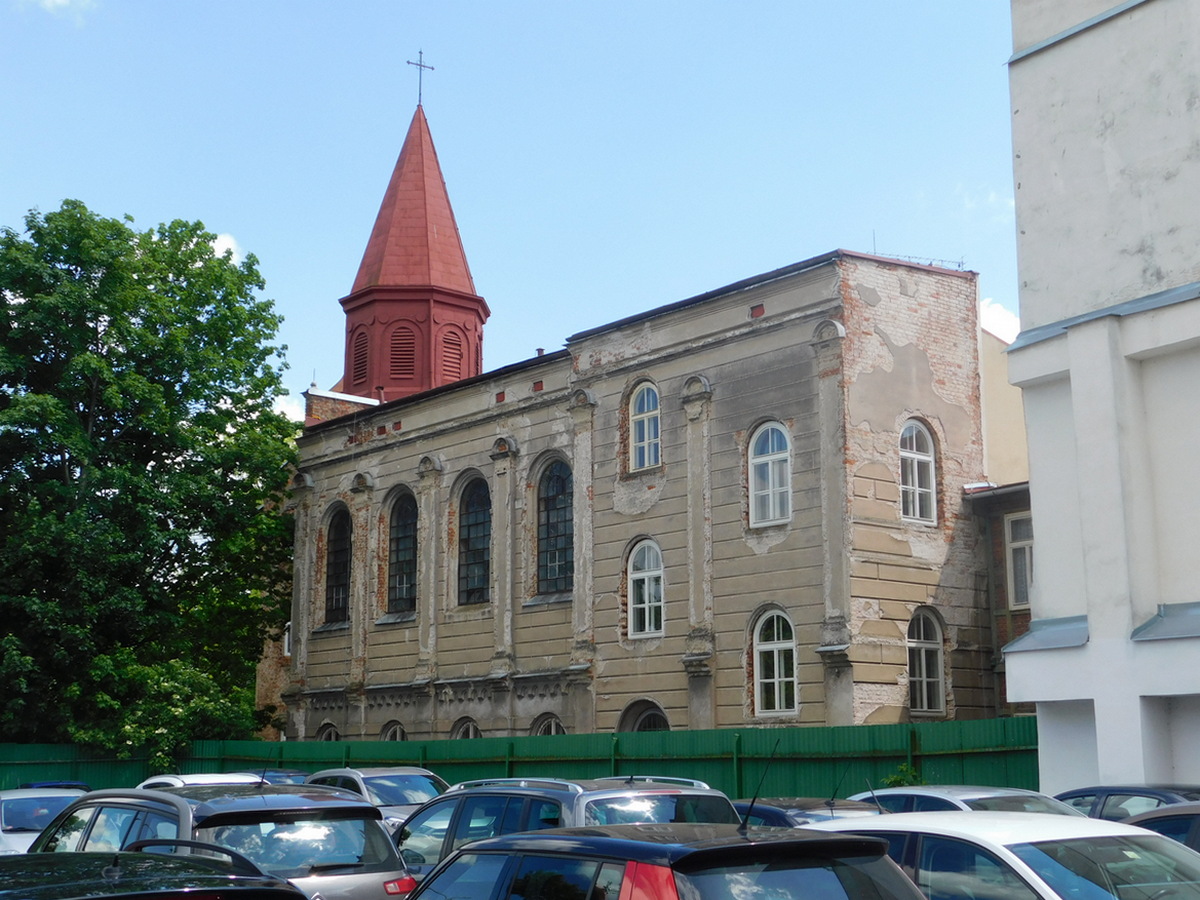
About this place
The Chapel of St. Charles Borromeo in Jihlava is a small but artistically remarkable religious building erected at the turn of the 20th century, tucked away in a monastery courtyard in the city centre. Easy to miss from the street, its interior holds one of the very few examples of Beuronese-style decoration anywhere in Moravia.
Where is it located?
The chapel stands in Jihlava, a city on the Bohemian-Moravian Highlands in the Vysočina region. It can only be entered through the building at Křížová 12, which gives it a distinctly intimate character rather than that of a typical walk-in tourist sight. The building and chapel belong to the Congregation of the Sisters of Mercy of St. Charles Borromeo.
Who built it, and when?
The chapel was built between 1903 and 1904 to a design by architect Karel Wagner. It was consecrated in November 1904, formally dedicated to the Sacred Heart of the Lord — the popular name referencing St. Charles Borromeo, patron of the sisters' congregation, took hold over time through common usage. From its consecration, the chapel served the needs of the Jihlava orphanage run by the sisters.
Its history was not continuous, however. In 1950, during the communist regime's crackdown on religious orders in Czechoslovakia, the building was deconsecrated and the convent was repurposed for other uses. Only decades later did the property return to the Sisters of Mercy of St. Charles Borromeo, and the chapel was reconsecrated in 2006, restoring it to its original spiritual purpose as the Chapel of the Divine Heart of the Lord.
What makes its architecture stand out?
The building follows a historicizing style that blends Romanesque forms with early Italian Renaissance motifs. A distinctive feature of its silhouette is an octagonal turret topped with a pyramidal roof, giving the chapel a recognisable, almost miniature monumentality.
The real value of the building, though, lies in its interior decoration, executed in the spirit of the so-called Beuronese art school — a strand of sacred art originating at the Benedictine abbey of Beuron, combining simplified, geometrised forms with influences from ancient Egyptian and early Christian art. The chapel preserves stained-glass windows with angel motifs, its original flooring, wooden sliding doors, and metal fittings kept in a unified Neo-Romanesque style. Original frescoes in the Beuronese style are believed to survive beneath the current layer of limewash — a building combining architecture and decoration in this specific aesthetic has no equivalent elsewhere in Moravia.
Can visitors see it?
Because of its location within the convent grounds, access to the chapel is limited. It is open during regular Mass, held every Monday at 5 p.m., and once a month it welcomes visitors through organised guided tours that offer a closer look at the interior and its decoration. Since 2015, the convent building together with the chapel has been listed as a cultural monument, confirming its historical and artistic significance.
Frequently asked questions
When was the Chapel of St. Charles Borromeo in Jihlava built? It was built between 1903 and 1904 to a design by architect Karel Wagner and consecrated in November 1904.
Why did the chapel stop functioning as a place of worship? In 1950, during the crackdown on religious orders in communist Czechoslovakia, the building was deconsecrated; it was reconsecrated only in 2006.
What is the most valuable feature of its interior? Its Beuronese-style decoration — stained-glass windows with angel motifs, the original floor, wooden sliding doors, and metal details — unique among buildings in Moravia.
How can visitors enter the chapel? Entry is only possible through the convent building at Křížová 12; the chapel is open during Monday Mass at 5 p.m. and once a month for guided tours.
Nearby places

Earn badges for the places you visit
Download NextOnTrip, discover new places and check off your trails.