About this place
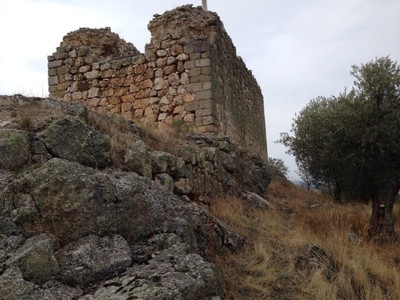
The Castle of Almonacid rises on the Cerro del Castillo hill, about 400 metres south of the town of Almonacid de Toledo, in the province of Toledo, Castilla-La Mancha. It ranks among the oldest documented fortifications near Toledo, with its first written record dating back to the year 848.
How do you get there?
Almonacid de Toledo lies roughly 20 km from the city of Toledo, reached via the Autopista de los Viñedos. The village itself is modest in size, and the castle ruins sit on a hill just beyond its edge. There are no gates, ticket booths, or fixed opening hours — the site can be entered freely at any time.
What will you see on site?
The fortress follows a polygonal layout enclosed by a defensive wall, of which parts of two square towers and three round towers still survive. At the centre of the old enclosure stands the one element that remains clearly recognisable: the keep (torre del homenaje), a three-storey structure roofed with brick vaults. The rest of the complex is in ruins, partly overgrown with vegetation, though the entire site stays open and accessible to visitors. From the hilltop, the view opens onto a wide stretch of the La Mancha plain — reason enough on its own to make the climb, even without a particular interest in history.
Because of its ongoing deterioration, the castle is listed in Castilla-La Mancha's regional catalogue of cultural heritage, and the heritage organisation Hispania Nostra has placed it on its "Lista Roja" (Red List) — a registry of Spanish monuments at risk due to neglect and lack of conservation.
What is the history behind it?
The fortress has Muslim origins, built to guard one of the routes linking La Mancha with Andalusia. Following the Christian conquest of the region, the castle passed in the 11th century to King Alfonso VI as part of the dowry of his wife, Zaida. Alfonso VI subsequently granted the fortress to the Cathedral of Toledo, tying its fate to the church for centuries. In the 14th century, on the orders of Archbishop Pedro Tenorio of Toledo, the castle underwent a substantial rebuilding that reinforced its defensive capacity.
When is the best time to visit?
The site is entirely exposed, with no shaded areas beyond a few surviving wall fragments, so spring and autumn are the most comfortable seasons to visit given the climate of Castilla-La Mancha. Summer visits are still possible, but the heat on the open hilltop can be intense — bring water, sun protection, and sturdy footwear, since the ground is uneven and rocky.
Frequently Asked Questions
Is there an entrance fee? No, the castle grounds are freely accessible to visitors, with no admission charge and no fixed opening hours.
Can you visit with a guide? Yes, guided tours are available in the area and offer more detailed insight into the site's history and architecture.
How long does a visit take? Given the modest size of the surviving ruins, a self-guided visit typically takes between 30 and 60 minutes.
How far is the castle from Toledo? Almonacid de Toledo, where the castle stands, is about 20 km from the city of Toledo.
Nearby places

Earn badges for the places you visit
Download NextOnTrip, discover new places and check off your trails.