About this place
The Castle of Alarcos stands on a hilltop above the Guadiana River, a short distance from Ciudad Real in Spain's Castile-La Mancha region. It marks the site of one of medieval Spain's most consequential battles — a defeat so severe it reshaped the course of the Reconquista for a generation.
What happened at Alarcos?
On 19 July 1195, the forces of King Alfonso VIII of Castile clashed with the Almohad army led by Caliph Yaqub al-Mansur on the hill of Alarcos. The castle itself was still under construction when the battle broke out, yet it played a decisive role in how the day ended. The Christian infantry was destroyed, and Alfonso VIII himself narrowly avoided capture as Almohad cavalry closed in around him.
Diego López de Haro, Lord of Biscay, managed to pull back into the unfinished fortress with a remaining band of knights. Roughly three thousand people crowded inside its walls, including women and children fleeing the rout. The siege that followed ended not in slaughter but negotiation: the defenders were allowed to leave after surrendering twelve knights as hostages against a ransom.
The defeat halted the Christian advance southward for more than a decade. Revenge came only in 1212, at the Battle of Las Navas de Tolosa, when Christian forces finally broke Almohad power and turned the Reconquista decisively in their favor.
What can you see there today?
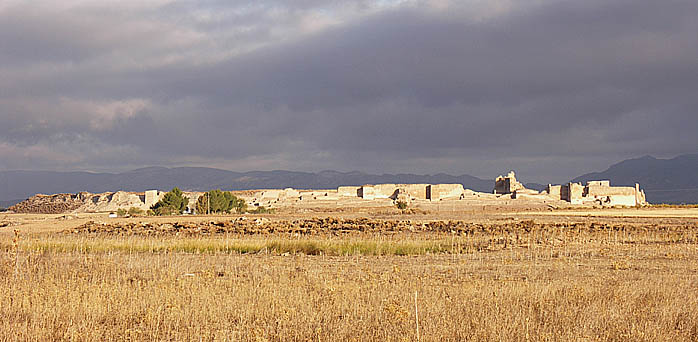
The hill of Alarcos held a commanding strategic position on the route between Toledo and Córdoba, which is precisely why it had been contested between Christians and Almohads long before the battle itself. Today, the remains of the fortress and its accompanying settlement form an archaeological site where visitors can trace the outline of defensive walls and earlier habitation layers. The open, largely unchanged landscape of the Guadiana valley makes it easy to picture the scale of what unfolded here more than eight centuries ago.
What sets Alarcos apart from more polished castle attractions in the region is its rawness — this is a genuine battlefield site rather than a reconstructed showpiece, and that authenticity is part of its appeal to visitors with an interest in medieval history.
How do you get there?
Alarcos sits close to Ciudad Real, the provincial capital, which is well connected by rail and road to Madrid and other cities across Castile-La Mancha. Ciudad Real makes a natural base for exploring the surrounding area, including the hill of Alarcos itself.
When should you visit?
The Ciudad Real region shares Castile-La Mancha's continental climate, with hot summers and cooler, often windy winters. Spring and autumn are the most comfortable seasons for exploring the exposed, largely shadeless terrain of the old fortress site.
Frequently Asked Questions
What was the Castle of Alarcos? A fortress built on a strategic hilltop above the Guadiana River, still unfinished at the time of the 1195 battle, yet strong enough to shelter thousands of people.
Why does the Battle of Alarcos matter in Spanish history? Its outcome — a crushing defeat for Alfonso VIII — stalled the Reconquista for more than a decade, until it was avenged at Las Navas de Tolosa in 1212.
What remains to see on site today? The traces of the fortress and settlement walls within an archaeological site, along with sweeping views over the Guadiana valley.
Is Alarcos close to Ciudad Real? Yes, the hill lies near the city, which serves as a convenient base for visiting the site.
Nearby places

Earn badges for the places you visit
Download NextOnTrip, discover new places and check off your trails.