About this place
Castell de Sant Marçal is a medieval castle on the outskirts of Cerdanyola del Vallès, in the Vallès Occidental region of Catalonia, with documented roots going back to the 11th century. Although privately owned today, its long history and the strikingly decorative 19th-century remodeling make it one of the town's notable landmarks.
Where does its name come from, and how old is the site?
The earliest written record dates to 1042 and refers to a chapel dedicated to Saint Marcellus (Sant Marçal in Catalan), which at the time fell under the parish of Sant Martí in Cerdanyola. The land is thought to have first belonged to the monastery of Sant Cugat, which sold its rights over the area to the Count of Barcelona. In 1135 the count granted the estate to the Montcada family, one of medieval Catalonia's most powerful noble houses. The castle later took its name from the patron saint of that original chapel.
How did ownership of the castle change over time?
In 1225, Raimon de Plegamans purchased the castle from Guillem de Montcada, setting off a long-running dispute over rightful ownership that dragged on, with interruptions, until 1542. Another turning point came in 1640, during the Reapers' War (Guerra dels Segadors), the Catalan revolt against Spanish royal authority, when rebellious peasants set the castle on fire. Reconstruction took decades: around 1680 the castle's Gothic chapel, dedicated to Saint Marcellus, was rebuilt. In 1690, Feliu de Marimon was granted the noble title of Marquess, creating the Marquisate of Cerdanyola tied directly to this estate.
What does the castle look like today?
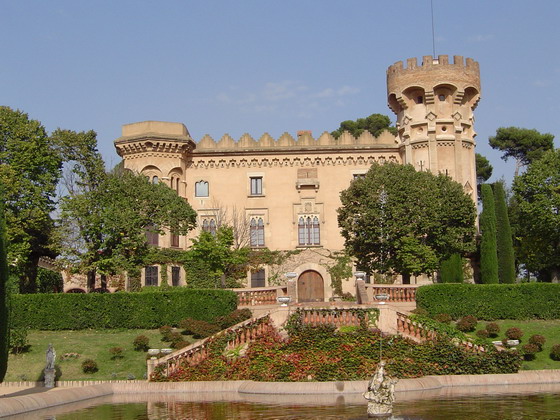
Originally, Castell de Sant Marçal was a quadrangular structure built around an inner courtyard, with a defensive tower and a Gothic chapel, the whole complex enclosed by a moat — a fairly typical layout for a medieval Catalan castle. Its current appearance, however, comes largely from a 1895 renovation, when the Arròspide family commissioned architect Gaietà Buïgas to convert the building into a summer residence. Buïgas kept the original layout and main walls intact but covered the façades in elaborate ornamentation inspired by Romanesque and Gothic motifs, giving the castle a far more decorative look than its medieval origins would suggest.
Can visitors go inside the castle?
Since 1949, Castell de Sant Marçal has been listed as a Cultural Asset of National Interest (Bé Cultural d'Interès Nacional), recognizing its importance to Catalan heritage. The building remains privately owned — currently by the Trénor family — so it is not open to the public on a regular basis. The Cerdanyola del Vallès town council does, however, organize occasional guided visits, giving visitors a chance to see the castle up close on specific dates. Checking the town's official website ahead of a trip is the best way to catch one of these openings.
Frequently asked questions
When was Castell de Sant Marçal built? The earliest record of a chapel on the site dates to 1042, while the castle itself developed over the following centuries under the Montcada and Plegamans families.
Why was the castle set on fire? In 1640, during the Reapers' War against Spanish rule, rebellious peasants burned the castle.
Who owns the castle today? It remains privately owned by the Trénor family and is not regularly open to visitors.
Can tourists visit the castle? Only occasionally — the Cerdanyola del Vallès town council periodically organizes guided tours of the building.
Why doesn't the castle look like a typical medieval fortress? Because in 1895 architect Gaietà Buïgas remodeled it into a summer residence, adding ornate Romanesque- and Gothic-inspired decoration while preserving the original layout.
Nearby places

Earn badges for the places you visit
Download NextOnTrip, discover new places and check off your trails.