About this place
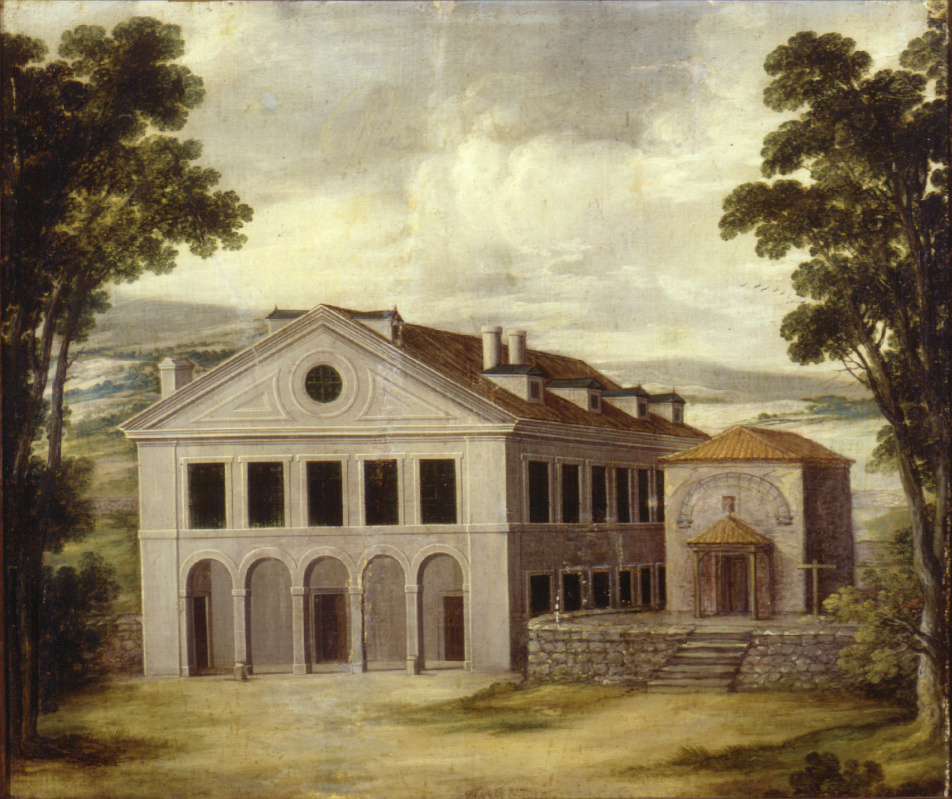
Casa Real de Monesterio is the ruined 17th-century royal service house in San Lorenzo de El Escorial, near Madrid, built to support the vast royal hunting grounds that Philip II and Philip III laid out around the Escorial monastery.
Where is the Casa Real de Monesterio?
The ruins stand within the former "Gran Cerca de Felipe II," the great walled hunting estate King Philip II established around the monastery he was building at San Lorenzo. Together with the neighboring tracts of La Herrería, La Fresneda, and El Campillo, the Monesterio lands were meant to supply the needs of the monastery's monks and the royal court. Today the ruins sit in a quiet, partly wooded stretch at the foot of the Sierra de Guadarrama, a short distance from the town centre and the monastery-palace that gives the area its fame.
Where does the name come from, and what is the site's history?
The name Monesterio already appears in the medieval "Libro de la Montería" of Alfonso XI, which singles out the area as prime hunting ground. In 1504, the Catholic Monarchs issued decrees regulating the fencing of this land, showing its importance even before the Escorial was built. When Philip II began construction of the monastery dedicated to San Lorenzo in 1561, he bought up further neighboring estates, including Monesterio, to secure supplies and support for the Hieronymite monks and the court. In 1594, he ordered the depopulation of Monesterio and the adjoining Campillo, turning both into a royal hunting forest and monastic pastureland later known as "Los bosques de Su Majestad" — His Majesty's forests.
The building whose ruins survive today, however, dates from later. It was built between 1611 and 1613 under Philip III. The royal architect Juan Gómez de Mora designed it as a "casa de oficios," a service house supporting the surrounding hunting grounds and pastures. The original plans are preserved in the Vatican Library. Construction was plain but solid, originally roofed in slate and later covered with curved tile.
What can visitors see today?
After the Madoz disentailment law secularized church property in 1869, the estate passed into private hands. The building gradually fell into disrepair: it has lost its roof, and one wall has collapsed from long neglect, though the chimneys of the old service house are still recognizable. Consolidation work in 2016 halted further deterioration of the remaining walls. Locally, the building is known as "la casa de las cigüeñas," the house of the storks, for the birds that nest on its ruins. The site holds Bien de Interés Cultural (BIC) protected status, and from October 25, 2013, to April 26, 2018, it appeared on Hispania Nostra's Red List of endangered Spanish heritage sites.
When is the best time to visit the area?
The former royal hunting grounds are most pleasant to explore in spring and autumn, when temperatures in the Sierra de Guadarrama are mild and visibility is at its best. Since the property remains in private hands, access to the ruins themselves can be limited, so it is worth checking current local conditions before planning a visit. A trip here pairs naturally with a visit to the nearby Real Monasterio de San Lorenzo de El Escorial and walks through the surrounding woodland of the old Cerca de Felipe II.
Frequently asked questions
What was the Casa Real de Monesterio originally used for? It was a service house (casa de oficios) built between 1611 and 1613 for Philip III, supporting the royal hunting grounds around the Escorial.
Why is the building nicknamed the "house of storks"? Because storks nest on the ruins — the local name "casa de las cigüeñas" has stuck among residents of the area.
Is the site protected today? Yes, it holds Bien de Interés Cultural status, and between 2013 and 2018 it was listed on Hispania Nostra's Red List as an endangered monument.
Can visitors tour the Monesterio ruins? The land belongs to a private estate, so access can be limited — it's best to check current conditions locally before visiting.
Nearby places
-

Centro de interpretación del yacimiento romano Miaccum
Collado Mediano
-
Stolperstein dedicated to Melchor Antuñano Montalvo
Moralzarzal
-
Los Molinos town hall
Los Molinos
-
Puente de la Alcanzorla, Galapagar
Galapagar
-
Casita del Príncipe
El Escorial
-
Royal Monastery of San Lorenzo de El Escorial
San Lorenzo de El Escorial
Earn badges for the places you visit
Download NextOnTrip, discover new places and check off your trails.