About this place
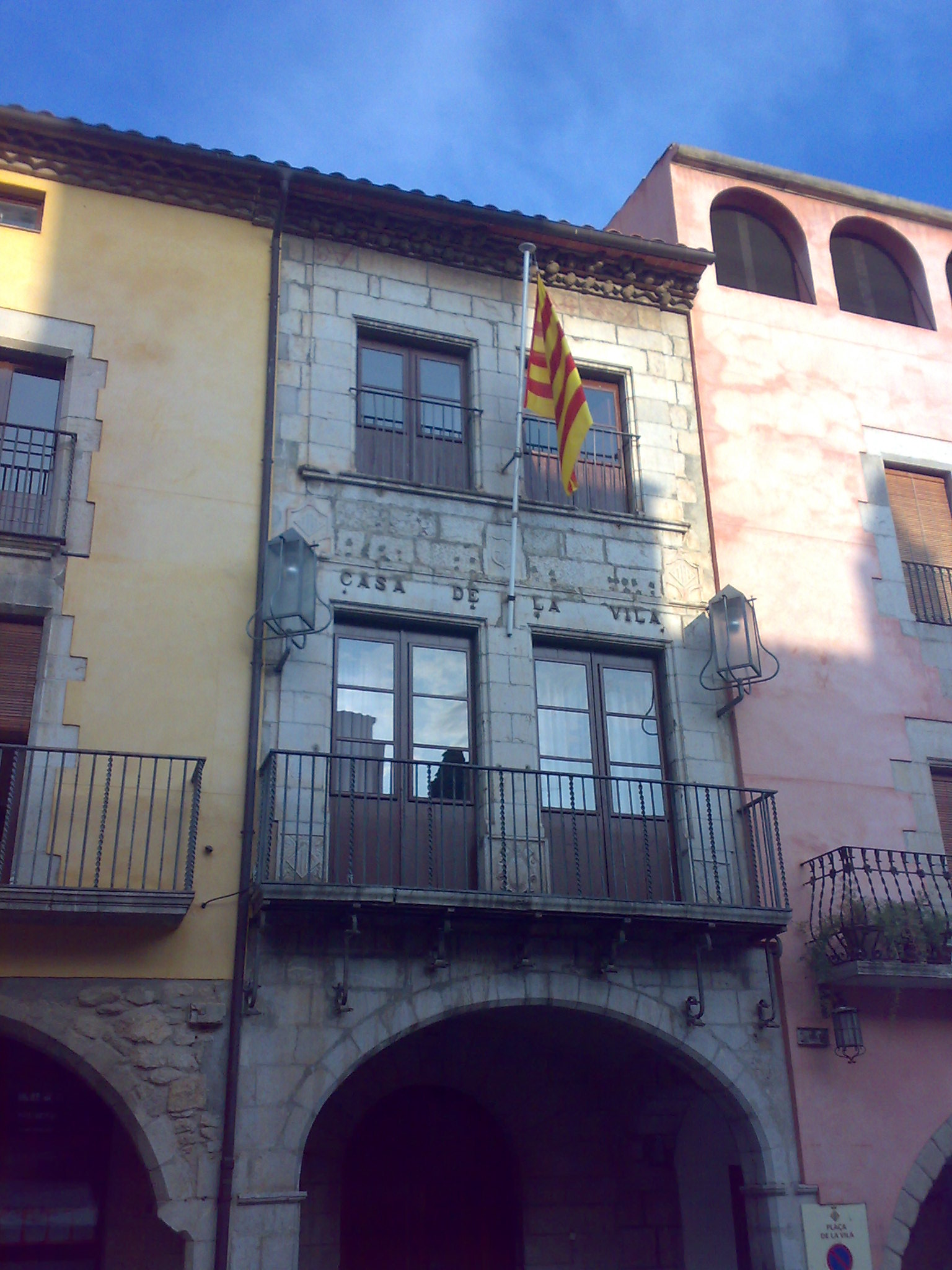
Casa de la Vila is the 16th-century town hall standing on the main square of the old town of Torroella de Montgrí, a town in the Baix Empordà region of Catalonia. The building still houses the municipal administration and is one of the most recognisable structures on Plaça de la Vila.
What can you see there?
The façade of Casa de la Vila rises directly out of the arcades that line the square: at ground level a wide carpanel arch runs across the full width of the building, forming part of the portico that surrounds the whole Plaça de la Vila. The entrance is a round stone arch built from carefully cut ashlar blocks, with the town's coat of arms carved into the keystone. On the first floor a balcony with two rectangular window openings is fitted with plain iron railings, while the second floor repeats the pattern with a pair of smaller balcony windows. A tiled roof tops off the building. Look closely at the stonework framing the windows — it echoes the same heraldic motif found on the entrance portal.
The building was most likely raised in the 16th century, during a period of Renaissance-era expansion in Torroella de Montgrí. In 1935 it was taken apart and rebuilt stone by stone, a restoration method typical of the era, meant to preserve the original fabric of the monument while reinforcing its structure.
Why is the square around the town hall so distinctive?
Plaça de la Vila sits at the very centre of the old town and is the heart of an urban layout that began taking shape in the 13th and 14th centuries, after Torroella was granted the status of a royal town (vila reial). From 1273 onward, the streets of the old town were laid out on a roughly orthogonal grid designed to converge on this very square. The square has been arcaded since its origins — part of the porticoes still show Gothic forms, even though many of the surrounding buildings were rebuilt between the 16th and 18th centuries. Casa de la Vila is therefore not just the seat of local government, but also a witness to centuries of the town's urban history.
How to get there and when to visit?
Torroella de Montgrí lies in Baix Empordà, in the province of Girona, just a few kilometres from the Costa Brava coastline and the resort town of L'Estartit. The old town is easiest to reach by car; in summer it's worth parking on the outskirts and continuing on foot, since the historic centre has narrow streets. Plaça de la Vila and its town hall are accessible year-round, though the building itself is mainly viewed from the outside, as the interior is used by the municipal offices. Spring and early autumn are the best times to visit, offering pleasant temperatures and fewer crowds than in high summer, when most visitors head straight for the beaches of L'Estartit and the Medes Islands.
Frequently asked questions
Can you go inside Casa de la Vila? The building houses the town hall, so visitor access is generally limited to the reception area during office hours — the main draw is the architecture of the façade and the square itself.
How old is the building? It most likely dates from the 16th century, although in 1935 it was dismantled and rebuilt stone by stone as part of a restoration project.
What else is worth seeing nearby? Plaça de la Vila is lined with porticoes, some of them Gothic, and the old town of Torroella de Montgrí has kept its medieval street layout — it's worth wandering toward the town walls and the other historic buildings nearby.
Is Torroella de Montgrí a good base for exploring the coast? Yes, the town is close to L'Estartit and the Medes Islands, making it a convenient base for combining a visit to the historic centre with time on the coast.
Nearby places

Earn badges for the places you visit
Download NextOnTrip, discover new places and check off your trails.