About this place
Burgos City Council (Casa Consistorial / Ayuntamiento de Burgos) stands on Plaza Mayor, right in the heart of the historic center of Burgos, capital of the Castile and León region. It houses the city's municipal government and is one of the defining landmarks of the old town, just steps from the route to the cathedral and the Paseo del Espolón.
How do you get there?
Plaza Mayor sits within easy walking distance of Burgos Cathedral — a few minutes through the narrow streets of the old quarter get you there. Most visitors reach it naturally while moving between the Arco de Santa María, the cathedral, and the riverside promenade along the Arlanzón. There's no car parking on the square itself, so it's best to leave your vehicle at the edge of the old town and continue on foot.
What will you see?
The building was raised in neoclassical style using stone from Hontoria, designed by architect Fernando González de Lara. Construction started in 1787, and the building was formally inaugurated on July 17, 1791. The upper section of the facade — with its clocks and heraldic shields — was added later, in a second phase during the 19th century.
The facade's defining feature is a row of six columns forming a broad portico that opens directly onto the Paseo del Espolón, one of the city's grandest boulevards. The building rises two floors with balconies and is flanked by two towers, each topped with a clock. Together, the towers and portico make the city hall one of the most recognizable structures on Plaza Mayor.
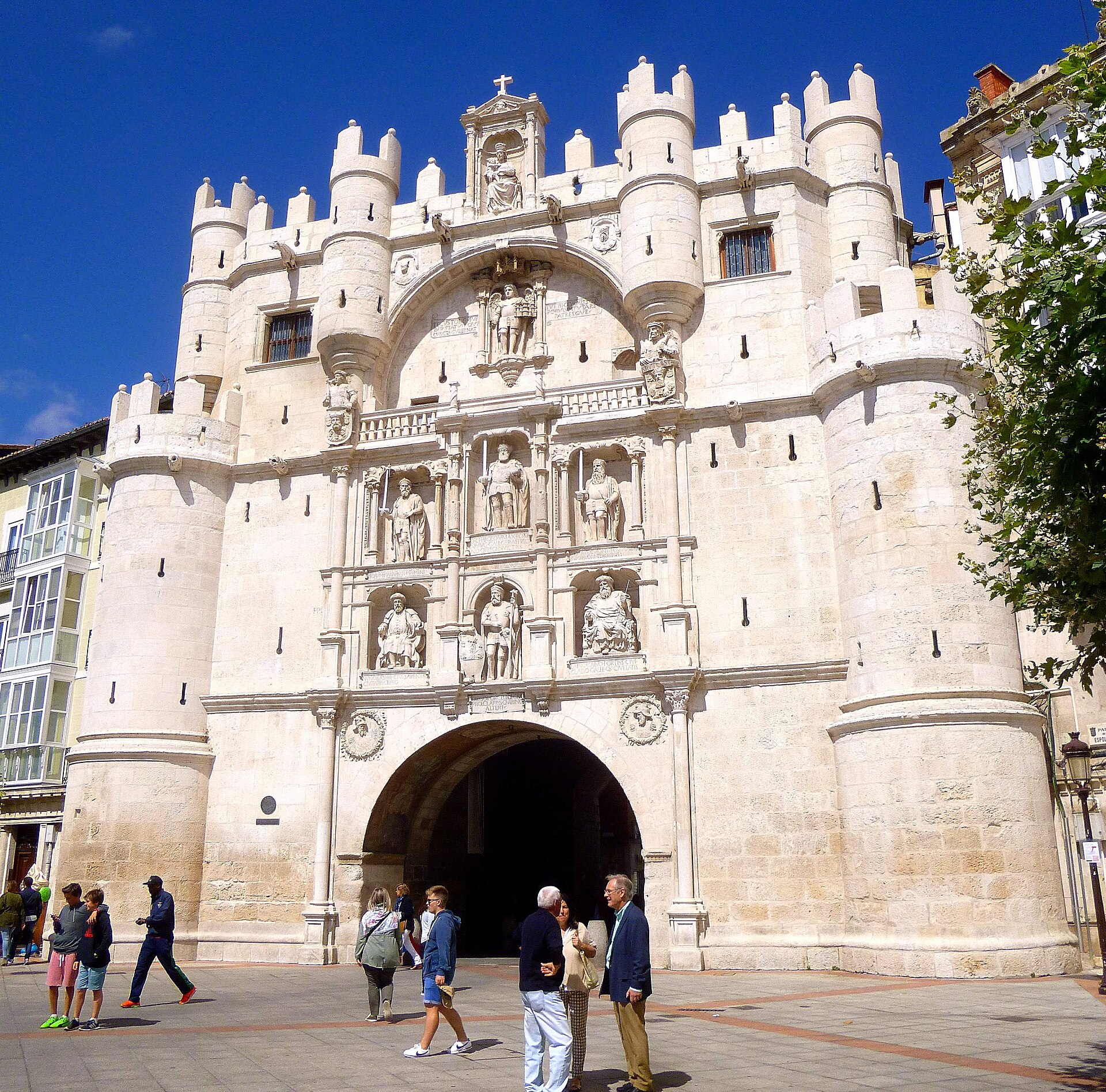
Interestingly, the city council didn't always meet here. Sessions were originally held inside the cathedral, then moved in the 13th century to the Arco de Santa María, one of the city's medieval gates. It wasn't until the 18th century that authorities commissioned a dedicated building on Plaza Mayor — the same one still in use today.
When should you visit?
The square and the city hall's facade can be admired from the outside year-round. Spring and autumn bring the most comfortable temperatures for a walk in Castile, while summers here tend to be hot and dry. The square comes alive in the evenings, when locals gather at the surrounding cafés and the building's architecture is lit up after dark.
Anything else worth knowing?
Plaza Mayor has served as a market square since as early as the 16th century, when it was laid out as a place for merchants and artisans to settle near the city walls and the Carretas gate. Today it functions mainly as a gathering spot and a natural starting point for exploring the rest of old Burgos — the cathedral, the Arco de Santa María, and the riverside boulevards are all a short walk away.
Frequently asked questions
Can you go inside the city hall? The building is an active seat of municipal government, so visits are generally limited to admiring the facade and portico from outside.
How much time should you set aside? The square and facade are a quick stop of ten to fifteen minutes — best combined with a walk through the old town, the cathedral, and the Paseo del Espolón.
Is entry to Plaza Mayor free? Yes, it's an open public square, accessible free of charge at any time.
How is the city hall different from Burgos Cathedral? They are two separate landmarks: the Cathedral of Santa María is a UNESCO-listed Gothic church, while the city hall is a neoclassical administrative building on Plaza Mayor — both are easily seen during the same visit to the old town.
Nearby places

Earn badges for the places you visit
Download NextOnTrip, discover new places and check off your trails.