About this place
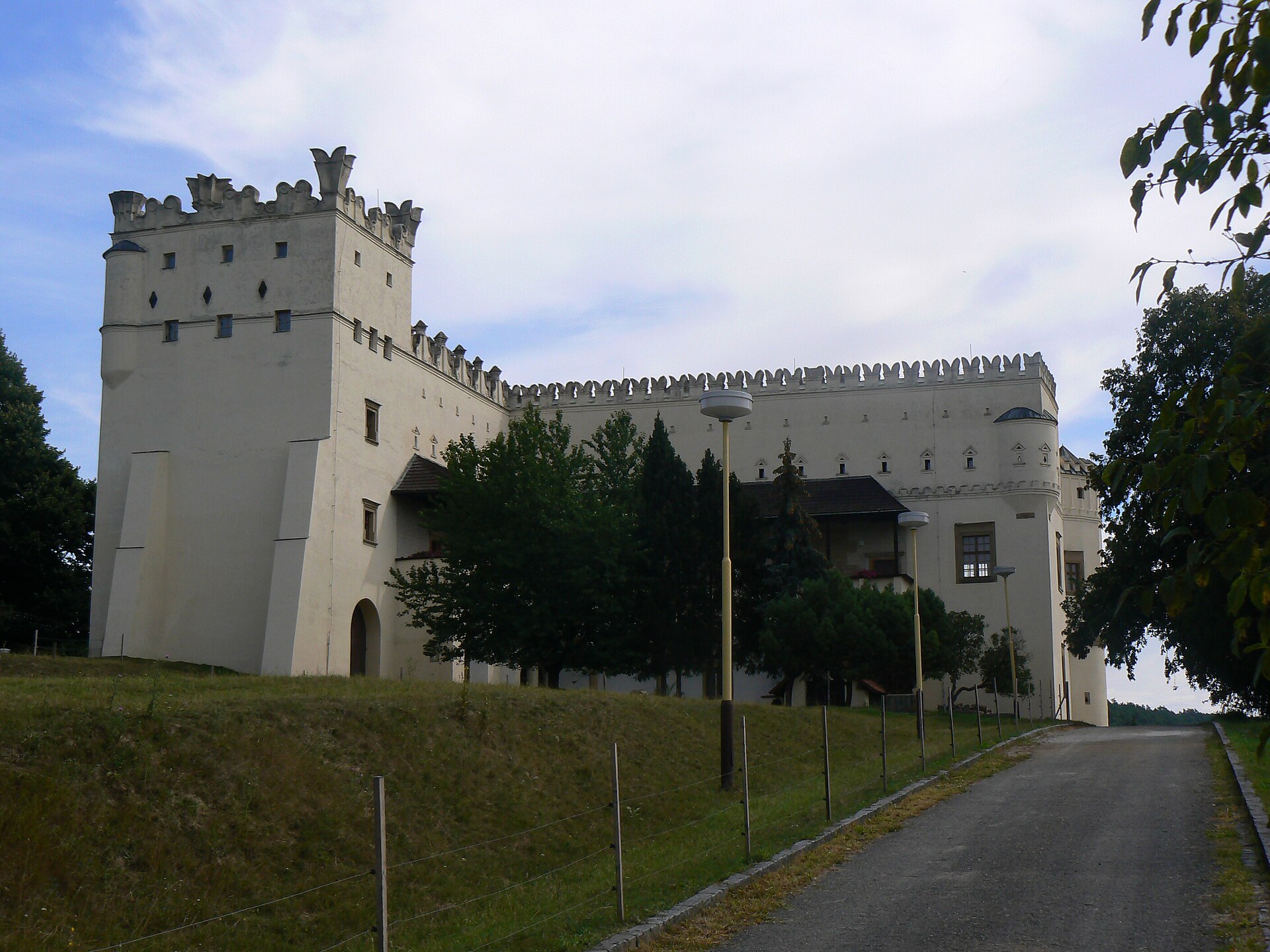
Bučovice Chateau is a Renaissance residence in the South Moravian town of Bučovice, built between 1575 and 1585 for Jan Šembera Černohorský z Boskovic, one of the wealthiest Moravian noblemen of his era. The chateau is best known for its arcaded courtyard, covered in hundreds of carved stone reliefs, and for a set of Mannerist state rooms that rank among the best-preserved of their kind in Central Europe.
Why was the chateau built the way it was?
Šembera was educated in Italy and Vienna, and rather than remodel an older stronghold, as most Czech and Moravian nobles did, he commissioned an entirely new residence modeled on the Italian "palazzo in fortezza" type — a fortified palace enclosed by a defensive wall, a moat, and a Renaissance garden. The design came from Jacopo Strada, a scholarly antiquarian and architect who curated the art collections of three Habsburg emperors: Ferdinand I, Maximilian II, and Rudolf II. That pedigree makes Bučovice one of the most distinctly Italian-influenced noble residences in the Czech lands.
What makes the arcaded courtyard so remarkable?
At the center of the chateau is a three-story courtyard ringed by arcades resting on ninety columns. The stonework — roughly 540 individual reliefs — was carried out by Elia Canavale and Antonio Silva, Italian masons who had settled in Bohemia. The carvings cover military scenes, coats of arms, plant ornament, fantastical creatures, mascaron faces, and musical instruments, with the decorative program varying from floor to floor. A Renaissance fountain stands in the middle of the courtyard and is often ranked among the finest of its kind in Central Europe.
What can visitors see inside?
The ground floor preserves a sequence of state rooms designed under Strada's direction. The best known are the Imperial Hall, the Venus Hall, and the Hall of the Five Senses, whose vaulted ceiling personifies the five human senses as female figures paired with animals. A separate highlight is the so-called Hare Room, decorated with an unusual "world upside down" cycle: hare cavalry charging human infantry, hares battling dogs, hares celebrating victory, hares hunting humans, and finally a banquet held by a royal hare couple. It is one of the most unusual painted cycles found in any Czech or Moravian noble residence.
What is the chateau used for today?
The chateau is administered by the National Heritage Institute (Národní památkový ústav) and open to visitors as a museum. Its permanent exhibition, "A Moravian Aristocrat in the Labyrinth of the World," focuses on the culture of Moravia's Renaissance nobility — an era of religious tolerance, estates defending their political rights, and general economic and cultural growth in the region.
Frequently asked questions
When was Bučovice Chateau built? Construction ran from 1575 to 1585, commissioned by Jan Šembera Černohorský z Boskovic.
Who designed the chateau? The architectural concept came from Jacopo Strada, an Italian art connoisseur and architect who worked for the Habsburg imperial court.
What is the chateau's main attraction? Its arcaded courtyard, with 90 columns and about 540 stone reliefs, and the Mannerist ground-floor halls, including the Hare Room.
Where is the chateau located? In the town of Bučovice, in the South Moravian Region of the Czech Republic.
Nearby places

Earn badges for the places you visit
Download NextOnTrip, discover new places and check off your trails.