About this place
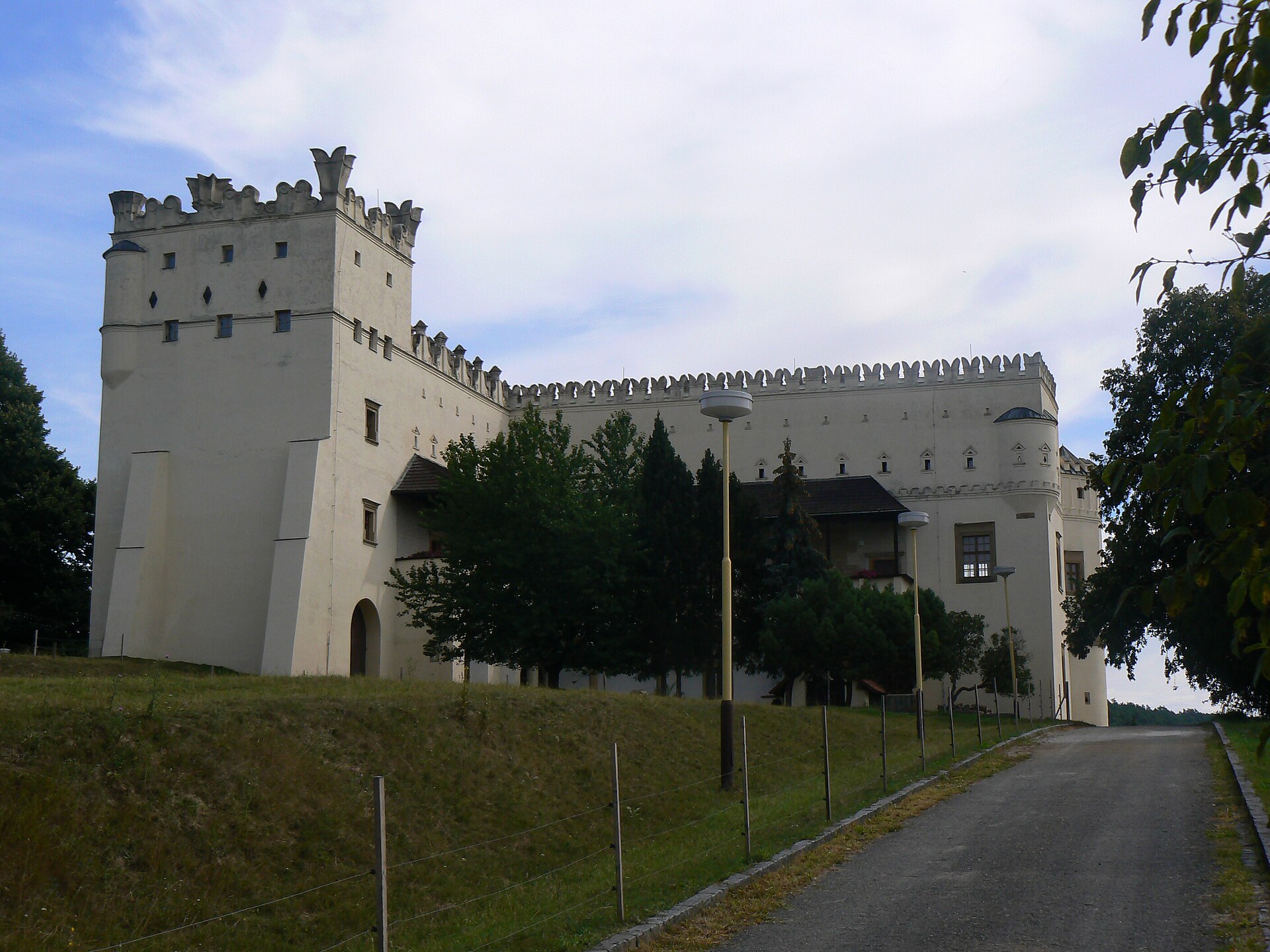
Koryčany Castle stands at the edge of the small town of Koryčany, in the Kroměříž district of the Zlín Region, on the south-western fringe of the Chřiby hills. Location databases sometimes link it to the nearby village of Jestřabice, but the castle building itself is in Koryčany — Jestřabice lies about 3 km to the south-west, at the confluence of the Jestřabický and Kratinka streams, and has been an administrative part of Koryčany since 1976. The two places share a long common history of ownership, which explains the close association.
Why was a manor built in Koryčany?
Until the 17th century, Koryčany belonged to the wider estate of Cimburk Castle. The living quarters at Cimburk, however, were remote and uncomfortable, which is why the estate's owners decided to build a permanent residence closer to the center of their lands. The first written mention of a manor house on a hill behind the local parish dates to 1611, and by 1631 a chapel already stood beside it.
The estate passed to the Horecký family after the death of Lady Alina in 1607: the inheritance — comprising Cimburk, the manor house in Koryčany, a farmstead, the parish, a brewery, toll rights, and the Jestřabice property with its village and vineyards — went to her two sons from different marriages. Guardians sold one son's share, leaving Gabriel Horecký z Horky as sole lord of the entire Cimburk estate.
How did the baroque castle come about?
After 1677, František Gabriel Horecký replaced the older fortified manor with a baroque castle of two wings. About a hundred years later, under Kristián z Gillernu, the building was extended with a third wing featuring a balustrade, and the main entrance was rebuilt and decorated with the family's coat of arms. Kristián's daughter, Marie Josefa, married to Konstantin z Münch-Belinghausen, was also involved in this later phase.
An ornamental garden and an English-style park already existed at the castle by around 1718. In the mid-19th century, the garden's parterre was reworked into a landscape park. Today the grounds cover about 2.8 hectares and include a chestnut-tree avenue along with a number of striking old trees, among them a large red-leaved beech and a yellow-leaved locust tree.
Who owned the castle later on?
Between 1848 and 1851 the estate belonged to Salomon Rothschild, after whom it passed to Vilém Figdor and then to Heřman Wittgenstein, a merchant from Vosendorf near Vienna.
What happened to the castle after the Second World War?
After the liberation of Czechoslovakia, the building became state property. In 1945–1946 it housed Yugoslav children of fallen partisans, then successively held a library, a kindergarten, a ceremonial hall, and a special boarding school. Until 1955, part of the castle served as a textile warehouse. In late 1955 and spring 1956 the building was adapted for educational use, and on 20 April 1956 a vocational school for training shoe salespeople — drawing students from Bohemia, Moravia and Slovakia — opened there.
Can visitors tour the castle today?
The castle building itself is not regularly open for public tours — for decades it served educational purposes, and its ownership and use have changed several times since. The surrounding park and garden, however, are accessible to visitors and remain a popular place for a walk in Koryčany.
Frequently asked questions
Is Koryčany Castle located in Jestřabice? No — the building itself stands in Koryčany. Jestřabice is a neighboring village about 3 km away that has been administratively part of the town of Koryčany since 1976, and historically shared the same estate ownership.
When did the castle take its present baroque form? The main baroque structure was built by František Gabriel Horecký after 1677, and the third wing with its balustrade was added roughly a hundred years later under Kristián z Gillernu.
Is there a park at the castle? Yes, an ornamental garden and park of about 2.8 hectares, established as early as the start of the 18th century and reshaped into a landscape park in the 19th century, featuring a chestnut avenue and notable old trees.
Is the castle open to tourists? The building itself is not regularly open for visits, but the surrounding park can be visited.
Nearby places

Earn badges for the places you visit
Download NextOnTrip, discover new places and check off your trails.