About this place
The Episcopal Palace of Ghent (Bisschoppelijk Paleis) is the administrative seat of the Diocese of Ghent and the residence of its bishop, standing on Bisdomplein in the heart of the city's historic centre, right next to Saint Bavo's Cathedral.
Where did the bishop's seat in this spot come from?
The Diocese of Ghent was created in 1559, but its earliest bishops did not immediately have a fixed, representative residence. They first lived in a townhouse on Nederpolder — the former Koraalhuis belonging to the chapter of the Saint Bavo collegiate church — and later moved between other houses close to the cathedral. A lasting solution only arrived in the 1620s, when Infante Ferdinand granted Bishop Antonius Triest the former Hof van Sint-Baafs. After a thorough renovation, Triest moved in in 1633, and his successors continued to reside there without interruption until 1794, when French troops seized the building and turned it into the seat of the administration of the Scheldt department.
What does the building standing there today look like?
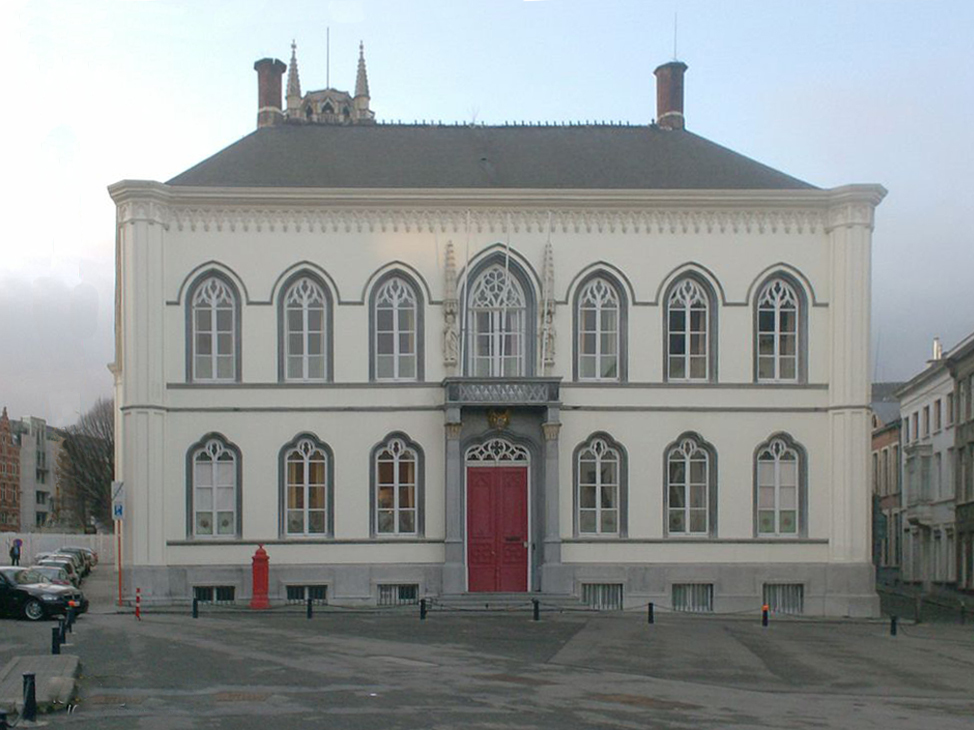
The structure visitors see on Bisdomplein today is considerably younger than the diocese itself. It was built between 1841 and 1845 to a design by engineer Matthias Jozef Wolters, commissioned by the provincial government of East Flanders at the request of Ludovicus Josephus Delebecque, Bishop of Ghent from 1838 to 1864. The building is an early example of Gothic Revival architecture — a style that drew on medieval architectural forms but was executed with nineteenth-century construction techniques and an experimental approach to Gothic detailing typical of its era.
A defining feature of the facade is its pale, almost white colour, which stands out sharply against the darker brick fronts of the neighbouring buildings on the square. The front is decorated with elaborate stonework — pointed arches and tall, slender windows characteristic of the Gothic Revival repertoire — giving the building a stately, almost ecclesiastical appearance, even though its function is administrative and residential rather than sacred.
What role does the palace play today?
The Bisschoppelijk Paleis still serves its original purpose: it is both the residence of the sitting Bishop of Ghent and the administrative headquarters of the diocese. That means the building is not a publicly accessible tourist attraction with regular opening hours, but a working church institution that houses day-to-day diocesan offices and representative functions.
Because of its historical and architectural value, the building is a protected heritage monument. Bisdomplein itself, the square on which it stands, forms part of one of the densest clusters of historic landmarks in central Ghent — Saint Bavo's Cathedral sits directly alongside it, making the area one of the key stops on any walk through the city's historic core.
For visitors strolling through Ghent, the palace is above all a distinctive part of the skyline around the cathedral square — a white, Gothic Revival facade that stands apart from the surrounding architecture and is a reminder of the centuries-long, if interrupted, presence of bishops in this part of the city.
Frequently asked questions
Can the Bisschoppelijk Paleis be visited on the inside? The building functions as a working bishop's residence and diocesan administrative headquarters, so it is not a standard tourist attraction with interiors open for visits.
In what style was the current palace built? It is an early Gothic Revival building, designed by engineer Matthias Jozef Wolters and constructed between 1841 and 1845.
Has the same building always stood on this site? No — the earlier episcopal residence, the former Hof van Sint-Baafs, served the bishops from 1633 to 1794, before French troops confiscated it; the current building is a much later, nineteenth-century construction.
Nearby places

Earn badges for the places you visit
Download NextOnTrip, discover new places and check off your trails.