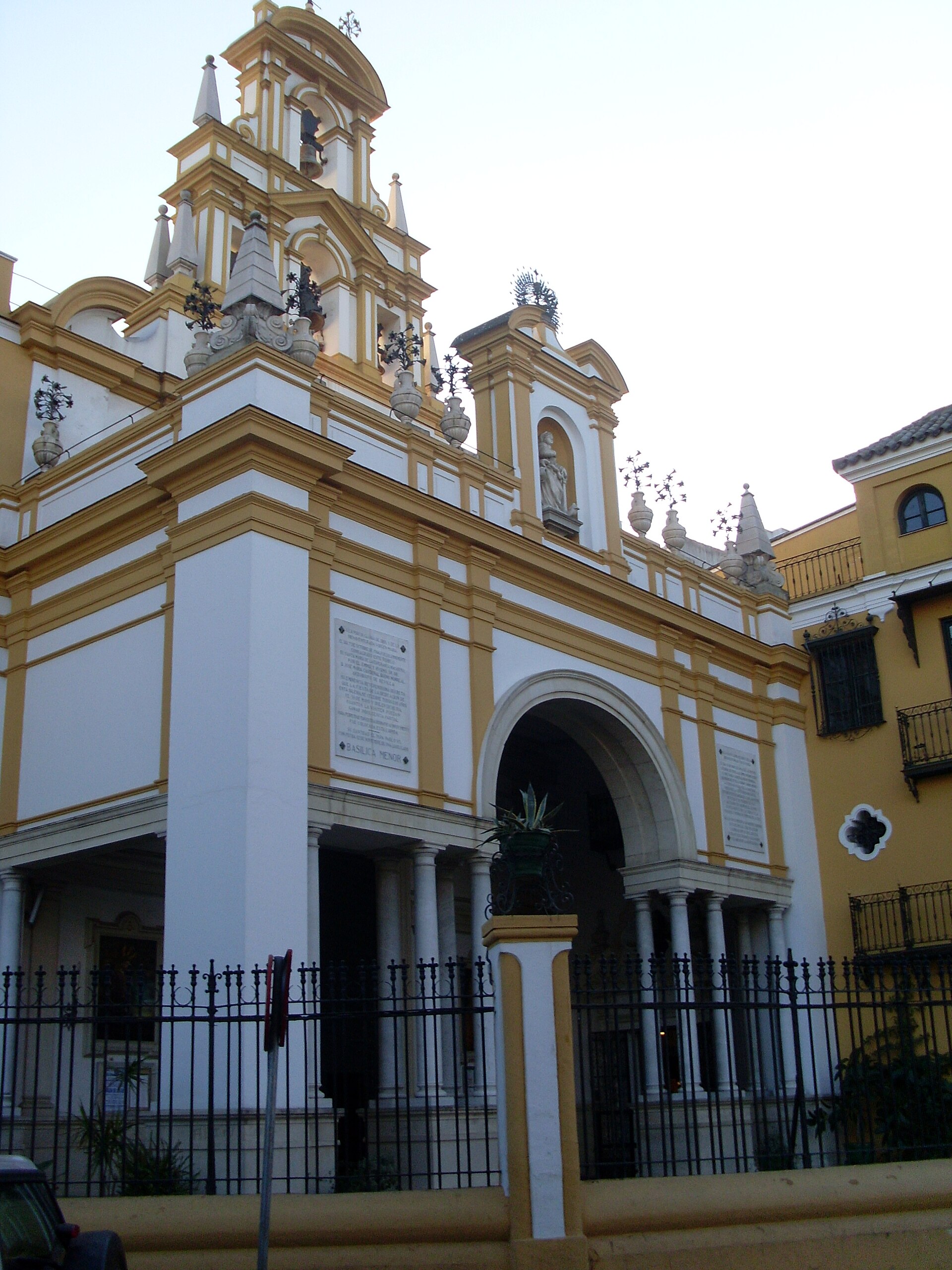
About this place
Basílica de la Macarena
Basílica de la Macarena is one of Seville's most important churches, standing in the historic part of the city right next to the medieval Puerta de la Macarena. It houses the image of the Virgen de la Esperanza Macarena, the most venerated Marian figure in the city, around which an entire neighborhood's identity has been built for centuries.
Who is the Virgen de la Macarena and why does she matter so much?
The Virgen de la Esperanza Macarena is a 17th-century talla de candelero — a wooden image with a movable frame designed to be dressed in real fabric robes. Its authorship was never firmly established; art historians have linked it to sculptors connected to Pedro Roldán's workshop, but no single name is confirmed. Her expression combines a mother's grief over her son's death with hope, which is where her name comes from — Esperanza, meaning Hope. In 1964 the image was canonically crowned, becoming only the second sorrowful Madonna in Seville to receive that honor. The brotherhood that cares for her, the Hermandad de la Macarena, traces back to 1595, founded by the market gardeners' guild in the now-vanished convent of San Basilio. It took until 1624 for the brotherhood to obtain permission to hold its annual Good Friday procession.
What is worth seeing inside the basilica?
The current building is fairly recent: it was blessed on 18 March 1949, after the brotherhood's previous chapel in the parish of San Gil burned down in 1936. Pope Paul VI declared it a minor basilica in 1966. Inside, the neo-baroque decoration draws the eye toward the main altar and the image itself, while an adjoining treasury museum lets visitors examine the historic robes, crowns, and jewels donated to the Virgin over the decades up close — including a well-known emerald brooch given by bullfighters, a reflection of the Macarena's long-standing patronage of the world of bullfighting.
Is it better to visit during Holy Week or on an ordinary day?
The basilica's most intense moment comes during Semana Santa. The brotherhood's procession, known as La Madrugá, sets out overnight between Holy Thursday and Good Friday and is regarded as one of the most emotionally charged processions in all of Seville, with crowds gathering hours in advance to see the image leave the church. Outside Holy Week, the basilica and its museum run at a much calmer pace, making it easy to take in the interior and the treasury without the crowds that build up around the festival.
What else is nearby?
The basilica sits directly beside the Puerta de la Macarena, one of the historic gates in Seville's old city walls. A stretch of those walls, dating back to the Almohad period, survives right next to the church and counts among the best-preserved sections of the old fortifications in the city. That makes it easy to pair a visit to the basilica with a short walk along the historic wall and through the neighborhood that shares its name with the Madonna venerated inside.
Frequently Asked Questions
What does "minor basilica" mean here? It is an honorary title granted by the Pope to churches of special religious or historical significance. The Basílica de la Macarena received it from Paul VI in 1966.
Can visitors see the Virgin's jewels and robes? Yes, the adjoining treasury museum displays historic crowns, processional robes, and jewels donated to the image over the centuries, including gifts from the bullfighters' brotherhood.
When does the Macarena's procession take place? Its main procession, La Madrugá, departs overnight between Holy Thursday and Good Friday during Seville's Semana Santa.
Is it worth combining the visit with the old city walls? Yes — a preserved section of the historic city walls and the Puerta de la Macarena stand right next to the basilica, making the area well suited to a relaxed walk after visiting the church.
Nearby places

Earn badges for the places you visit
Download NextOnTrip, discover new places and check off your trails.