About this place
Archivo Histórico Provincial de Cádiz is the provincial historical archive of Cádiz, housed in a striking baroque mansion on Calle Cristóbal Colón in the heart of the old town, in Andalusia, Spain. Locally known as Casa de las Cadenas (House of the Chains) or Casa Palacio de las Cadenas, the building is worth a look even for visitors who have no interest in archival records, thanks to its ornate late-17th-century facade.
How do you get there?
The archive sits within easy walking distance of Cádiz's main landmarks — the cathedral, the harbor, and Plaza San Juan de Dios. The city occupies a narrow peninsula on Spain's southwestern coast and is well connected by train and bus to Seville and Jerez de la Frontera. Once in the old town, walking is by far the easiest way to get around: the streets are narrow and the historic core is dense, so a car is more of a hindrance than a help.
What will you see?
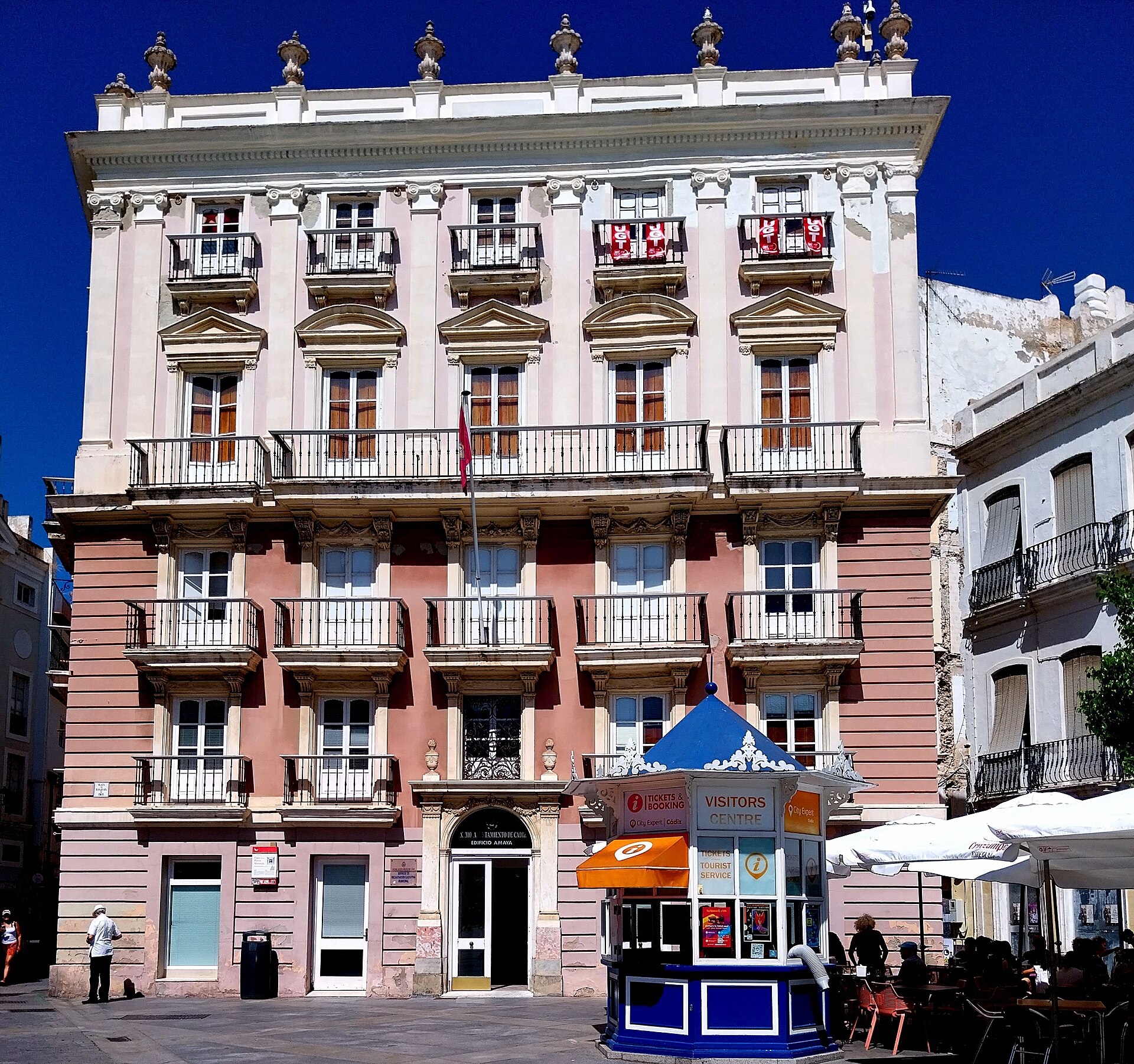
The building's facade is a showpiece of baroque craftsmanship — a monumental portal carved from Genoese marble, flanked by twisted columns, which has survived intact despite later neoclassical alterations to the rest of the elevation. The house itself dates back to 1693, built by Diego de Barrios de la Rosa on commission from Manuel de Barros. Local tradition ties its construction to an incident the previous year: during the Corpus Christi procession of 1692, a sudden storm forced the Blessed Sacrament to be sheltered inside this very house, an event said to have given the building its special standing.
Inside, the archive holds extensive collections of notarial, judicial, and administrative records covering the region from the early modern period through the 20th century. This isn't a museum in the conventional sense but a working research institution, so visits take the form of themed guided tours: a guide walks visitors through the history of the institution itself, its functions, and the nature of the documents and collections kept there. These guided visits are organized for groups — secondary school and university students, associations, and other collectives — making the archive a worthwhile stop for anyone curious about administrative history and archival science rather than a conventional sightseeing attraction.
The institutional backstory adds context: the archive was formally established as a state body on 6 March 1975, though it had already been operating provisionally since 1972 out of the Diputación Provincial building. It moved into its current home — purchased by Spain's Ministry of Culture in 1980 — in May 1987, and was officially inaugurated by the president of the Junta de Andalucía on 2 May 1991.
When should you visit?
Opening hours shift with the season, so it's worth checking before you go. During the summer period — 16 June through 15 September — the archive welcomes visitors Monday to Friday from 8:30 to 13:45. During special periods such as Christmas, Carnival week, and Holy Week, shorter hours apply: Monday to Friday, 8:30 to 13:30. Because of the nature of the institution, visits only take place on weekdays, so it's best to plan ahead and pair a visit with exploring the surrounding old town.
Frequently asked questions
Do you need to book in advance? Guided visits, particularly for groups (school classes, university students, associations), typically require prior arrangement with the archive — it's best to contact them ahead of your planned visit.
Is this a place for independent travelers, or only for groups? Guided tours are aimed mainly at organized groups, but the building itself — with its baroque facade — can be admired from the outside without any booking.
What can you actually see inside? The interior houses historical documents from the Cádiz region — notarial deeds, judicial records, and administrative files — and guided visits focus on the history of the institution and the nature of its holdings rather than a conventional exhibition.
Why is the building called "Casa de las Cadenas"? The name is tied to local tradition surrounding the house's history, built in 1693 and linked to the events of the 1692 Corpus Christi procession — one of the details that gives this building its distinctive character among Cádiz's historic sites.
Nearby places

Earn badges for the places you visit
Download NextOnTrip, discover new places and check off your trails.