About this place
Abbatiale Saint-Magloire de Léhon is a former Benedictine abbey standing in a bend of the River Rance, in the picturesque village of Léhon, about 2.5 km from central Dinan in Brittany. Since 2018 Léhon has been administratively merged into the commune of Dinan, yet it keeps its own identity as a "Petite Cité de Caractère" and a distinct monastic history.
How was the abbey founded?
The monastery was established in the mid-9th century, around 850, by Nominoë, the ruler of Brittany, and its origin is tied to the relics of Saint Magloire, a bishop from Dol. Tradition holds that his remains were brought from Sercq, an island in the Channel Islands, where they had previously rested. The new Benedictine community quickly grew into a significant spiritual centre on the banks of the Rance.
Norman raids and exile
The peace of the monastery was broken by Norman raids. The monks of Léhon had to flee, taking refuge in Paris, where they founded a sister community dedicated to the same saint. They only returned to their abbey on the Rance once the danger had passed.
Rebuilding under Marmoutier
Monastic life in Léhon revived in the 12th century with the establishment of a priory. In 1181 the community came under the authority of the powerful abbey of Marmoutier, near Tours. The local lords of Dinan-Bécherel responded to the abbey's growing influence by asserting their own: in 1218 they built the castle of Léhon and made it the seat of their lordship.
What remains of the old monastery?
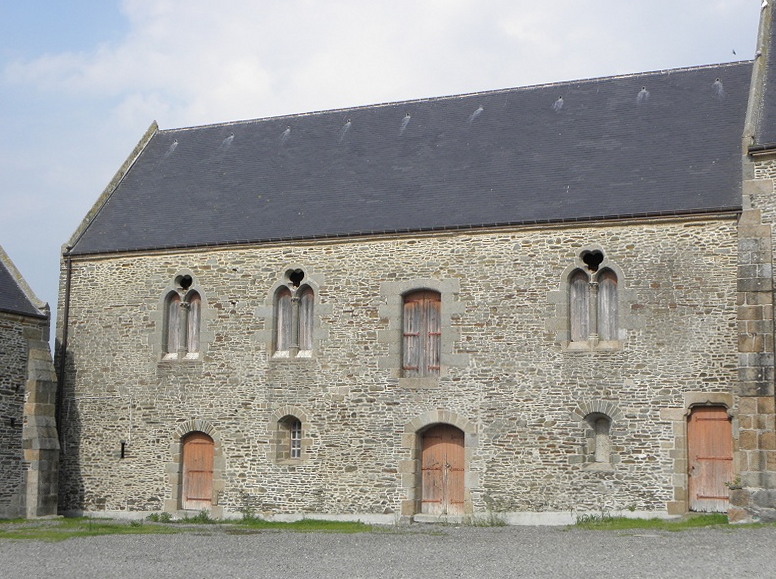
The surviving complex includes an abbey church that blends Romanesque and Gothic elements, a cloister, and a Gothic refectory covered by ribbed vaulting and lit by modern stained glass. The buildings were partly reworked in the 17th century as part of a monastic reform, though the medieval layout survived.
The cloister garden by the Rance
Inside the cloister, a small garden of aromatic and medicinal herbs recalls the community's old herbalist tradition. The abbey grounds slope down toward the Rance, where excavations uncovered a covered channel linking the monastic buildings directly to the river, part of the community's former water system.
Rescue and later restoration
The abbey nearly fell into ruin before being rescued at the end of the 19th century, between 1892 and 1897, through the efforts of Léhon's mayor at the time, Louis Chupin, and a local priest, abbé Fouéré-Macé. Further restoration campaigns followed from the 1980s onward, leaving the buildings in good condition for visitors today.
What is the village of Léhon like today?
The village sits in a loop of the Rance, below the hill topped by the medieval castle of the Dinan-Bécherel lords. Stone houses, narrow lanes and a bridge over the river create an intimate setting in which the abbey remains the main historical and visual landmark.
How do you get to the abbey and visit it?
From central Dinan, Léhon can be reached on foot along a charming towpath beside the Rance, or by car, with free parking available near the abbey. The cloister is generally open free of charge year-round, while guided tours run during the summer season; it is worth checking current dates and opening hours with the local tourist office.
Frequently asked questions
Who founded the abbey at Léhon? It was founded by Nominoë in the mid-9th century, linked to the cult of the relics of Saint Magloire.
Why did the monks leave Léhon? Norman raids forced the community to flee to Paris, where they founded a related monastery, returning to Brittany only once the threat had subsided.
What can visitors see at the abbey today? The abbey church, the cloister, the Gothic refectory with its stained glass, and the herb garden sloping toward the Rance.
How far is Léhon from Dinan? About 2.5 km, reachable on foot along the river or by car, with free parking by the abbey.
Is entry to the abbey free? The cloister is usually free to visit, while guided tours are seasonal; details are available from the Dinan-Cap Fréhel tourist office.
Nearby places

Earn badges for the places you visit
Download NextOnTrip, discover new places and check off your trails.