About this place
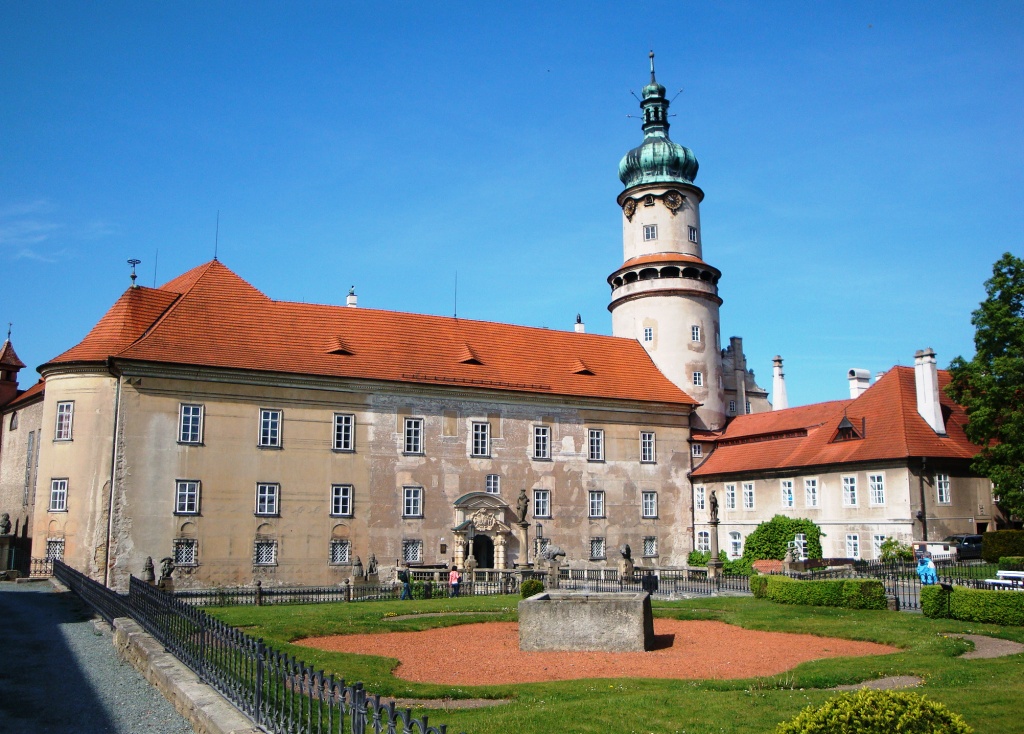
Nové Město nad Metují Castle is one of the few chateaux in the Czech Republic where an entire early-20th-century Art Nouveau interior scheme survives almost intact. It occupies the northwest corner of the town square, forming a single protected ensemble with it in the Hradec Králové Region.
How did the chateau take shape over the centuries?
The story begins in 1501, when Jan Černický of Kácov built a Gothic castle on the site. A fire in 1526 badly damaged the structure, and the Pernštejn family carried out the repairs. The real transformation came in the second half of the 16th century, when the lords of Stubenberg converted the Gothic stronghold into a Renaissance residence — the layout they created is still recognizable in the building's outline today. Between 1652 and 1665 the chateau underwent a further remodeling, this time in an early Baroque idiom.
The turning point in its history came in 1908, when the industrialist Bartoň family of Dobenín bought the estate. They commissioned the Slovak architect Dušan Jurkovič to rework the interiors into a comfortable, representative family seat. The 1909–1912 renovation combined respect for the historic fabric with modern comforts: central heating, running water, electricity, a telephone line, bathrooms, and two lifts — one for goods, one for passengers — were all installed during this campaign. In the 1920s and 1930s, architect Pavel Janák picked up where Jurkovič left off, working alongside a circle of leading Czech artists.
What can visitors see inside today?
Touring the chateau means moving through several design languages at once — rooms furnished in Art Nouveau, Art Deco, Rondo-Cubist and Functionalist styles, making this one of the rare places in the country where a single, coherent early-20th-century interior vision has survived largely intact. Visitors curious about the working side of the house can follow the "From Attic to Cellar" route, which opens up the service rooms, kitchen and cellars — spaces normally closed to the public.
What does the chateau garden look like?
The garden bears Jurkovič's signature just as clearly as the interiors. He spanned the old defensive moat with a wooden bridge built in the folk-architecture style of the Wallachia region, and it remains one of the estate's most distinctive features. The lower garden terrace, by contrast, he laid out in the manner of a French garden, with clipped hedges and strict axial symmetry — a formal counterpoint to the rustic charm of the bridge.
Is the chateau a good visit for children?
It is — a dedicated exhibition called "The Magic Chateau" was created for younger visitors, combining interactive elements with a themed "Magic Café" and a set of "magic chambers." It gives families a way to enjoy the historic building alongside something built specifically for kids.
Frequently asked questions
Where exactly is the chateau located? In the northwest corner of the main square in Nové Město nad Metují, in the Hradec Králové Region, forming part of the town's protected historic core.
Is it a Gothic or a Renaissance building? It began as a Gothic castle in 1501 and was converted into a Renaissance residence in the second half of the 16th century, later gaining early Baroque touches and, eventually, its Art Nouveau interiors under Jurkovič.
Who carried out the last major renovation? The industrialist Bartoň family of Dobenín, who from 1908 commissioned architect Dušan Jurkovič and later Pavel Janák to remodel the interiors.
What is worth seeing besides the rooms? The chateau garden, with Jurkovič's wooden bridge over the old moat and the French-style lower terrace.
Is there anything designed for families with children? Yes, the "Magic Chateau" exhibition, with interactive elements and a themed café.
Nearby places

Earn badges for the places you visit
Download NextOnTrip, discover new places and check off your trails.