About this place
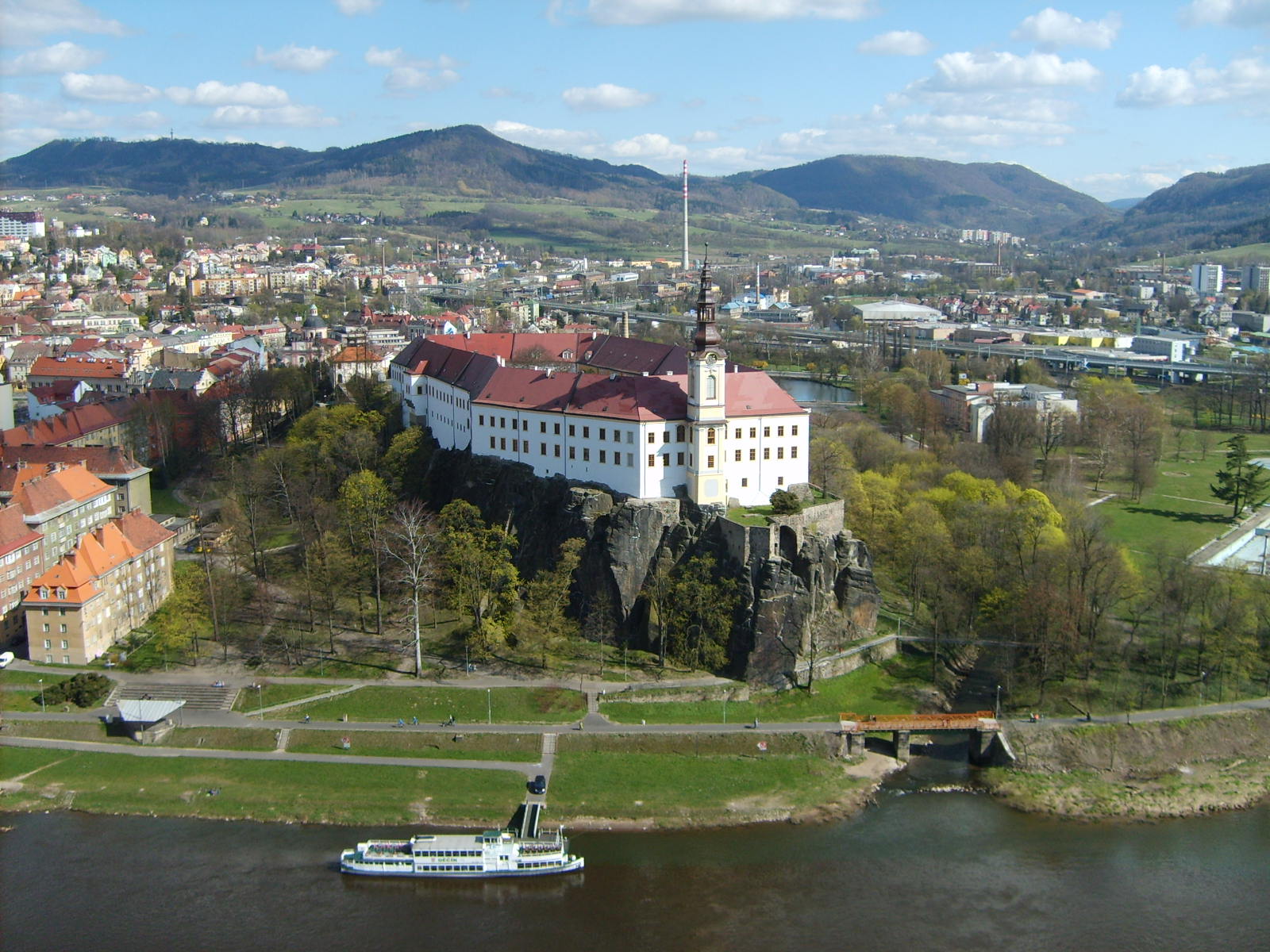
Děčín Castle stands on a rocky outcrop right where the Ploučnice River flows into the Elbe, overlooking the town of Děčín in northern Bohemia. It ranks among the oldest and largest fortified complexes in the region, protected as a cultural monument of the Czech Republic, and its outline has shaped the town's skyline for centuries.
How did a castle end up on this rock?
The site's story begins at the close of the 10th century, when Bohemian princes had a wooden stronghold built on the cliff. The surrounding province is first mentioned in writing in 993, while the fortress itself appears in records from 1128. Ownership and layout changed hands repeatedly over the following centuries until 1628, when the estate passed to the Thun-Hohenstein family, who held it without interruption until 1932.
What did the Thun-Hohensteins change?
It was this family that gave the castle its present look. The first Baroque remodeling was commissioned by Maximilian von Thun, an imperial diplomat, turning the once-austere stronghold into a stately residence. The Thun era is remembered as the castle's golden age: notable guests passed through its halls, and Frédéric Chopin is said to have composed a piece known as the Děčín Waltz during a stay here. Financial pressure eventually forced the family to sell the property to the Czechoslovak state in 1932.
Why did the castle become a barracks?
Once in state hands, the complex was converted into military barracks. Over the following decades it was used successively by the Czechoslovak army, then German forces, again by Czechoslovak troops, and finally, from 1968 to 1991, by the Soviet army. Decades of military use took a toll on the buildings, and it was only in 1991 that the castle returned to the administration of the town of Děčín, launching a long-running restoration that continues in stages today.
What is there to see inside the grounds?
The undisputed highlight is the Rose Garden, a name that took hold after 1881, when one of the most celebrated rosariums in the entire Habsburg monarchy was planted here. The garden is framed by a Baroque sala terrena with murals surviving from 1678 and by an ornamental gloriette lined with Baroque statues; peacocks still roam the grounds. Visitors can walk through rooms once used by the former owners, take in views over the town and the Elbe valley from the castle's lookouts, and continue down through terraced gardens toward Mariánská louka by the riverbank. In the adjoining park stands the only chain bridge in the Czech Republic still preserved in its original location.
How do you get up to the castle and visit it?
The castle sits atop a cliff roughly 51 metres high on the Elbe's right bank, so the approach from the town runs up a steep road or staircase. The interiors and gardens are open on ticketed, guided routes, and the grounds regularly host cultural events and exhibitions.
Frequently asked questions
Where exactly is Děčín Castle located? On a rock above the right bank of the Elbe, right where the Ploučnice joins it, in the town of Děčín in northern Bohemia, Czech Republic.
Who built the castle? Bohemian princes raised the original wooden stronghold in the 10th century; its current Baroque form comes from the Thun-Hohenstein family, who owned the estate from 1628 to 1932.
What is the Rose Garden known for? It is the castle's best-known feature, a Baroque garden with a rosarium established after 1881, enclosed by a sala terrena and a statue-lined gloriette.
Was the castle ever used as a barracks? Yes. Between 1932 and 1991 it served as a military site, occupied in turn by Czechoslovak, German, Czechoslovak again, and Soviet forces.
Can visitors tour the castle today? Yes. Since being returned to the town of Děčín in 1991, the castle has been gradually restored and opened to the public, including its gardens and viewpoints.
Nearby places

Earn badges for the places you visit
Download NextOnTrip, discover new places and check off your trails.