About this place
Vlasatice Castle – from fortified manor to Renaissance residence
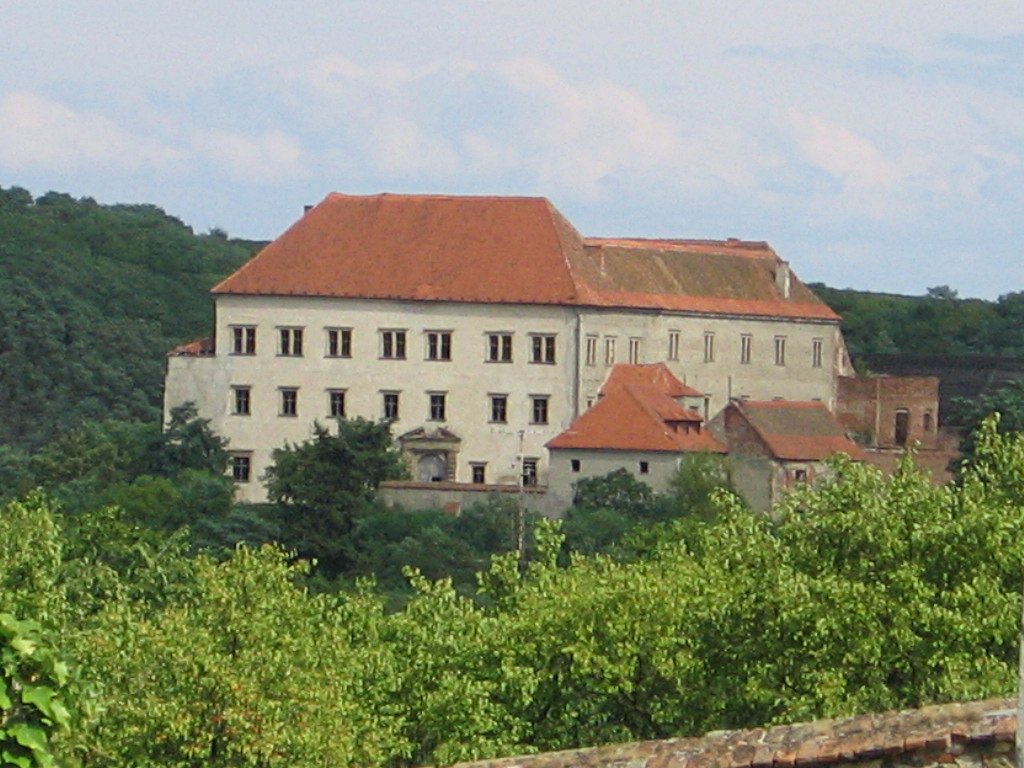
Vlasatice Castle is a modest estate in the South Moravian village of Vlasatice, in the Břeclav district, whose story stretches back nearly seven centuries. Today it looks like an unassuming red-plastered office building, but behind that plain facade lies a history of fortification, rebuilding, war damage and slow decline.
How did the fortified manor begin?
The site's earliest recorded history goes back to the mid-14th century, when a burgher named Dětřich Mořic held Vlasatice. In 1342 he was granted permission to fortify his courtyard, an act generally taken as the origin of the local tvrz — a small fortified manor house typical of medieval Bohemian and Moravian lordships. The structure itself is not documented again until 1567, when the estate was purchased by Albrecht Černohorský of Boskovice.
When did the manor become a Renaissance castle?
Albrecht Černohorský began converting the old fortified manor into a Renaissance-style residence, but ran out of money before the work was finished. The task was completed by the next owners, the Thurn family, who saw the castle through to completion. Their tenure ended abruptly: having backed the losing side in the conflict that culminated in the 1620 Battle of White Mountain, the Thurns had the estate confiscated from them.
What happened during the Thirty Years' War?
After the confiscation, Vlasatice passed to Cardinal Dietrichstein. The turmoil of the Thirty Years' War (1618–1648) took a heavy toll on the castle, which suffered significant damage; repairs were only carried out in the second half of the 17th century. In the second third of the 18th century the building was remodeled in the Baroque style, giving it a form closer to what visitors would recognize today. During the 19th century, a park was laid out around the residence, following the fashion common among noble estates of the period.
Who owned the castle after the Dietrichsteins?
The Dietrichstein family held Vlasatice until 1864, when ownership passed to the Herberstein family, closing out a long stretch of aristocratic management of the estate.
What happened to the castle after 1945?
Following the Second World War and the transition to state control, the castle was absorbed into an agricultural enterprise. Decades of use as part of a farming operation took a toll on the building, and its Renaissance-Baroque fabric gradually deteriorated.
Is the castle being restored today?
The building is protected as a cultural monument. In recent years a new owner from abroad has begun a comprehensive reconstruction of the entire castle complex, offering hope that its historic character will be restored. For now, the structure — still recognizable by its red-plastered facade — is used as office space.
Frequently Asked Questions
Can visitors go inside Vlasatice Castle? Because the building currently serves as office space and is undergoing reconstruction, public access to the interior is limited — it is worth checking locally or with the municipality before planning a visit.
What is the difference between a tvrz and a castle here? A tvrz was a smaller, fortified noble residence typical of the medieval period, while the later castle (or chateau) was usually a grander rebuilding of that same site — exactly what happened at Vlasatice, where the medieval fortified manor grew into a Renaissance and later Baroque residence.
Which family owned the estate the longest? The Dietrichsteins controlled Vlasatice for the longest single stretch, from after the Battle of White Mountain until 1864.
Was the castle damaged during any wars? Yes — the Thirty Years' War left the castle significantly damaged, and repairs were not completed until the second half of the 17th century.
Nearby places

Earn badges for the places you visit
Download NextOnTrip, discover new places and check off your trails.