About this place
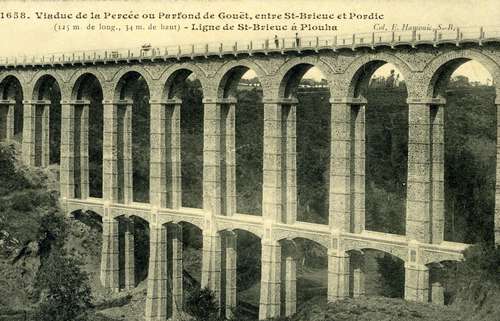
Viaduc du Parfond du Gouët is a former railway viaduct straddling the border of Pordic and Plérin, in the Côtes-d'Armor department of Brittany. Built in 1904, it now serves walkers and cyclists as part of a scenic coastal route.
What is this place?
Also known as the Viaduc de la Percée, the structure was completed in 1904 to a design by engineer Louis Harel de la Noë. It was built for the Côtes-du-Nord departmental railway network, a project meant to open up Brittany's rural areas and coastline to rail transport. The viaduct spans the valley of the Gouët river, known locally as Parfond du Gouët, which gave the structure its name.
It is one of thirteen similar viaducts Harel de la Noë built between 1903 and 1904 using his standardized stone-masonry design, known as the Grognet type. Among all of these structures, this one stands out as the tallest, rising 34 meters above the valley floor. The viaduct stretches 124 meters in length and rests on thirteen stone arches, each spanning roughly 7 meters. The rail line it carried remained in service until 1956, when it closed along with the wider decline of the departmental railway network.
How do you get there?
The viaduct sits on the boundary between Pordic and Plérin, close to the Côtes-d'Armor coastline near Saint-Brieuc. By car, local roads lead toward the Gouët valley, with nearby parking areas offering an easy walk or ride to the structure itself. Its coordinates are 48.5579, -2.7975.
What will you see?
For years, walking across the viaduct was forbidden due to the condition of the structure. Following a renovation completed before 2010, it reopened to pedestrians and cyclists. Walking along the old rail bed, visitors get a close-up view of the stone arches and a sweeping look at the wooded valley below — a striking sight from 34 meters up. It's also a chance to see early 20th-century railway engineering from the region, preserved in something close to its original form.
Today the viaduct forms part of the Vélomaritime cycling route, roughly 40 kilometers long, connecting Hillion and Pordic along the coast. It's a popular stretch both for cyclists covering longer distances and for anyone after a quiet walk with a view.
When should you visit?
The viaduct can be visited year-round, as it's an open-air structure with no set opening hours. Spring and summer are best for longer rides along the full Vélomaritime route, while autumn and winter give the Gouët valley a quieter, more intimate feel — a good pick for visitors who prefer fewer crowds.
Frequently Asked Questions
Can visitors walk across the viaduct? Yes, it has been open to pedestrians and cyclists since a renovation completed before 2010. Before that, crossing it was forbidden.
How tall is the viaduct? It stands 34 meters high, making it the tallest of the thirteen similar viaducts engineer Harel de la Noë built between 1903 and 1904.
What was it originally used for? It carried a line of the Côtes-du-Nord departmental railway network until the line closed in 1956.
Can you reach it by bike? Yes, the viaduct lies along the Vélomaritime route, which links Hillion and Pordic over roughly 40 kilometers of coastline.
Nearby places

Earn badges for the places you visit
Download NextOnTrip, discover new places and check off your trails.