About this place
Valderejo Natural Park stretches across a wide valley enclosed by limestone hillsides in the westernmost corner of Álava, right on the border with the province of Burgos, in the Basque Country. Declared a protected natural park in 1992, it has since become one of the best-preserved corners of Basque nature.
What defines the valley?
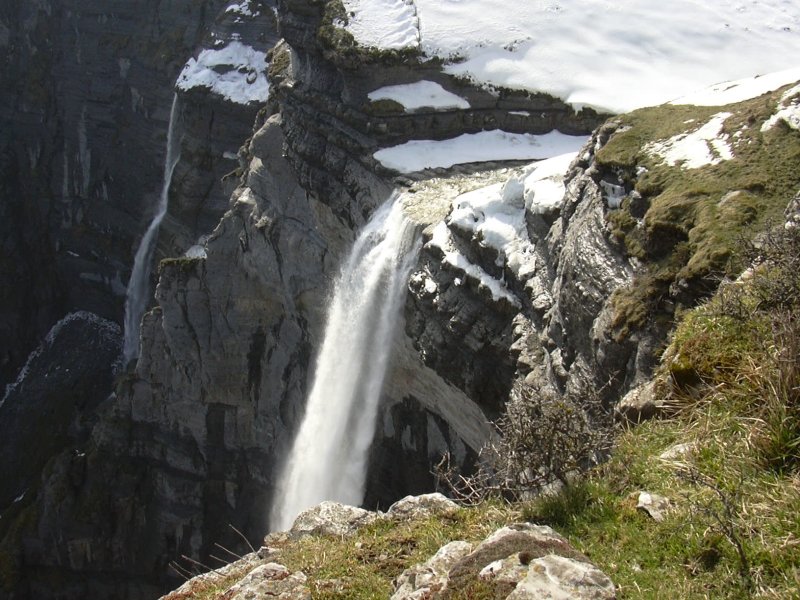
The heart of the park is the gorge carved by the Purón river, cutting between steep, rock-topped slopes. For centuries this gorge carried an important route linking Frías, in Burgos, with the port of Orduña — traces of an old Roman road, once used for trade and military communication between the two regions, can still be found here. The valley itself, ringed by rocky hills, forms a natural amphitheater crossed by nine marked walking trails of varying difficulty.
What plants and animals live here?
The landscape is shaped mainly by forests of Scots pine, accompanied by holm oak woodland, beech stands, and small pockets of gall-oak. Along the watercourses grow elms, willows, and hazel trees, forming a rich riverside belt of vegetation.
Valderejo is especially known for its birdlife — it is home to one of the largest colonies of griffon vultures in the entire Basque Country, making the park a popular destination for bird-watching. Alongside the vultures, visitors may spot golden eagles, hawks, and crossbills. Among the mammals found here are squirrels, wildcats, roe deer, and wild boar, with wolves occasionally passing through.
What historical traces does the park hold?
The Valderejo valley has been inhabited since ancient times, a fact reflected in its cultural and architectural heritage. Megalithic monuments survive here, including the San Lorenzo burial mound and the monolith on Mount Lerón, alongside churches and hermitages built across different historical periods. Valderejo itself was once an independent municipality, remaining self-governing until 1966, when it was absorbed into the municipality of Valdegovía (known in Basque as Gaubea).
Frequently asked questions
Can you go hiking in the park? Yes, nine marked walking trails cross the park, suited to different levels of difficulty, allowing visitors to explore both the Purón river gorge and the higher stretches of the valley.
What is the park's biggest natural attraction? Without doubt, its colony of griffon vultures — one of the largest in the Basque Country — which has made the park a well-known spot for bird-watchers.
Are there historical monuments in the park? Yes, the valley preserves megalithic sites (the San Lorenzo burial mound, the Lerón monolith) as well as churches and hermitages that testify to centuries of settlement in the area.
What role did the Purón gorge play historically? The gorge once carried a Roman road connecting Frías with the port of Orduña, serving as an important communication and trade route between Burgos and the coast.
Nearby places

Earn badges for the places you visit
Download NextOnTrip, discover new places and check off your trails.