About this place
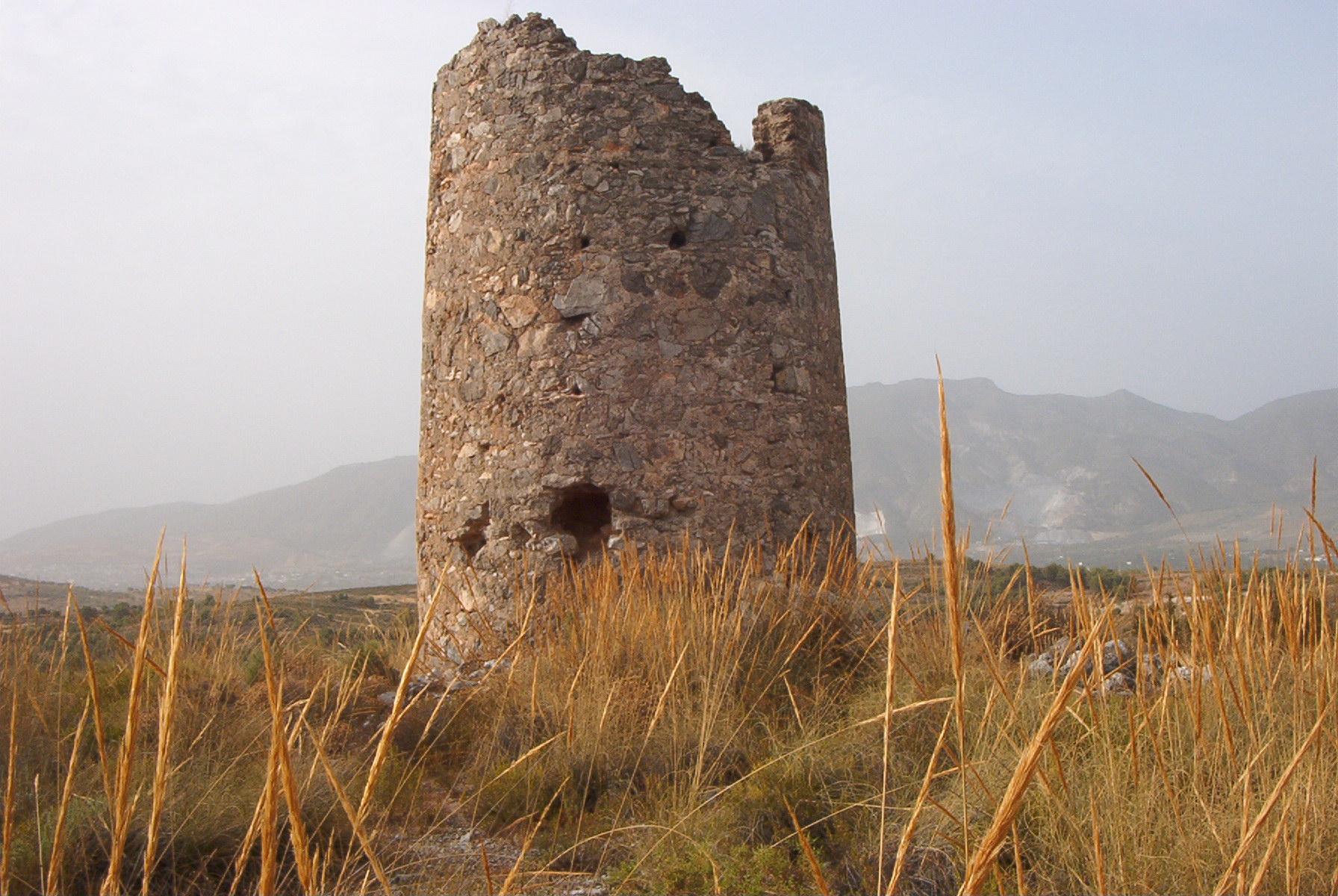
Torre de Cónchar is a medieval watchtower in the municipality of Villamena, set in the Valle de Lecrín in Granada province. Also known as Atalaya de Cónchar, it belonged to a network of signal towers raised during the Nasrid period, the last stretch of Muslim rule on the Iberian Peninsula.
What kind of building is it?
Unlike a castle, Torre de Cónchar was never meant to house a garrison. It is an atalaya, a lookout tower built to relay light or smoke signals between watch points scattered across the valley. The structure has a circular, truncated-cone plan and was built in masonry (mampostería). Its surviving height today is roughly 6.5 metres, and patches of the original exterior render are still visible on parts of the wall.
Two brick-lined openings remain in the structure. The upper one may have worked as a door-window, giving the watchman access to the interior and a vantage point over the surroundings. The second is a loophole with a flared, funnel-like profile — a common defensive feature of the period, designed to let a lookout scan the terrain while limiting exposure to anyone approaching from outside.
Where is it and how do you get there?
The tower stands along the route linking the villages of Cónchar and Cozvíjar, both part of the Villamena municipality in the Valle de Lecrín. Its coordinates are approximately 36.978, -3.600. Because it sits outside the built-up centre of either village, a car is the most practical way in: the local road connecting the two settlements passes near the tower, and the final stretch is on foot. There is no regular public transport to the site, so it works best as a stop on a self-driven route through the Lecrín valley rather than a standalone destination.
What will you see on site?
Despite its modest size, the tower's clean conical silhouette and the surviving traces of render make an impression up close. Look closely at the two openings in the wall — it is easy to picture a watchman scanning the valley from there, waiting for a signal from a neighbouring post. That network of mutual visibility is really what gives the site its meaning: from Torre de Cónchar there is a clear line of sight to the Castillo de Dúrcal, to Torre de Marchena, and to the atalaya at Saleres. Together, these towers formed an early-warning system that covered the entire Valle de Lecrín.
The surrounding landscape is classic Sierra Nevada foothill country — terraced slopes, orchards, and views over the neighbouring hills. It is a good spot to pause and take in the valley from roughly the same vantage point its medieval watchmen once had.
When is the best time to visit?
The tower stands in open country with no shade or shelter nearby, so spring and autumn bring the most comfortable conditions in this part of Andalusia. In summer, an early-morning visit is worth planning before the heat builds up. Winters in the valley tend to be cool but largely dry, which makes for good walking and photography conditions around the site.
Frequently asked questions
Is Torre de Cónchar a castle? No. It is an atalaya, a watch-and-signal tower built for surveillance and communication rather than permanent habitation or garrison defence.
How old is the tower? Archaeologists date it broadly to the Nasrid period, the final centuries of Muslim rule in Andalusia before the conquest of Granada in 1492.
Can you go inside the tower? The site is a protected piece of cultural heritage, so visits are generally limited to viewing the structure and its surviving openings from the outside.
Which other towers did it communicate with visually? It kept sightlines to the Castillo de Dúrcal, to Torre de Marchena, and to the atalaya at Saleres, together covering the whole Valle de Lecrín.
Nearby places

Earn badges for the places you visit
Download NextOnTrip, discover new places and check off your trails.