About this place
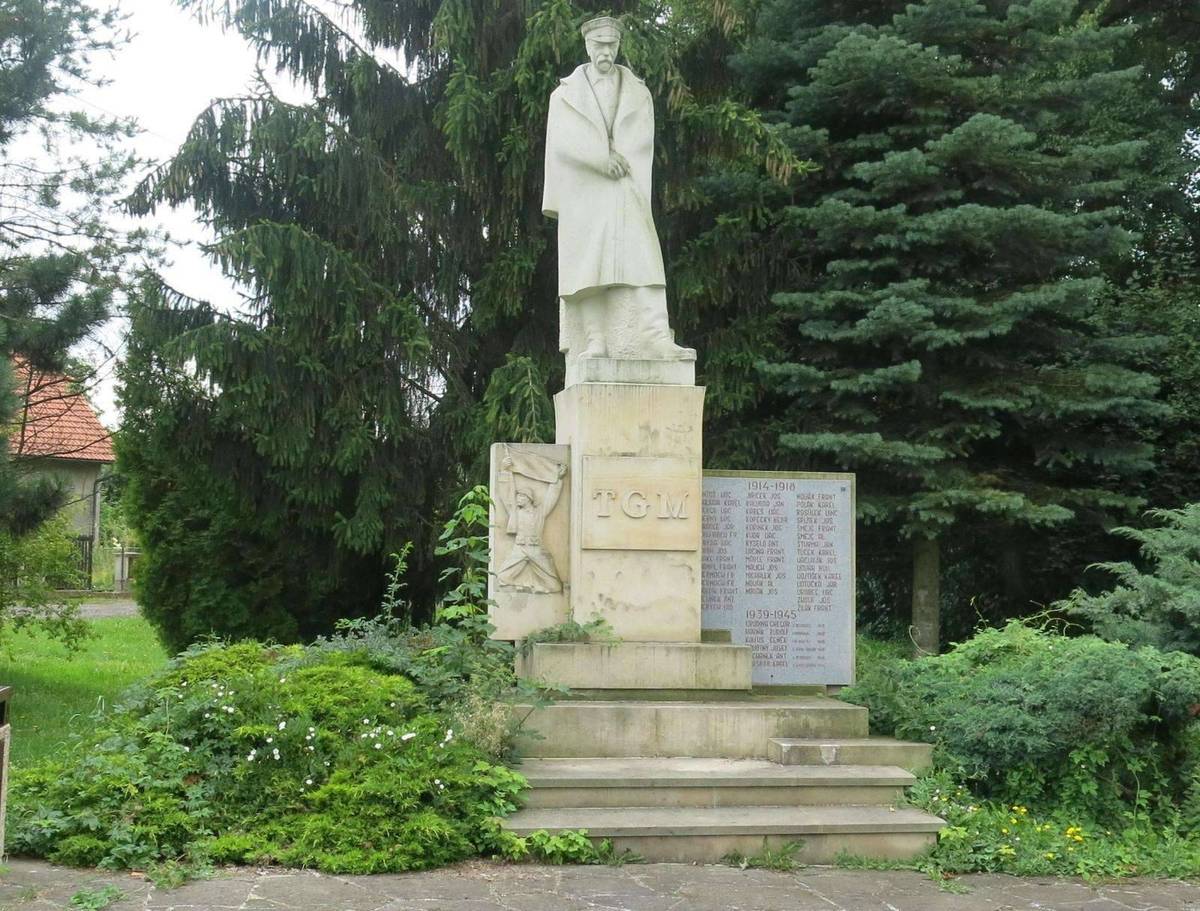
The Tomáš Garrigue Masaryk Monument stands on the bank of the Javorka stream beside road No. 35, right where the village of Sylvárův Újezd borders neighbouring Ostroměř, in the Jičín district of the Hradec Králové Region. It is not a plain statue of Czechoslovakia's first president — its pedestal also carries a plaque listing local victims of both world wars, which is why heritage records classify the object simply as a war memorial.
Who was Masaryk, and why does he have a monument here?
Tomáš Garrigue Masaryk was a Czechoslovak statesman, political activist and philosopher who served as the first president of Czechoslovakia from 1918 to 1935. He is regarded as the founding father of Czechoslovakia and was widely known by the nickname "TGM." After independence, statues of him were raised in hundreds of Czech towns and villages as a symbol of the new state — this monument near Ostroměř is one of them.
A pedestal with a turbulent history
The story of this monument is, in miniature, the story of twentieth-century Czechoslovakia. The original statue of Masaryk was taken down during the German occupation, when the new authorities removed symbols of independent Czechoslovakia from public space. It was re-unveiled in 1946, only to be removed again in 1953 under the communist regime, which saw Masaryk as a symbol of pre-war democracy incompatible with the new ideology — the statue was destroyed and the pedestal stood empty for almost four decades. The current, third statue was unveiled only in 1991, shortly after the Velvet Revolution, once Czechoslovakia could once again openly commemorate its first president. The monument is associated with the name of Ladislav Zívr (1909–1980), a respected Czech sculptor and a member of the postwar Group 42.
What else does the monument commemorate?
Alongside the figure of the president, the pedestal carries a plaque with the names of local residents who died in the First and Second World Wars. This combination — a symbol of national independence and a local roll of war dead — explains why official descriptions list the site as a "war memorial" rather than purely a Masaryk statue. For a visitor, that means the site carries a double meaning: a national symbol and a local place of remembrance in one.
Where is it and how do you get there?
The monument stands on the bank of the Javorka stream, right next to road No. 35 connecting the Jičín area with the Nová Paka region, at an elevation of around 262 metres above sea level. Sylvárův Újezd itself is a tiny village first documented in 1397; today it has around 45 residents, down from over two hundred in the late 19th century. Since 1976 it has administratively belonged to the municipality of Ostroměř, about 2.5 km to the north. The surroundings are quiet countryside, so the monument is best combined with a visit to Ostroměř itself or a stop while passing through the region.
Frequently Asked Questions
Is this a monument to Masaryk himself, or a war memorial? Both — the statue depicts Masaryk, but the pedestal also bears a plaque with the names of First and Second World War casualties, which is why it is officially classified as a war memorial.
Why does the current statue only date from 1991? Because earlier versions were removed twice for political reasons — first during the German occupation, then in 1953 under the communist regime. The present statue was unveiled after the Velvet Revolution.
Where exactly is the monument located? On the bank of the Javorka stream, beside road No. 35, right on the boundary between Sylvárův Újezd and Ostroměř.
Is there anything else to see nearby? Yes — Sylvárův Újezd itself has a separate memorial to First World War victims from 1928 (a sandstone pyramid with a kneeling, weeping woman) and a statue of St. John of Nepomuk.
Nearby places

Earn badges for the places you visit
Download NextOnTrip, discover new places and check off your trails.