About this place
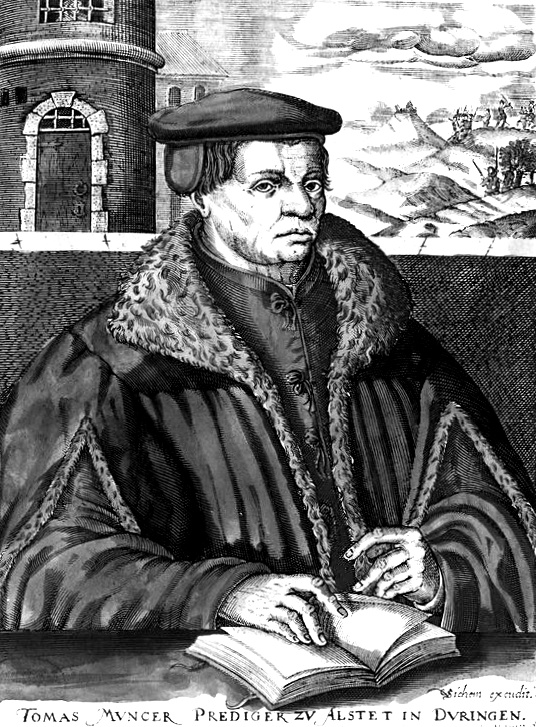
Thomas Müntzer Monument in Zwickau
The Thomas Müntzer monument stands in front of the Katharinenkirche (St. Catherine's Church) in Zwickau, marking a short but pivotal chapter in the life of this early Reformation preacher. It was in this church that Müntzer delivered sermons in late 1520 and early 1521, and the experiences of that brief stay shaped the increasingly radical path he followed until his death in 1525.
Who was Thomas Müntzer, and why did he come to Zwickau?
Thomas Müntzer, a theologian who began his career in the Catholic Church, aligned himself in the early 1520s with the Reformation movement launched by Martin Luther. He arrived in Zwickau in October 1520, recommended by Luther himself, and was welcomed by the city council as a preacher at the Katharinenkirche. His time there was brief, however — he left the city in April 1521, after less than half a year.
What happened in Zwickau that changed Müntzer's views?
In Zwickau, Müntzer came into contact with a lay preaching movement centered on the clothmaker Nikolaus Storch, later known as the Zwickau Prophets. Exposure to this circle, which took a critical view of parts of established sacramental practice, reinforced Müntzer's conviction that genuine Christian faith had to carry consequences for political and social life, not remain confined to the spiritual realm. These encounters marked the beginning of his growing distance from Luther's more compromising stance toward feudal authority, a divergence that eventually led him to become the leading ideologue of the German Peasants' War of 1525.
What does the monument look like, and when was it made?
The bronze monument in front of the Katharinenkirche was created by sculptor Jürgen Raue and unveiled on 20 May 1989, to mark the 500th anniversary of Müntzer's birth. The figure is shown with his face turned slightly upward, robes flowing as if caught mid-motion, in a pose meant to convey the energy of a preacher absorbed in delivering his message. In the following decades, the city of Zwickau commissioned conservation work on the statue, including cleaning and protective treatment of the bronze surface.
Why is the Katharinenkirche an important Reformation heritage site?
The Katharinenkirche, next to which the monument stands, belongs to the network of "Sites of the Reformation" awarded the European Heritage Label in 2014. Müntzer's brief but intense episode in Zwickau is one of the reasons the church holds a distinct place in the history of the early Reformation in Germany, alongside its ties to Luther's own story.
Who was Müntzer beyond his time in Zwickau?
After leaving Zwickau, Müntzer continued preaching and developing his theology in other German towns, including Allstedt and Mühlhausen, where his conflict with Luther and his opposition to feudal authority reached their most radical form. He was married to Ottilie von Gersen, with whom he had two sons. He was killed in 1525 following the defeat of the peasant uprising he had helped lead.
Frequently asked questions
Where exactly does the Thomas Müntzer monument stand? In front of the Katharinenkirche (St. Catherine's Church) in the center of Zwickau.
Who made the monument, and when was it unveiled? Sculptor Jürgen Raue, unveiled on 20 May 1989 for the 500th anniversary of Müntzer's birth.
How long did Müntzer stay in Zwickau? About six months, from October 1520 to April 1521, serving as a preacher at the Katharinenkirche.
Why is Müntzer's stay in Zwickau considered significant? It was there that he encountered the Zwickau Prophets movement, an experience that fed his growing radicalism and eventual break with Luther.
Are there other monuments to Müntzer elsewhere? Yes, Müntzer is also commemorated in other towns tied to his life, such as Mühlhausen and Stolberg, but the Zwickau monument specifically marks his preaching episode at the Katharinenkirche.
Nearby places

Earn badges for the places you visit
Download NextOnTrip, discover new places and check off your trails.