About this place
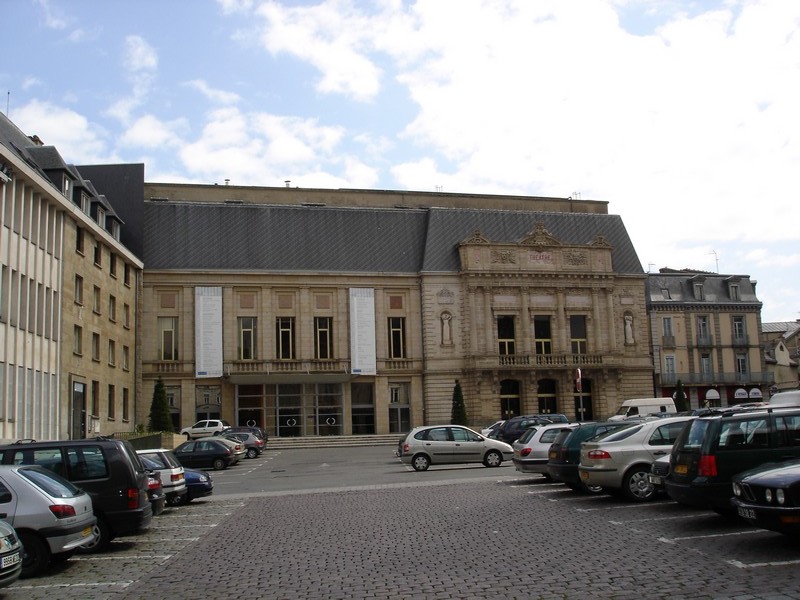
Théâtre de Saint-Brieuc is the historic municipal theatre standing in the center of Saint-Brieuc, the capital of the Côtes-d'Armor department in Brittany. This small, intimate Italian-style hall is one of the few surviving examples of this kind of theatre architecture in the region, and it has been officially protected as a French historic monument for several decades.
Where did this theatre come from?
The first theatre on this site was built between 1809 and 1811, designed by the Parisian architect Guillot. It served the town for most of the 19th century until a fire destroyed it in 1875. Reconstruction began a few years later, in 1879, this time overseen by Alexandre Angier, the town's own architect. The new building was formally inaugurated in 1884, and it is that same structure that still stands in Saint-Brieuc today.
What will you see, inside and out?
The front facade follows a neoclassical layout: a ground floor, an upper floor and an attic level arranged in a clear, symmetrical composition, with the entrance doors and foyer windows grouped together at the center of the front. It's a modest but elegant front, typical of French municipal theatres built in the second half of the 19th century.
The real reason to step inside, though, is the auditorium itself. The hall is elliptical in plan — the classic "Italian-style" layout — and seats around three hundred people, making it intimate compared with the grand opera houses of the same era. The ceiling is painted with a sky scene featuring four allegorical figures: Music, Dance, Comedy and Tragedy. The decoration of the foyer and the hall was carried out by Carpezat and Lavastre, the artists responsible for the interior finishes. The whole ensemble was clearly inspired by Parisian projects of the period, including the Opéra Garnier, though naturally on a much smaller scale.
The Saint-Brieuc theatre is considered one of the few surviving small Italian-style theatres in Brittany with such a rich interior decorative programme — that rarity is precisely what draws the attention of architecture enthusiasts, not just theatre-goers. Since 1996 the building has been listed on France's supplementary inventory of historic monuments (inventaire supplémentaire des monuments historiques), formally recognizing its historical and architectural value.
How to get there, and when to visit?
The theatre stands in central Saint-Brieuc, in an easily walkable part of town, close to the department capital's other heritage sites — a visit can easily be combined with a stroll to Saint-Étienne Cathedral or the old town. Saint-Brieuc has its own train station with direct connections to Paris, Rennes and Brest, making it a convenient base for exploring this part of Brittany.
The best time to visit depends on what you're after: the exterior and facade can be admired year-round, but to see the auditorium from the inside, it's worth checking the local cultural programme and catching a performance or an event open to the public — that's the surest way to see the painted ceiling and the decorated hall in person.
Frequently asked questions
Is today's theatre building the same one built in 1811? No. The original 1809–1811 theatre burned down in 1875. The building standing today was constructed between 1879 and 1884 to a design by architect Alexandre Angier.
How many people does the auditorium hold? The elliptical, Italian-style hall seats around three hundred spectators.
What's the most distinctive feature of the theatre's interior? The painted ceiling with allegorical figures of Music, Dance, Comedy and Tragedy, along with the foyer decoration by Carpezat and Lavastre.
Is the theatre a protected historic monument? Yes, it has been listed on France's supplementary inventory of historic monuments since 1996.
Earn badges for the places you visit
Download NextOnTrip, discover new places and check off your trails.