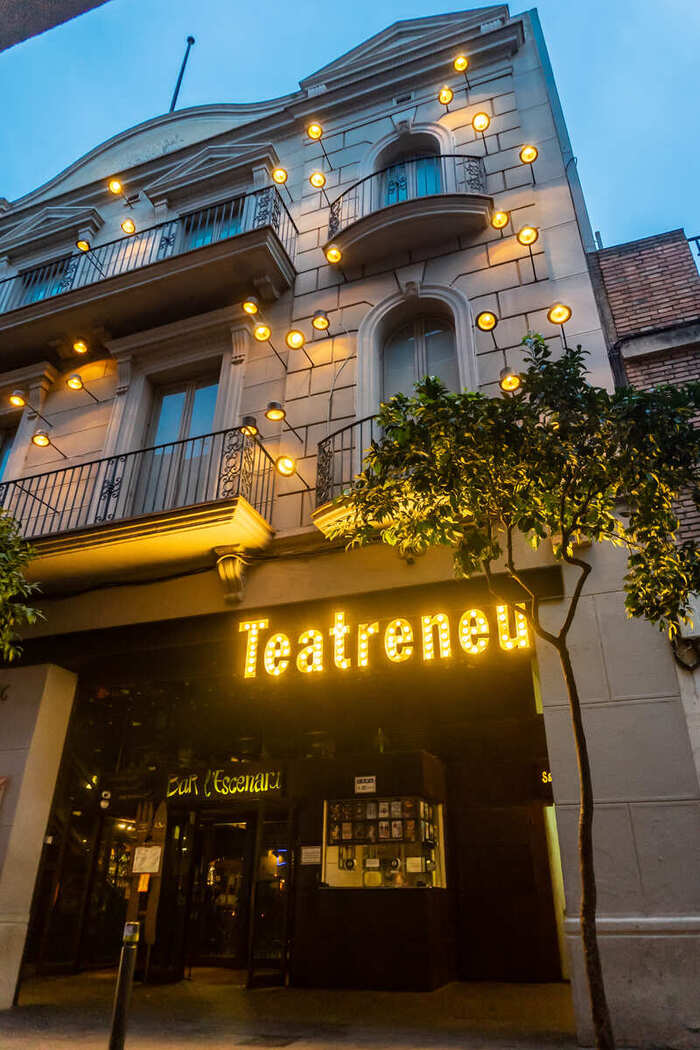
About this place
Teatreneu is one of Barcelona's best-known comedy venues, tucked into the lively Gràcia neighborhood. Open since 1988 on Carrer de Terol 26-28, it has built a loyal following for stand-up, improv, cabaret, and musical theatre, drawing both locals and visitors keen to see a side of Barcelona nightlife well away from the main tourist trail.
Where is Teatreneu and how do you get there?
Teatreneu sits in the heart of Gràcia, a district known for narrow streets, small squares, and a neighborhood feel that contrasts with the more polished city center. The nearest metro stops are Fontana or Diagonal on line L3, both a short walk from the theatre. The surrounding streets are packed with bars and restaurants, making it easy to build a full evening around a show — dinner before or drinks after.
What can you see at Teatreneu?
The building holds three separate halls, the largest seating up to 360 people, which keeps Teatreneu on the more intimate end of Barcelona's theatre scene despite its packed calendar. Around 30 performances take place here every week, spanning stand-up monologues, improvised theatre, cabaret, musical shows, magic acts, and family-friendly productions. The lineup rotates often, so it's worth checking the current schedule before booking, especially if you're looking for a show that doesn't rely on fluent Spanish or Catalan.
The theatre's name honors Xavier Fàbregas i Surroca, a Catalan theatre critic and historian regarded as one of the most influential figures in 20th-century Catalan theatre.
Why did Teatreneu become internationally famous?
In 2014, Teatreneu ran an experiment that made headlines worldwide: the "Pay per Laugh" system. Entry was free, but every seat was fitted with a tablet using facial-recognition technology to count how many times each guest laughed during the show. Every registered laugh cost 0.30 euros, capped at a maximum of 24 euros per performance.
The idea was a direct response to a Spanish tax hike on theatre tickets, which jumped from 8% to 21% and hit attendance hard. The campaign's logic was simple: if people are paying for entertainment, they should pay in proportion to how much they actually enjoyed it. The results outperformed expectations — revenue per show rose from around 4,400 to 7,200 euros, the number of people queuing to attend increased by 35%, and the average amount paid per ticket climbed by nearly 6 euros. The concept went on to inspire similar pricing experiments at other comedy venues across Spain.
When is the best time to catch a show?
Teatreneu programs shows throughout the week, with the fullest lineup typically on Friday and Saturday nights, when the biggest improv and comedy productions take the stage. Visitors without Spanish or Catalan should look for physical formats — improv, acrobatics, magic — which work well without understanding the dialogue. Booking ahead is worth it for the long-running improv shows, which have built a steady, returning audience over the years.
Frequently asked questions
Is Teatreneu suitable if you don't speak Spanish? Partly — shows built around physical comedy, music, or visual improv are enjoyable without language skills, but stand-up monologues and verbal cabaret require solid Spanish or Catalan comprehension.
Does the "Pay per Laugh" system still operate? No — the 2014 experiment was a time-limited campaign responding to a specific ticket tax hike, not a permanent pricing model. The theatre now runs on standard ticket sales.
How many people can Teatreneu hold? The largest of its three halls seats up to 360 people, making Teatreneu one of the smaller, more intimate theatres in Barcelona.
Where does the name Teatreneu come from? It pays tribute to Xavier Fàbregas i Surroca, a Catalan theatre critic considered one of the key figures of 20th-century Catalan theatre.
Nearby places

Earn badges for the places you visit
Download NextOnTrip, discover new places and check off your trails.