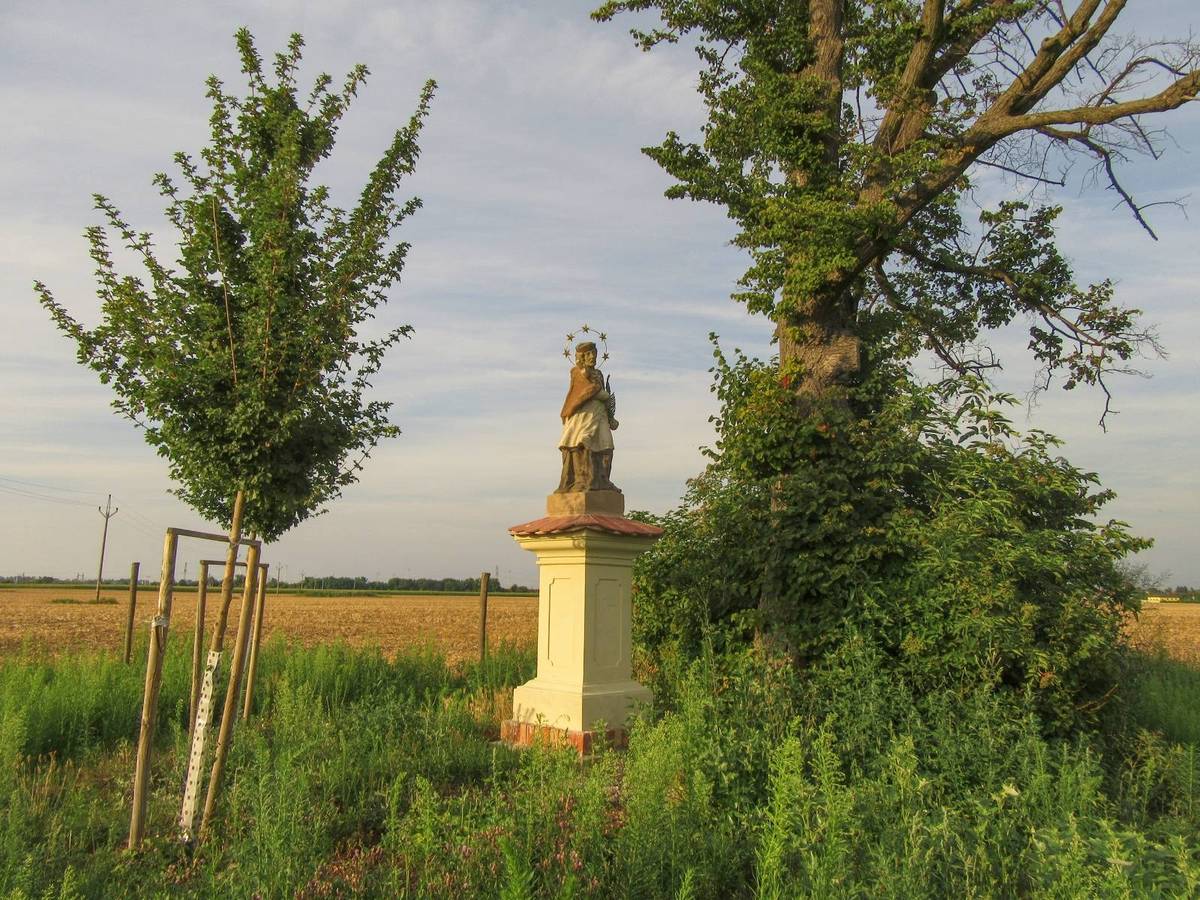
About this place
The statue of St. John of Nepomuk stands along the old road leading from Lanžhot to Břeclav, near the point where the route once crossed a branch of the Malá Caja watercourse. It is one of the few surviving markers of the historical road network that fanned out from the town toward the surrounding countryside in South Moravia.
When was the statue built?
The figure dates back to 1744. This is confirmed by a surviving revers — a written pledge made by the Lanžhot municipality that same year, committing to the upkeep of the statue. The existence of such a formal document indicates that the town treated the monument as a permanent civic responsibility from the outset, rather than a casual roadside shrine.
The road connecting Lanžhot to the statue used to be called Hluboká — a name recalling a deep ravine that once cut through the terrain at that spot. The ravine has long since been leveled by changes to the landscape, but the name, and the memory of the old route, survive in local tradition.
What role did it play in town life?
The statue was never purely decorative. It formed part of the town's religious calendar through the Rogation Days, the supplicatory processions held before the feast of the Ascension. On the second day of these processions, the route led from the parish church to a wayside shrine of Divine Mercy in Sůhrady, and from there along the Hluboká and Vrbková paths to the statue itself, known locally simply as "u Jana" ("at John's"). The procession stitched together several sacred waypoints scattered around the town, with the statue serving as one of its fixed stops.
Why St. John of Nepomuk specifically?
St. John of Nepomuk, a 14th-century Bohemian priest, remains one of the most frequently depicted saints across the Czech and Moravian lands — his statues stand watch over bridges, roads, and squares in nearly every sizeable town in the region. Placing his likeness at this spot on the Lanžhot–Břeclav road reflects a common 18th-century practice: figures of the saint were erected along key travel routes to watch over travelers and to mark sensitive points along the way, such as crossings over ravines or streams.
What can visitors see today?
The site itself — on the former route to Břeclav, close to where it once met the Malá Caja branch — still allows visitors to trace the outline of the historical road network radiating from Lanžhot, even though the surrounding landscape has changed considerably since the 18th century. For anyone interested in local history or the tradition of Rogation Day processions, the statue offers a tangible link between the town's sacred topography and its older road system.
Frequently asked questions
When was the statue erected? In 1744, as confirmed by a surviving municipal document (revers) concerning its maintenance.
Where exactly does it stand? Along the former road from Lanžhot to Břeclav, near where it once crossed a branch of the Malá Caja watercourse, on the stretch historically known as Hluboká.
What role did it play in local tradition? It was one of the stops on the Rogation Day procession, which ran from the parish church via the Divine Mercy shrine in Sůhrady to the statue known as "u Jana."
Does the original road to the statue still exist? The name Hluboká has survived, but the deep ravine that gave the road its name is no longer visible in the terrain today.
Nearby places

Earn badges for the places you visit
Download NextOnTrip, discover new places and check off your trails.