- Sacred Monuments
- Religious monuments
Statues of John of Matha, Felix of Valois and Saint Ivan, Charles Bridge
About this place
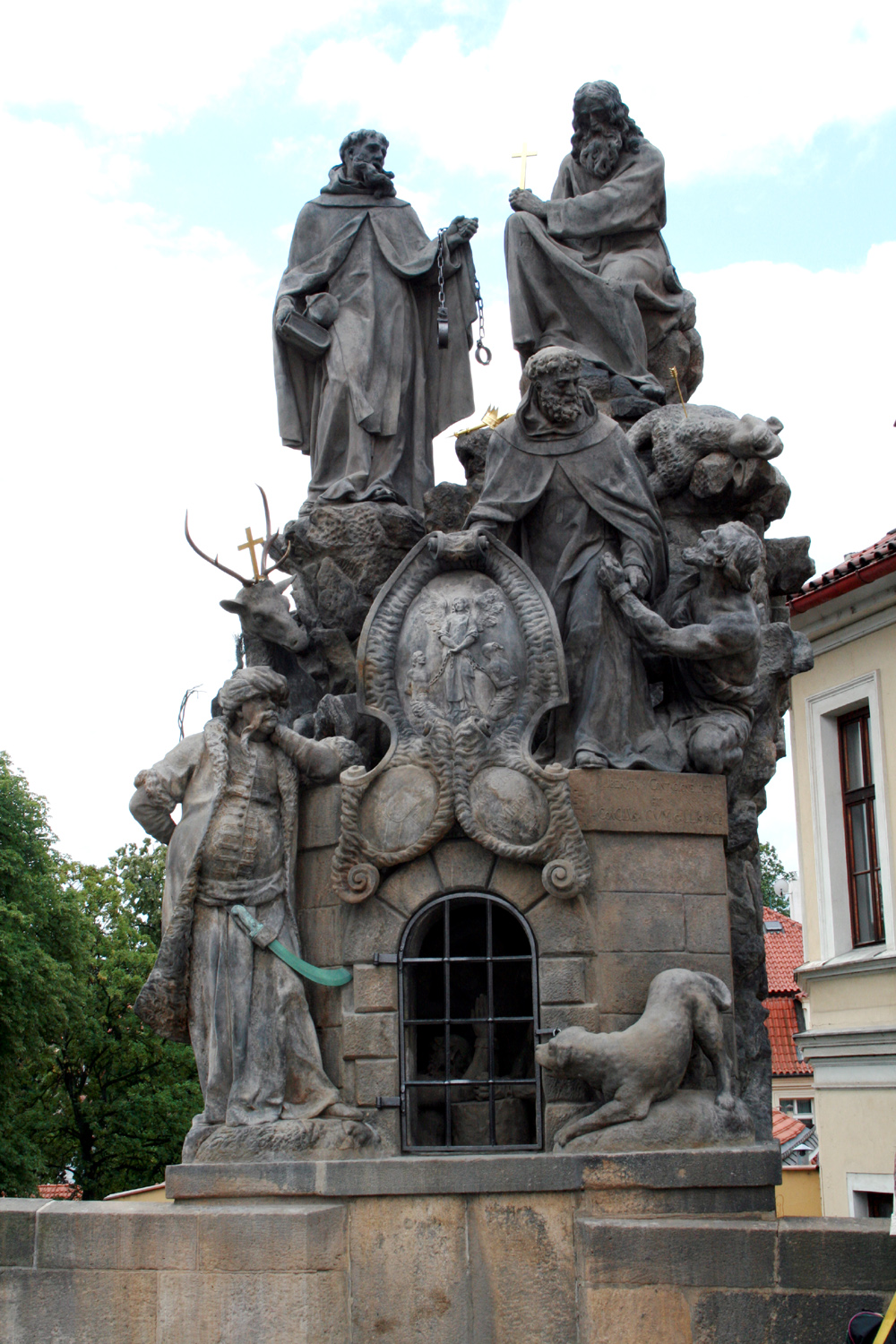
The statue group of Saints John of Matha, Felix of Valois and Ivan is one of the most elaborate and dramatic sculptural compositions on Prague's Charles Bridge — a Baroque work by Ferdinand Maxmilián Brokoff, installed on the bridge's south side in 1714.
Where exactly does the monument stand?
The sculpture stands on the south balustrade of Charles Bridge, among the Baroque statues of saints added to the crossing around the turn of the 18th century. Its coordinates are 50.086997, 14.407663. It is one of the more elaborate compositions on the bridge, worth a longer look than the single-figure statues nearby since it tells a layered story rather than depicting one saint alone.
Who made it and who paid for it?
The work is by Ferdinand Maxmilián Brokoff, one of the leading sculptors of Prague Baroque, whose statues appear at several points along the bridge. It was commissioned and financed by Count František Josef Thun on behalf of Prague's Trinitarian monastery. Given its size and complexity, it ranks among the most expensive statues ever installed on the bridge, and it underwent a thorough restoration in 2007.
Who is depicted in the monument?
The composition brings together three figures with quite different backgrounds. John of Matha and Felix of Valois were French clergymen who in 1198 founded the Trinitarian Order (Order of the Most Holy Trinity), approved by Pope Innocent III, with the mission of ransoming Christians held captive by Muslim raiders, chiefly in territory under Ottoman Turkish control. The third figure, Saint Ivan, has no direct connection to the order's founders — he was a ninth-century Bohemian hermit, venerated as a patron saint of the Slavs, added as a local Czech reference within a monument otherwise dedicated to a French religious order.
What does the lower part of the sculpture show?
The most distinctive feature of the monument is its pedestal, shaped as a cave. Inside it, three Christian captives are shown in chains, guarded by an armed figure in Turkish dress accompanied by a dog, holding a weapon (originally a spear, since replaced) and a sabre. Above this scene stand John of Matha and Felix of Valois: John holds a purse of money and a broken pair of chains, while Felix is shown freeing one of the prisoners — together the figures spell out the Trinitarians' mission at a glance, captives ransomed and freed in exchange for the order's money.
Why did this scene end up on Charles Bridge?
During the Baroque period, Charles Bridge served as Prague's principal open-air gallery of religious sculpture, lined with statues tied to the city's various orders, brotherhoods, and institutions. The Trinitarian monastery's commission follows that same pattern: the order wanted a clear visual account of its mission displayed in Prague's most prominent public space, seen daily by thousands of people crossing the bridge.
Who was Saint Ivan?
Saint Ivan is a ninth-century figure regarded as one of the first hermits in Bohemia. According to later medieval accounts, he belonged to the Slavic aristocracy and gave up a prominent position at court to live in solitude on Bohemian soil. After his death from natural causes, he is said to have been buried by Saint Ludmila, one of the central figures of early Czech Christianity. He came to be venerated as a patron saint of the Slavs, though the exact date of his canonization is unknown.
Frequently asked questions
When was this statue group created? In 1714, part of the main wave of Baroque statues added to Charles Bridge between 1683 and 1714.
Who sculpted it? Ferdinand Maxmilián Brokoff, one of the leading sculptors of Prague Baroque.
Who paid for the monument? Count František Josef Thun, on behalf of Prague's Trinitarian monastery.
Why does one monument combine three different saints? John of Matha and Felix of Valois founded the Trinitarian Order, dedicated to ransoming Christian captives, while Saint Ivan is a Bohemian hermit added as a local reference with no direct link to the order's history.
What does the scene at the base of the monument represent? A cave holding three chained Christian captives guarded by a Turkish-dressed figure with a dog — illustrating the Trinitarians' mission of ransoming captives from Muslim raiders.
Where exactly on the bridge should visitors look for it? On the south side of Charles Bridge, among the other Baroque statues of saints.
Nearby places

Earn badges for the places you visit
Download NextOnTrip, discover new places and check off your trails.