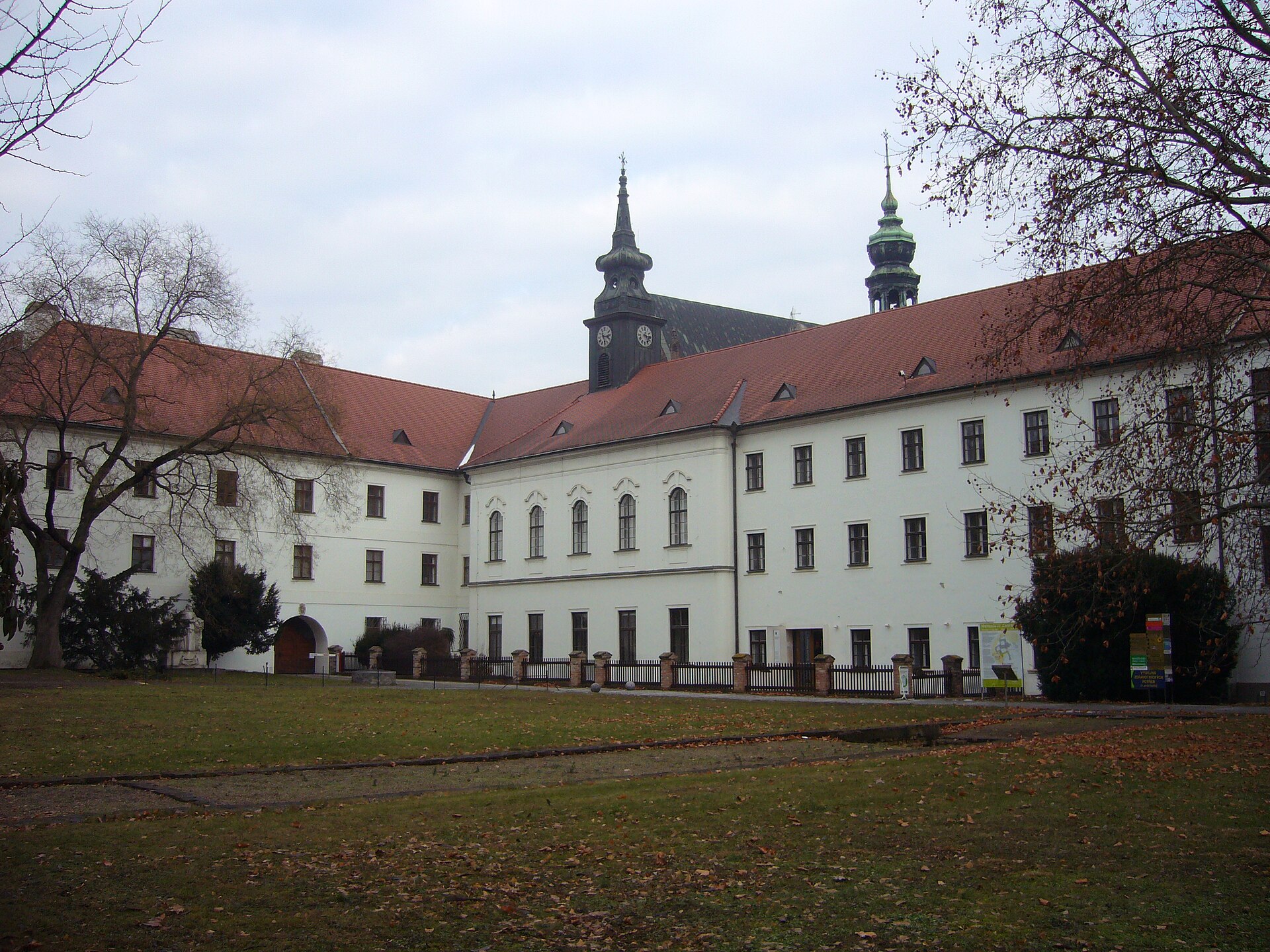
About this place
St Thomas's Abbey in Brno is an Augustinian monastery in the Czech city of Brno, best known as the place where the friar and later abbot Gregor Mendel carried out his groundbreaking genetic experiments on pea plants. It was in the monastery garden here that the foundations of modern genetics were laid.
Where did the Augustinian abbey in Brno come from?
The Augustinians arrived in Brno in 1346, and two years later the Margrave of Moravia, John Henry of Luxembourg, began building their original cloister on what is now Moravian Square (Moravské náměstí), next to St Thomas's Church. The order remained at this site for more than four centuries, until the Josephine reforms of 1783, when imperial authorities confiscated the monastery attached to St Thomas's Church. In exchange, the Augustinians were given the former Cistercian convent in Old Brno, founded in 1323 by Elizabeth Richeza, the Czech and Polish queen dowager. It was to this new location that the monks relocated, carrying the name of St Thomas's Abbey with them.
Why is this place associated with Gregor Mendel?
The abbey's most famous religious figure was Gregor Mendel, a friar and later abbot, who between 1856 and 1863 conducted his experiments on pea plants in the monastery garden in Old Brno. His observations led him to formulate two generalizations about the inheritance of traits, known today as Mendel's Laws of Inheritance — the foundation on which modern genetics is built. The Augustinian order remained active at the Old Brno site continuously until 1950, when its activities were banned by Czechoslovakia's communist authorities.
What can visitors see on the abbey grounds?
At the heart of the monastery complex stands the Basilica of the Assumption of the Virgin Mary, built in the Silesian Gothic style characteristic of the region, distinguished by its use of unplastered red brick as a building material. The former abbey grounds today house the Mendel Museum of Masaryk University, dedicated to the scientist and abbot, including the garden where he carried out his experiments. Alongside it operates the Museum of the Old Brno Monastery (MUSO), which traces the site's nearly seven-hundred-year history, from its origins as a Cistercian convent through the arrival of the Augustinians to the present day.
Frequently asked questions
Is St Thomas's Abbey the same place as the Mendel Museum? The history here is layered. The name "St Thomas's Abbey" originally referred to the monastery attached to St Thomas's Church on Moravian Square. Following the Josephine reforms of 1783, the religious community relocated to the former Cistercian convent in Old Brno, keeping its name. It was at this Old Brno site that Mendel carried out his experiments, and it is there that the museum dedicated to him is located today.
Where exactly is the abbey located? The monastery complex lies in the Old Brno (Staré Brno) district, in the southern part of the city.
Is the Augustinian order still active at the site? The Augustinian community was active at the Old Brno abbey continuously from 1783 until 1950, when its activities were prohibited by the communist authorities. Today the former monastery grounds serve primarily a museum and educational function.
Why were Mendel's experiments so significant? By observing how traits were passed down across generations of pea plants grown in the monastery garden, Mendel was the first to formulate mathematical rules governing the inheritance of hereditary traits. Though his work was only widely recognized after his death, it became the foundation of modern genetics.
Nearby places

Earn badges for the places you visit
Download NextOnTrip, discover new places and check off your trails.