About this place
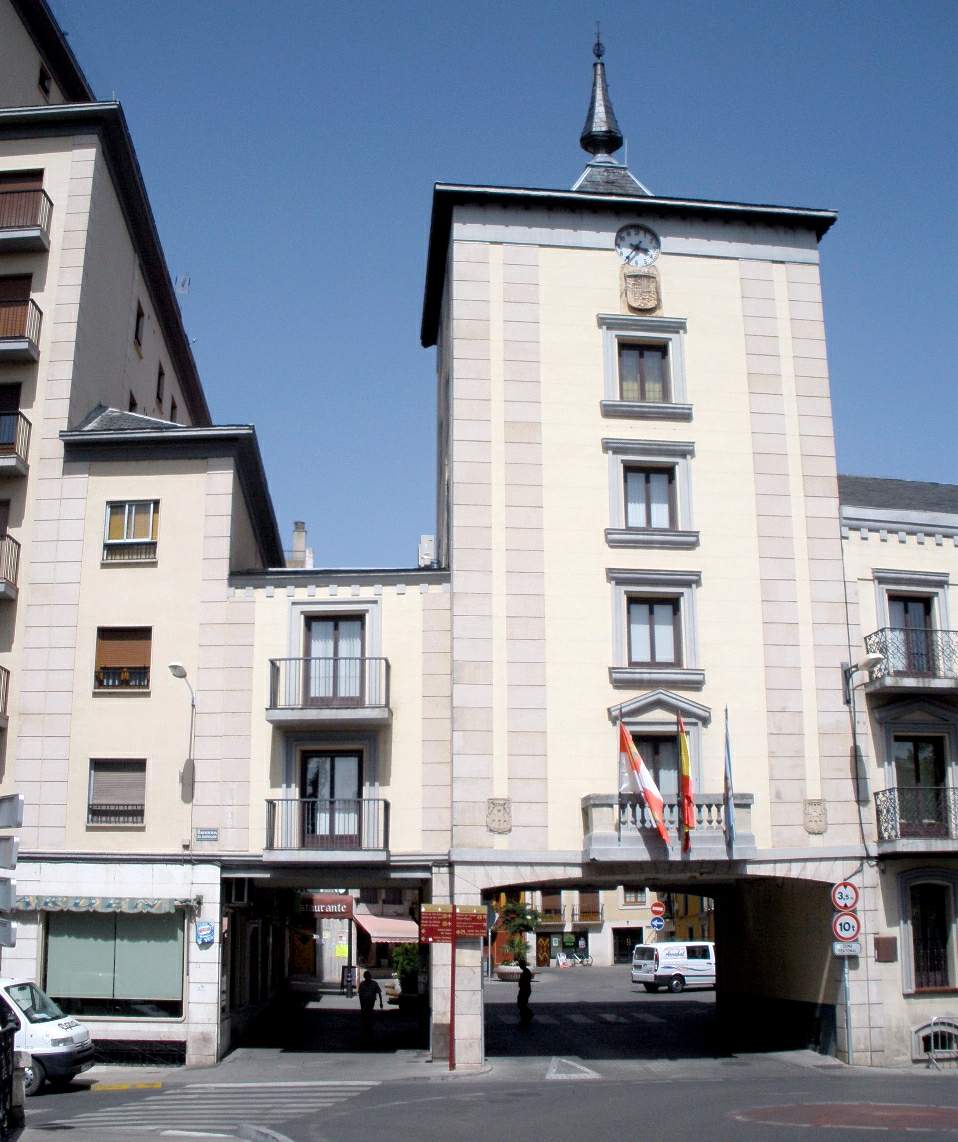
The town hall of Sotillo de la Ribera stands at the heart of a small town in the province of Burgos, in the Castile and León region of northern Spain, on the banks of the Esgueva river, not far from Roa and the Duero valley. The building follows a classical architectural style typical of municipal offices raised in this area around the turn of the 17th and 18th centuries, and it forms part of a small cluster of notable heraldic buildings in the town — standing alongside a former pharmacy building and a mansion known as the Palacio de los Serranos.
What does the town hall building look like?
The façade is built from carefully dressed ashlar stone, laid in regular rectangular blocks. The plain lines and restrained ornamentation typical of classicism give the elevation a sober yet elegant character, quite different from the more decorative, aristocratic façades of the neighbouring buildings. Despite its modest decoration, the building stands out clearly within the town centre, signalling its role as a public institution. It still serves today as the seat of the local municipal government of Sotillo de la Ribera, which makes it a living part of everyday town life rather than a monument frozen for sightseeing alone.
What is the history behind the town where the building stands?
Sotillo de la Ribera began in the Middle Ages as a rural estate administratively dependent on Gumiel de Mercado, with an economy based mainly on livestock farming. The income generated by that activity, combined with a favourable position on the route between Roa and the villages of the Esgueva valley, allowed the settlement to grow steadily until it reached the status of a village. The earliest documented references to Sotillo de la Ribera as a distinct "villa," still formally under the administration of Gumiel de Mercado, date back to the middle of the 15th century. Full administrative independence followed in the 17th century, and in 1667 the town was granted the official title of villa, raising its standing even though it had not yet gained complete independence from its feudal lord. In the middle of the 18th century, the Duke of Medinaceli, who held the rights over Gumiel de Mercado and Sotillo, sold them to the Marquis of Iturbieta, who in turn transferred them to the local council (concejo). It was during this period of prosperity, spanning the 17th and 18th centuries, that most of the town's representative buildings were raised, including the town hall that still stands today.
Where is Sotillo de la Ribera, and what else is worth seeing nearby?
The town lies right in the heart of Ribera del Duero, one of Spain's best-known wine regions, and it sits along the local wine route of the area. A visit to the town hall pairs naturally with a short walk through the historic centre, where other heritage buildings survive — the former pharmacy and the Palacio de los Serranos — and, when the opportunity allows, with a tasting of the local Ribera del Duero wines, one of the region's main draws for visitors.
Frequently asked questions
Where is the town hall of Sotillo de la Ribera located? In the centre of the town of Sotillo de la Ribera, in the province of Burgos, in the Castile and León region of northern Spain.
In what style was the building constructed? In a classical style, with an ashlar stone façade featuring sober, restrained decoration typical of municipal buildings from this region dating to the 17th and 18th centuries.
Does the building still function as a town hall? Yes — it has continuously served as the seat of the local municipal government.
What other historic buildings stand nearby? The same part of town is home to a former pharmacy and the Palacio de los Serranos, together forming a small cluster of historic buildings.
What is the surrounding region known for? Mainly winemaking — the town lies along the Ribera del Duero wine route, one of Spain's most important wine-producing regions.
Nearby places

Earn badges for the places you visit
Download NextOnTrip, discover new places and check off your trails.