About this place
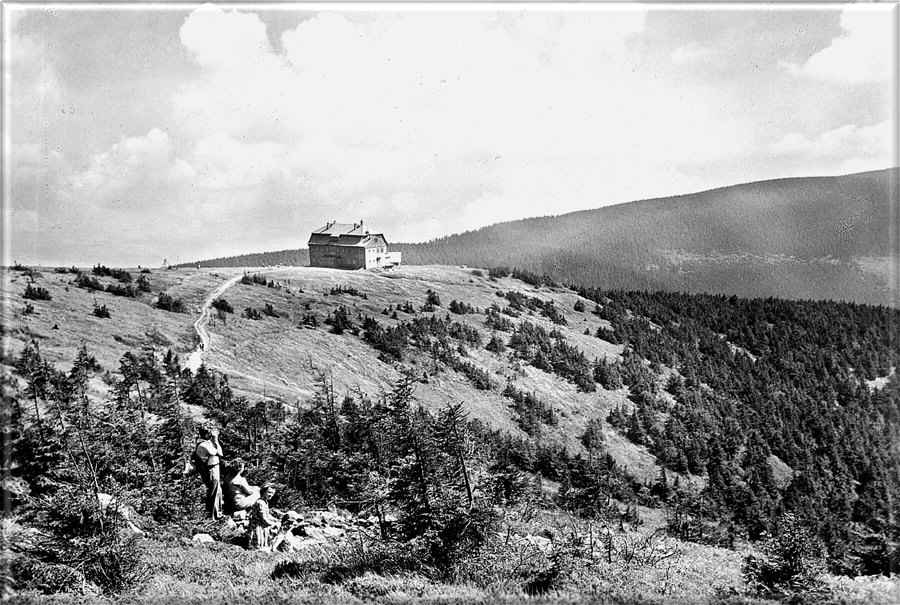
Prince Liechtenstein's Chalet on Śnieżnik once stood on the Czech, south-eastern slope of Králický Sněžník, below the summit, close to today's Dolní Morava. The building itself disappeared more than fifty years ago, yet its story and the traces it left behind still draw hikers exploring the massif.
Who built the chalet, and why was it named after a prince?
The idea came from the Staré Město pod Sněžníkem branch of the Moravian-Silesian Sudeten Mountain Association. Gustav Baldermann, a long-serving board member of the branch, is credited as the driving force behind the project, while the construction itself was overseen by branch chairman Alois Bulla with help from forester Eduard Letfuß of Stříbrnice. Because the building plot belonged to Prince Johann II of Liechtenstein, the association first had to secure approval from his estate administration. The foundation stone was laid in 1908, and the chalet was named after the prince in recognition of his support for the mountain association's work.
How long did construction take, and when did the chalet open?
Building work dragged on well past the original schedule: the chalet had been expected to welcome its first guests in 1909, but the formal opening did not take place until 21 July 1912. Roughly a thousand guests attended the ceremony, an orchestra played, and speeches and toasts were raised in honour of Prince Liechtenstein and the reigning Austrian and German monarchs.
What did the building look like inside?
The chalet was a timber structure with a basement, measuring about 22 by 12 metres and reaching roughly 15 metres in height. The ground floor held a kitchen, a dining room and utility spaces; the first floor contained eleven guest rooms, while the attic was fitted out with large communal dormitories for bigger groups of visitors. For a mountain refuge built before the First World War, it was remarkably well equipped: running water was piped up from the nearby source of the Morava river, a telephone line was connected in 1925, and electric lighting followed in the 1930s.
What role did the chalet play between the wars?
From 1922 the building was leased by the Gutwiński couple, and Oskar Gutwiński turned it into a meeting point not only for tourists but for local artists as well. In 1932, when the chalet marked its twentieth anniversary and the Jescher Gruppe artists' circle celebrated its own tenth, a stone elephant sculpture was unveiled in front of the building. It was designed by Amei Hallegger and carved by the Förster stonemasonry workshop from Zlatá Hora. The sculpture has survived to this day and now serves as the main landmark on the site of the former chalet.
Why did the chalet eventually disappear?
After the Second World War the building operated under a new name, "U pramene Moravy" ("At the Source of the Morava"), referring to the nearby river spring. Its technical condition, however, kept deteriorating, and in 1968 the decision was made to close it; the structure was demolished in 1971.
What is left to see today?
Only fragments of the foundations and walls remain from the chalet itself, but the stone elephant — known locally as "Slůně" or the Śnieżnik elephant — still stands and is now a popular waypoint for hikers, often combined with a walk to the nearby summit and its lookout tower.
Frequently asked questions
When was Prince Liechtenstein's chalet built? The foundation stone was laid in 1908, and the chalet officially opened on 21 July 1912.
Why was the chalet named after Prince Liechtenstein? The building stood on land belonging to Prince Johann II of Liechtenstein, who supported the mountain association behind the project, so the chalet was named in his honour.
When and why was the chalet torn down? It was closed in 1968 due to its poor technical condition and demolished in 1971.
What remains of the chalet today? Foundation and wall fragments survive on site, along with the 1932 stone elephant sculpture, which now marks the spot for passing hikers.
Nearby places

Earn badges for the places you visit
Download NextOnTrip, discover new places and check off your trails.