Save this place and discover nearby attractions with NextOnTrip
In the app you can add it to your favorites, see what else is worth visiting nearby on the map, and earn a badge for your visit.
The app is available for iPhone and Android.
About this place
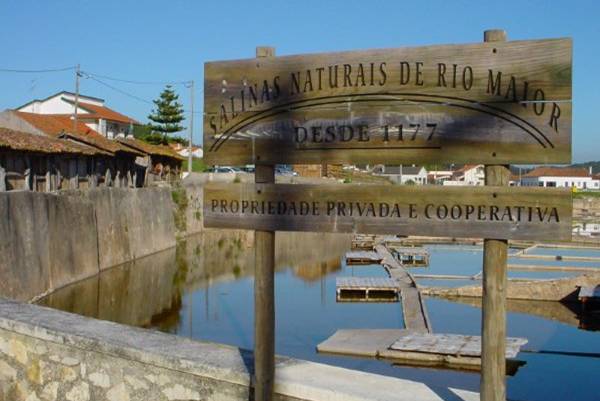
Salinas da Fonte da Bica is a complex of natural salt pans near Rio Maior in central Portugal. It lies at the foot of the Serra dos Candeeiros, about 3 km from the town centre, in the Tifónico valley. You may also see it called the Salinas Naturais de Rio Maior or the Marinhas do Sal de Rio Maior. What sets it apart is that the salt does not come from the sea but from underground.
Where does inland salt come from?
Brine reaches the surface from a well fed by an underground stream. The water passes through a deposit of rock salt, so it is far saltier than seawater – around seven times, according to the Portuguese Wikipedia entry. It is then channelled into shallow tanks, where the sun evaporates the water and leaves the salt behind. The principle is the same as at coastal salt works, but here the whole system depends on water drawn from beneath the ground.
How big are the salt pans?
The layout consists of hundreds of small tanks, rectangular and trapezoidal in plan. Figures vary by source: one heritage record lists 470 tanks, while other accounts mention about 400. The tanks are spread across a slope, which gives the landscape a distinctive geometric pattern, especially striking when they are full of water or covered with a white layer of salt.
What is the history?
The oldest known reference dates from 1177, when a deed of sale transferred the salt pans to the Knights Templar. Some writers suspect the salt was worked even earlier, in Roman and Arab times, but this is not documented. That still gives the site at least eight centuries of recorded salt production.
Is it a protected monument?
Yes, the site has heritage status. Sources disagree on the date: the Portuguese Wikipedia gives 1943 and the category of Property of Public Interest (Imóvel de Interesse Público), while another source says 1997. Keep this in mind if you need precise details.
When is the best time to visit?
Salt work happens only in the summer season, when the sun is strong enough to evaporate the water. That is the best moment to see traditional production in action. Outside the season the tanks are quieter, but there is less going on.
How do you get there?
The salt pans are close to Rio Maior, reached by the N1 road towards the town. They suit a short stop on a road trip, or a walk combined with exploring the surrounding area and the Serra dos Candeeiros.
Frequently asked questions
Does the salt come from the sea? No. It comes from brine drawn from a well fed by an underground stream that flows through a rock-salt deposit.
How many tanks are there? Sources give different numbers, from about 400 to 470.
How old are the salt pans? The oldest known reference dates from 1177.
When is salt harvested? During the summer season.
Nearby places

Earn badges for the places you visit
Download NextOnTrip, discover new places and check off your trails.