About this place
Salamanca is one of the most distinctive cities in Castile and León, famous for sandstone buildings that turn golden at sunset and for hosting the oldest university in Spain. Its historic centre was inscribed on the UNESCO World Heritage List in 1988 as one of the essential centres of Churrigueresque art, whose 18th-century influence spread from the Iberian Peninsula all the way to Latin America.
What makes the University of Salamanca so significant?
The university traces its origins to 1218, when King Alfonso IX of León founded the "scholas Salamanticae." In 1254 King Alfonso X the Wise granted it full university status, making Salamanca one of the first institutions in Europe to hold that title officially, alongside Bologna, Oxford and Paris. For centuries the school trained lawyers, theologians and scholars, and it was here that debates on colonial law in the New World famously took place.
What should visitors look for on the historic facade?
The campus's best-known feature is the Fachada Rica, a richly carved Plateresque facade built between 1521 and 1529, roughly three hundred years after the university's founding. Floral motifs and Italian-influenced ornamentation dominate the design, and a central medallion depicts the Catholic Monarchs. Hidden among the carvings is a small frog — local tradition holds that any student who spots it unaided will have good luck in exams.
Why does the Plaza Mayor draw so many visitors?
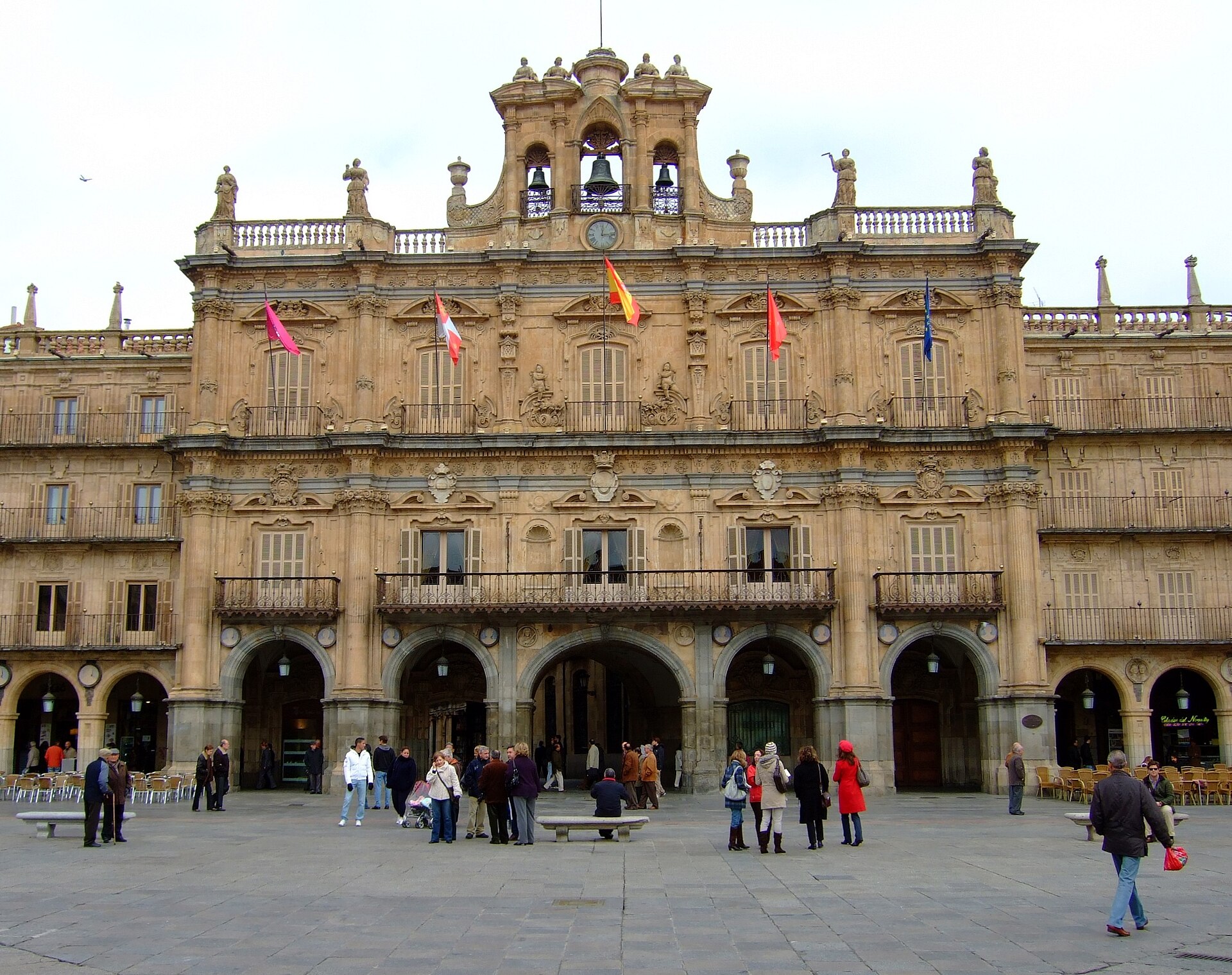
Construction of the Plaza Mayor ran from 1729 to 1755, an initiative led by Rodrigo Caballero de Llanes and funded by the city's own residents rather than the crown. Architects Alberto Churriguera and Andrés García de Quiñones designed the square, which rests on 88 semicircular arches decorated with medallions honouring figures tied to the city's history. The ornamental gable above the main facade, known as the espadaña, was not added until 1852 — more than a century after the square itself was finished. Today the square is ringed by cafes, pastry shops and small stores, making it the natural gathering point for locals and travelers alike.
How do Salamanca's two cathedrals differ from each other?
The city holds two cathedrals standing directly next to one another. The older Old Cathedral, dedicated to Santa María, was built between the early 12th century and the late 14th century in Romanesque and Gothic style. The New Cathedral was constructed starting in 1513 and was consecrated in August 1733. Rather than demolishing the older building to make way for the new one, the two structures were architecturally joined, creating a unique dialogue between styles that spans nine centuries.
How should a visit to the historic centre be planned?
A logical starting point is the Plaza Mayor, from which the university complex and the two cathedrals are only a short walk through the narrow streets of the old town. Covering the main landmarks on foot typically takes anywhere from half a day to a full day, depending on how much time is spent inside each building.
Frequently Asked Questions
When was the University of Salamanca founded? It was founded in 1218 by King Alfonso IX of León, and received full university status in 1254 under Alfonso X the Wise.
Since when has Salamanca been a UNESCO World Heritage Site? The old city was added to the UNESCO World Heritage List in 1988.
How many arches does the Plaza Mayor have? The square rests on 88 semicircular arches, each decorated with medallions of figures connected to the city's history.
Why does Salamanca have two cathedrals? Because the New Cathedral, built between 1513 and 1733, was added directly beside the older Romanesque-Gothic cathedral from the 12th–14th centuries instead of replacing it — together they form a single, architecturally joined complex.
Nearby places

Earn badges for the places you visit
Download NextOnTrip, discover new places and check off your trails.