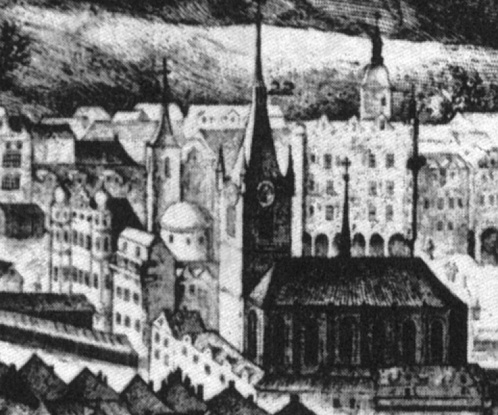
About this place
The Rotunda of Saint Wenceslaus is the surviving remnant of an early medieval round church in Prague's Malá Strana district, uncovered by chance during construction work in 2004 and now open to visitors as an underground archaeological site.
Where does the rotunda's story begin?
A legend about Saint Wenceslaus, written down in the 13th century, links the founding of the church to a miraculous event that occurred while the prince's body was being carried from Stará Boleslav to Prague Castle. The rotunda actually uncovered by archaeologists, however, dates from a later period — the 11th century — and most likely served as the main parish church for the settlement that would eventually grow into Malá Strana. At the time, it was one of only a handful of stone places of worship on this side of the Vltava river, serving residents of the developing settlement below the castle.
How was it discovered?
For centuries it was assumed the building had been completely demolished. The truth turned out to be different: on 3 February 2004, during renovation work in a building belonging to Charles University, workers came across a previously unknown space beneath the ground. It turned out that the remains of the Romanesque rotunda had not vanished but had instead been built into the foundations of a later house — a so-called house of professions erected by the Jesuits. Rather than being torn down, the older structure was effectively absorbed into the newer building above it, which allowed its lower sections to survive right up to their rediscovery in the 21st century. The find was made within an area listed as a UNESCO World Heritage Site, adding to its significance.
What can visitors see today?
Following the discovery, conservation work was carried out to protect and present the surviving nave of the Romanesque rotunda. The space now open to the public shows the layout and scale of the original building from nearly a thousand years ago — sections of wall and the outline of the circular plan typical of early medieval Central European rotundas are clearly visible. The archaeological exhibit sits below current street level, in the basement of the university building, which makes for an unusual visit in itself: a descent of just a few metres leads straight into a layer of the city centuries old.
Why is this site significant?
The Rotunda of Saint Wenceslaus is one of only a few surviving examples of round Romanesque churches in present-day Prague. Its importance goes beyond architecture alone — the 2004 discovery provided direct physical evidence of organized settlement and parish life in Malá Strana as early as the 11th century, long before this part of the city was granted municipal rights. The conservation and presentation of the find have been recognized with a European heritage award, underscoring the quality of the restoration work carried out on the site.
Frequently asked questions
Where is the Rotunda of Saint Wenceslaus located? It is located in Prague's Malá Strana district, on grounds now belonging to Charles University, within an area listed as a UNESCO World Heritage Site.
When were the remains of the rotunda discovered? Fragments of the building were uncovered by chance on 3 February 2004, during renovation work in the basement of a university building.
How old is the rotunda? The excavated Romanesque nave dates from the 11th century, though the legend connecting the site to Saint Wenceslaus is older still and was first written down in the 13th century.
Why did the rotunda survive if it was thought to have been demolished? Its remains were not removed but instead incorporated into the foundations of a later building erected by the Jesuits, which kept them hidden underground until their rediscovery in the 21st century.
Nearby places

Earn badges for the places you visit
Download NextOnTrip, discover new places and check off your trails.