About this place
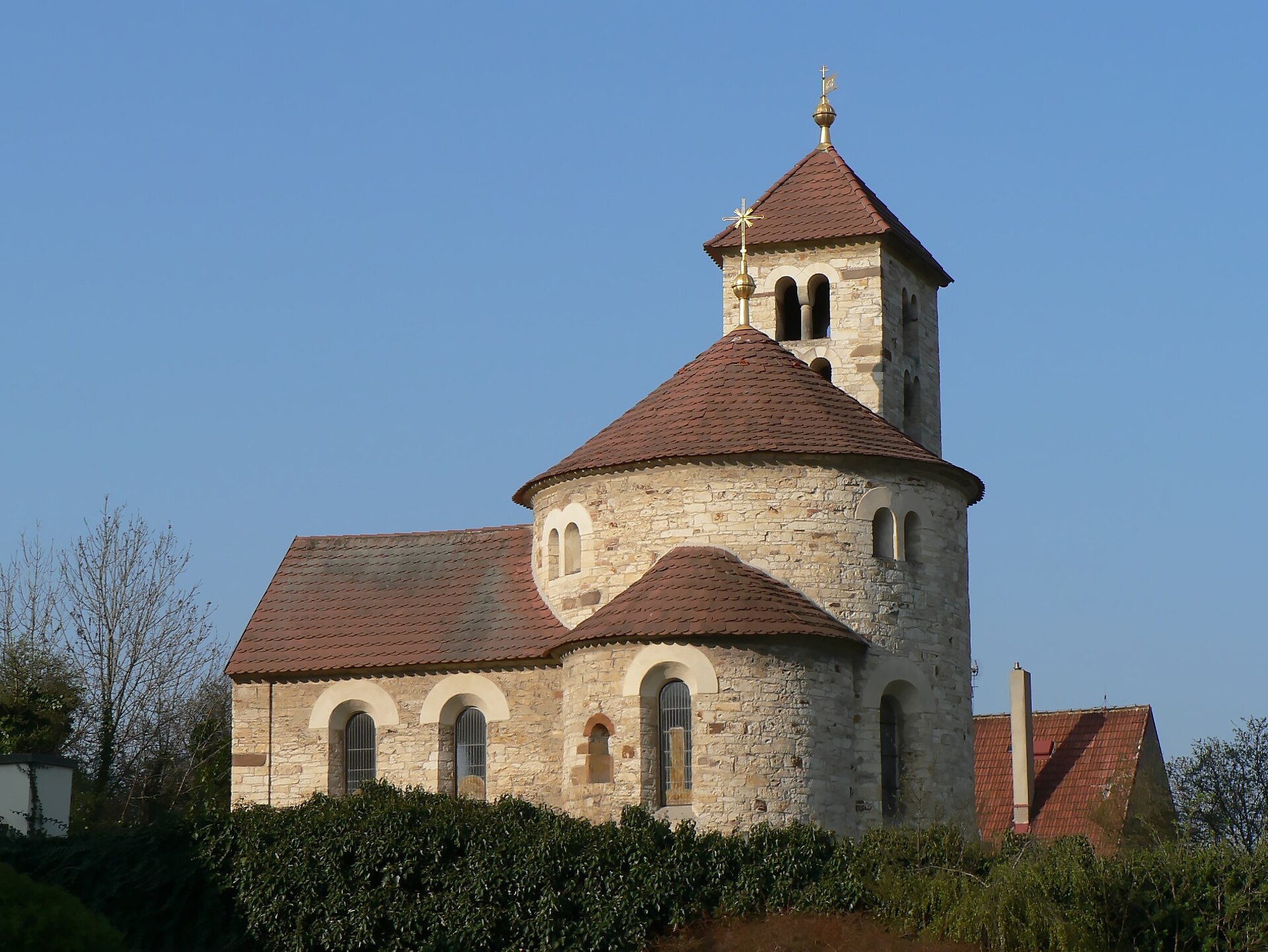
The Rotunda of Saint Mary Magdalene stands in Přední Kopanina, on the north-western edge of Prague, within the administrative district of Prague 6. It is one of the oldest surviving sacred buildings in the Czech Republic and by far the most significant landmark of this small, still village-like part of the city.
Where does the rotunda come from?
The Romanesque building was raised from local opuka, a pale limestone quarried for centuries in the surrounding area, most likely sometime between the 11th and 12th centuries. A local legend credits Saint Ludmila as its founder, though historians treat this claim with caution and tend to favour a somewhat later, 12th-century origin. Whichever date is correct, the rotunda ranks among the oldest masonry churches in Bohemia that have survived in a recognisable form to this day.
What will you see there?
The building has kept its original layout, typical of Romanesque rotundas. The main body is a cylinder with an internal diameter of 5.3 metres, closed on the east side by a low apse, while a tall, square-plan tower rises on the west side. Over the following centuries a rectangular extension was added on the south side, and it is this addition that now serves as the church's main nave. The old rotunda became the presbytery, and the tower was turned into a sacristy. As a result, a single small site lets you trace how a modest Romanesque church gradually grew new functions over time without losing its oldest core.
The building's history has not been a straight line. In 1779 the vault collapsed, and the rotunda was left in ruins for decades, with only the tower remaining intact. In the first half of the 19th century, its picturesque, half-ruined walls caught the eye of Romantic painters and became a favourite subject for them. The building's fortunes changed only with a restoration carried out between 1852 and 1858, driven largely by the efforts of Karel Wiesenfeld, a professor at the Prague polytechnic, whose work saved the monument and rebuilt it into a form close to what visitors see today.
How do you get there?
Přední Kopanina lies on the outskirts of Prague, in a quiet, largely rural setting far from the city's tourist core. That means a visit feels very different from a stroll through the Old Town — it is worth allowing extra time to travel out from the city centre and treating the trip as an unhurried excursion into the suburbs rather than a quick stop on a sightseeing route.
When should you visit?
The rotunda remains an active parish church, so the interior tends to be accessible around services and local heritage-opening events — it is worth checking current hours locally or with the parish before setting out. The exterior and the church grounds can be viewed year-round, at any time of day.
Frequently asked questions
How old is the rotunda in Přední Kopanina? It is dated to the 11th–12th century, making it one of the oldest surviving churches in the Czech Republic.
Is it true that Saint Ludmila founded the rotunda? That is what local legend claims, but there is no firm historical proof — some researchers lean toward a later, 12th-century date instead.
Why isn't the rotunda the church's main nave anymore? After a rectangular extension was added on the south side, that section took over as the main nave, while the original rotunda became the presbytery.
Has the building always looked the way it does now? No — after its vault collapsed in 1779 it fell into ruin, and only the restoration of 1852–1858 gave it the shape it has today.
Nearby places

Earn badges for the places you visit
Download NextOnTrip, discover new places and check off your trails.