- Sacred Monuments
- Churches
Reformierte Kirche Lüsslingen-Nennigkofen
Save this place and discover nearby attractions with NextOnTrip
In the app you can add it to your favorites, see what else is worth visiting nearby on the map, and earn a badge for your visit.
The app is available for iPhone and Android.
About this place
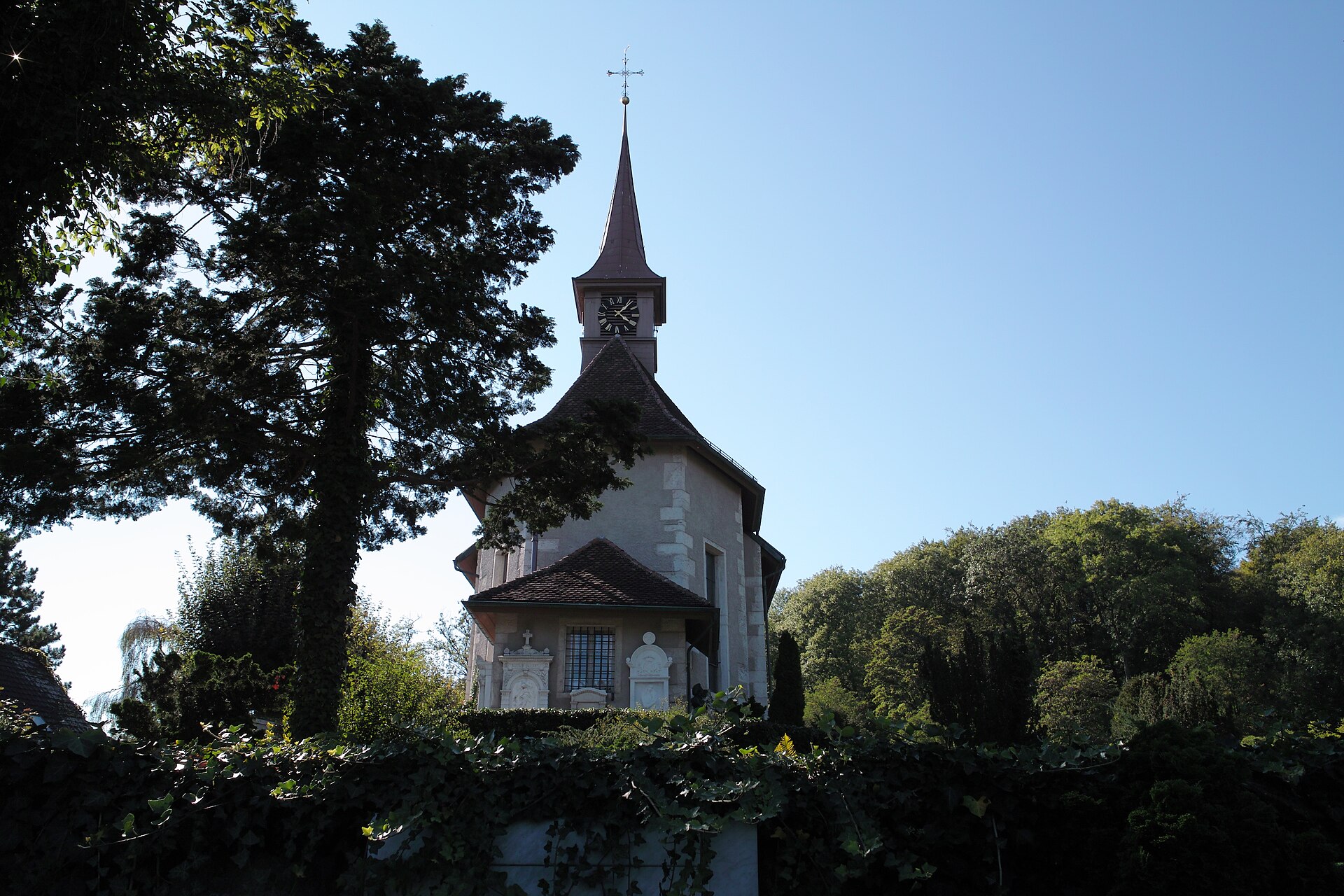
The Reformed church in Lüsslingen (Kirche Lüsslingen, municipality of Lüsslingen-Nennigkofen) sits on the northern slope of the Bucheggberg hills in the canton of Solothurn. It is the Protestant parish church of the village, with roots reaching back to the early Middle Ages, and the cantonal heritage office lists it at Kirchgasse 83.
Where is the church?
The church stands in Lüsslingen village, at about 439 m above sea level. Until 2013 Lüsslingen was a municipality of its own; on 1 January 2013 it merged with neighbouring Nennigkofen to form Lüsslingen-Nennigkofen. Of all the municipalities in the Bucheggberg district, Lüsslingen lies closest to the city of Solothurn, so a stop here fits easily into a day trip from the old town.
What is its history?
According to the Historical Dictionary of Switzerland, the church was founded in the early Middle Ages. The building you see today dates mainly from 1652 and 1722. Lüsslingen and Nennigkofen came under the rule of the city of Solothurn in 1539, and the village is first recorded in 1251 as "Luslingen".
Whom does it serve?
The Reformed parish of Lüsslingen covers more than the village itself: Nennigkofen and Lüterkofen-Ichertswil belong to it too. The church is therefore a shared centre for several nearby communities. Solothurn is a mostly Catholic canton, which makes the Reformed parishes of the Bucheggberg a distinctive trait of the region.
What else is there to see nearby?
The village keeps a rectangular street layout and several farmhouses with hipped roofs, although its farming character has been reshaped by the Solothurn urban area next door. Charcoal was burned on the Aarefeld for about four decades until 1869, and a cheese cooperative was founded in 1887. Early medieval graves were found near the village in 1953, and a Roman road from Aventicum to Augusta Raurica ran between Lüsslingen and Leuzigen. A walk around the village with the church as its focal point gives a good picture of rural life on the Bucheggberg.
How do you get there?
The church lies on Kirchgasse in the village centre, at roughly 47.188 N, 7.501 E. Lüsslingen borders Bellach, Biberist, Lohn-Ammannsegg, Lüterkofen-Ichertswil, Nennigkofen and Selzach, and the short distance from Solothurn is easy to cover by car or bike.
Frequently asked questions
Is this the church in Lüsslingen or Nennigkofen? It is in Lüsslingen. The parish also includes Nennigkofen, so residents of both villages belong to it.
When was the building constructed? The church was founded in the early Middle Ages; its present form comes mainly from work carried out in 1652 and 1722.
Which denomination does it belong to? It is a Reformed church, part of the Protestant tradition that follows Calvin.
Is there anything else to see close by? Yes. The village preserves its traditional street plan and some old farmhouses, and Solothurn with its historic old town is only a few kilometres away.
Nearby places

Earn badges for the places you visit
Download NextOnTrip, discover new places and check off your trails.