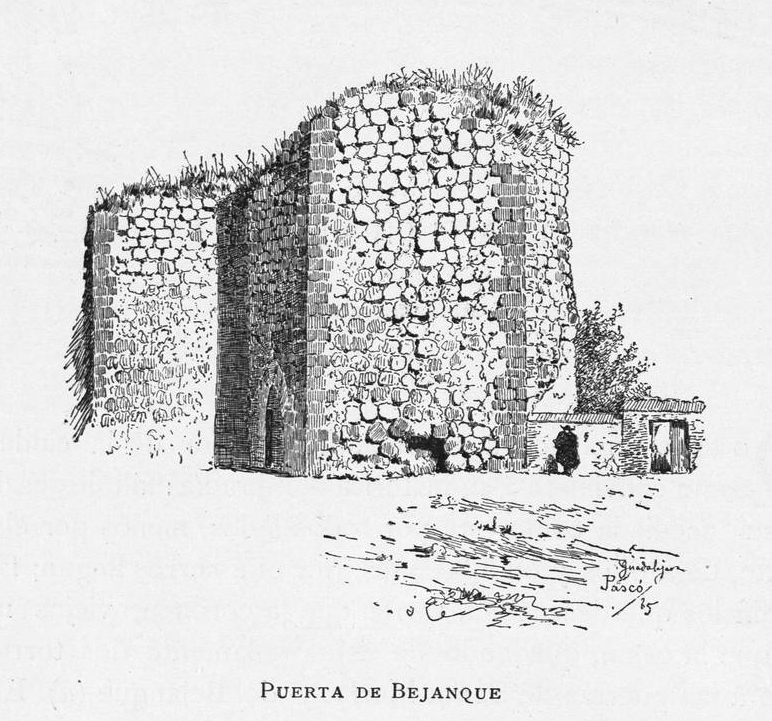
About this place
Puerta de Bejanque is a medieval city gate in Guadalajara, Spain, and the most recognizable surviving fragment of the walls that once enclosed the old town. It stands on Plaza de Bejanque and is one of only three remaining pieces of the fortification, alongside the Torreón de Alvar Fáñez and the Torreón del Alamín.
Where did this gate come from?
Guadalajara's city walls date back to the early medieval period, but the Puerta de Bejanque as it stands today was built in the 14th century. It was one of the main gates along the defensive perimeter that protected the city from military attack, and local tradition also credits it with a role in controlling movement into the city during outbreaks of disease. The structure was raised from flint and large dressed limestone blocks, materials typical of Castilian defensive architecture of the period.
How was it built to withstand an attack?
Bejanque is considered one of the strongest gates in the entire city wall system. It was guarded by a tower on a pentagonal plan, and the passage itself ran through two arches set in a zig-zag arrangement — a layout known as a "bent gate," designed to slow down attackers and prevent a straight charge into the city. This kind of staggered entrance appears in many medieval Spanish towns and was meant to buy defenders extra time during a siege.
What happened once it lost its defensive role?
Once the walls stopped serving a military purpose, the gate was repurposed as a municipal storage building. In 1884 most of the monumental structure was torn down, leaving only the arch that can still be seen today. Over the following decades the site fell into neglect, hemmed in by commercial buildings, including a scrap metal yard that sat right against the monument.
How was it brought back?
The turning point came in 1989, when the Guadalajara city council decided to reclaim the monument — the adjacent scrapyard was demolished and restoration work rescued the gate from decades of neglect. As part of the redevelopment of the square, previously known as Plaza de la Olma, the surrounding area was cleared and turned into a quiet public space with the Puerta de Bejanque as its centerpiece. Today the gate is protected under Spain's historical heritage law (Ley 16/1985).
What can you see on site today?
At Plaza de Bejanque, visitors can inspect the surviving arch up close, note the contrast between the flint and limestone used in its construction, and trace the rough line the old walls once followed toward the city's other remaining towers. It makes a good starting point for exploring medieval Guadalajara further, including the nearby Torreón de Alvar Fáñez.
Frequently Asked Questions
How old is the Puerta de Bejanque? The gate in its current form dates to the 14th century, though the city wall system it belonged to has earlier, early-medieval roots.
Has the gate survived in its original form? Not entirely — most of the structure was demolished in 1884, and only the distinctive arch has survived, restored in 1989.
Why is it called a "bent gate"? Because the passage ran through two arches arranged in a zig-zag, a defensive design meant to slow attackers and a common feature of medieval city walls.
What else is worth seeing nearby? The route along Guadalajara's old walls also includes the Torreón de Alvar Fáñez and the Torreón del Alamín, other surviving fragments of the city's medieval fortifications.
Nearby places

Earn badges for the places you visit
Download NextOnTrip, discover new places and check off your trails.