About this place
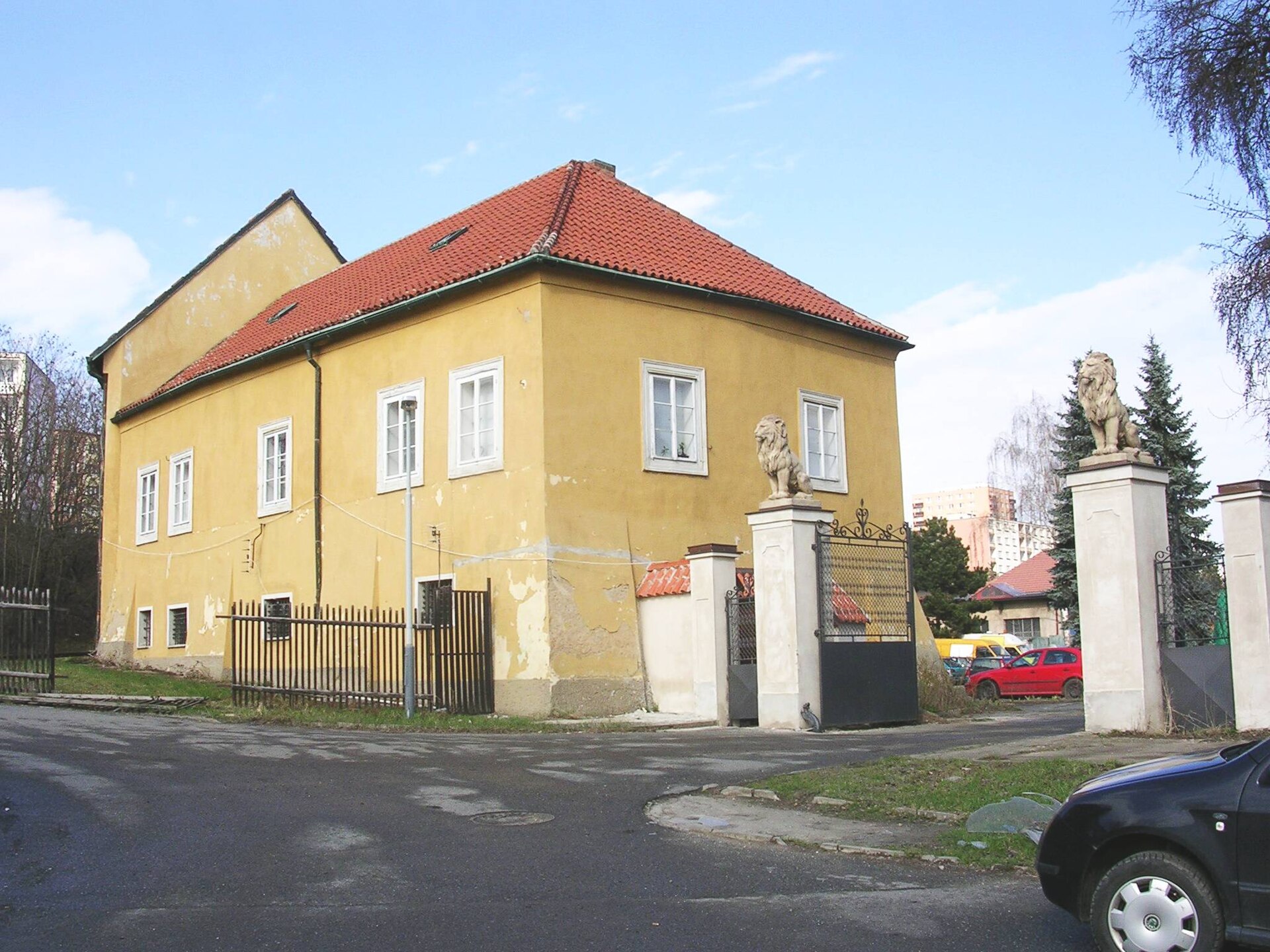
Práče is a small château standing in the historic settlement of the same name, now part of Prague's Záběhlice district (Prague 10), on the banks of the Botič stream between Hostivař and the Zahradní Město housing estate. That Prague location explains why this entry is tagged "Praga" — despite its modest size, Práče is a genuine heritage site within the Czech capital, not a mislabeled village elsewhere.
How far back does the site's history go?
The village of Práče is first documented in written records from 1352. A fortified manor house (tvrz) on the site is mentioned for the first time in 1407. Its early history was turbulent: on 20 March 1444 the fortress burned down under unclear circumstances, and although it was rebuilt, records from 1592 already describe it as abandoned and dilapidated. Throughout the 16th and 17th centuries the estate changed hands repeatedly among Prague burghers and minor nobility.
When was the present château built?
The building seen today went up shortly before 1710, on the site of the older tvrz and partly incorporating its remains. In 1705 the property was bought by Kryštof Ferdinand Pichler, and soon after 1710 it passed to the Dominican convent of St. Mary Magdalene in Prague's Malá Strana, which used it as a residence with its own chapel. At that time the estate also included a monastery brewery, a watermill and a fishpond.
What happened after the convent was dissolved?
Following the dissolution of the convent in 1784, as part of the Josephine church reforms, Práče was purchased by Josef Meissner (also recorded as Meissler). The Meissner family retained ownership until 1867. In the second half of the 19th century, and again in 1910, the building underwent significant alterations: the originally single-storey, rectangular core was extended into a two-storey, bent-rectangular (roughly L-shaped) layout.
What does the château look like architecturally?
The core structure is a rectangular, partly single-storey building with an arcade on the eastern façade and a balustrade along the courtyard elevation. Fragments of early Baroque painted ceilings survive inside. The wider complex includes a residential house, a former farm building now used as a carpentry workshop, a three-part entrance gate decorated with lion sculptures, and a separate two-storey Baroque granary with oval windows and a stone portal. The grounds also held a chapel with a statue of St. John of Nepomuk and an English-style landscape park.
Can Práče be visited today?
No. The château is listed as a protected cultural monument of the Czech Republic, but it remains privately owned and currently serves as a company headquarters, with its courtyard used for parking. Between 1969 and 1970 the building housed the administration of a state vegetable-growing farm. A small pond (a reservoir on the old millrace) and the adjoining park were open to visitors until 2006 but have since been closed. The monastery brewery operated until 1936; part of the brewery buildings, including a drying kiln, was demolished in the late 1980s.
Frequently asked questions
Where exactly is Práče located? In Prague, in the Záběhlice district (Prague 10), on the Botič stream between Hostivař and Zahradní Město.
Is this the same Práče as the village near Znojmo? No. They share a name but are unrelated — Práče near Znojmo, in South Moravia, is a separate village with no château of its own.
Can visitors go inside the château? No, it is privately owned and not open to the public.
Does anything remain of the original medieval fortress? The tvrz itself did not survive; the current château was built on its site shortly before 1710, reusing some older remains.
Was there a brewery on the estate? Yes, a monastery brewery operated on the grounds until 1936.
Nearby places

Earn badges for the places you visit
Download NextOnTrip, discover new places and check off your trails.