About this place
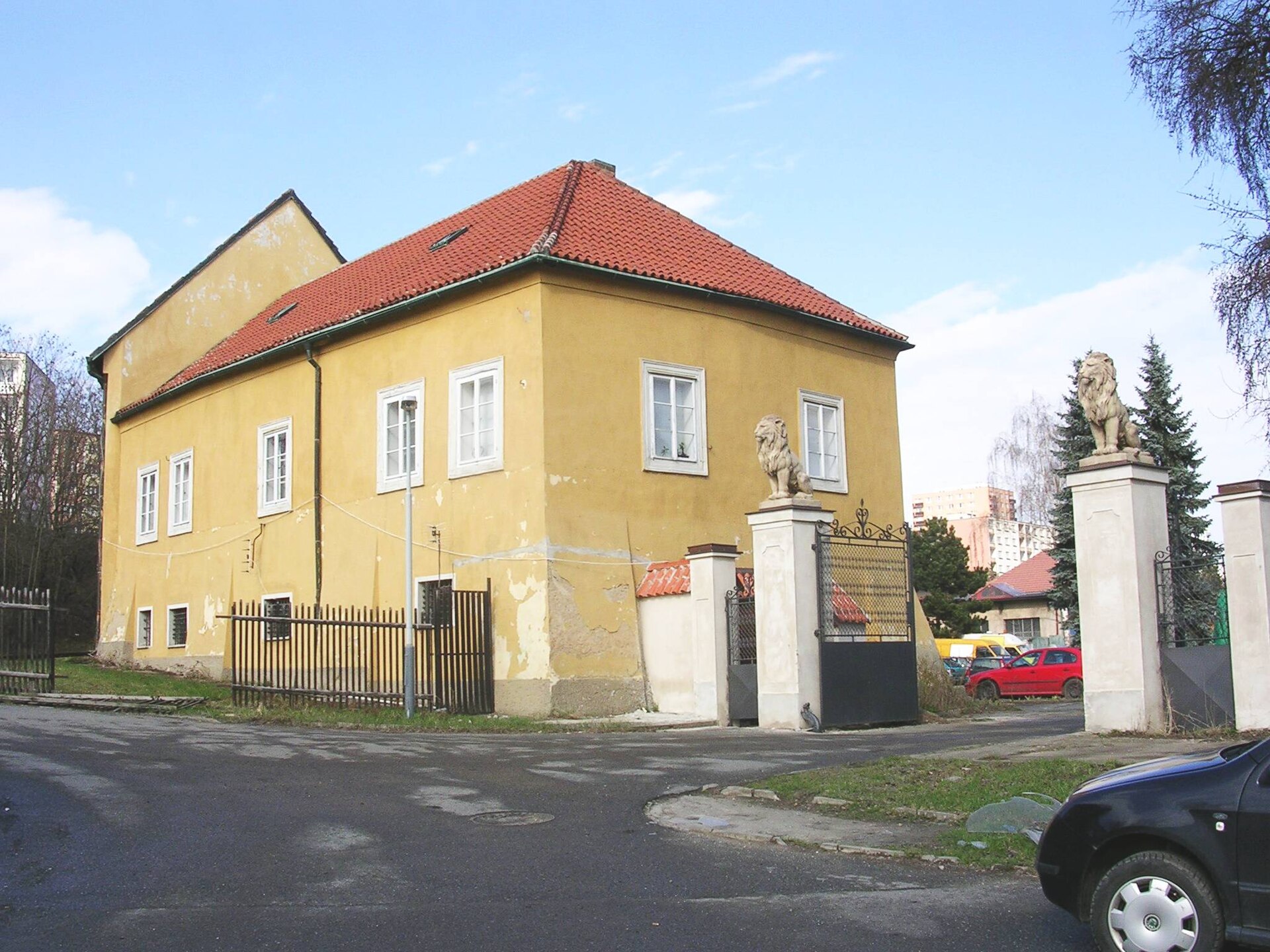
Chodov Fortress (Chodovská tvrz) is a nearly circular medieval stronghold in Prague's Chodov district, now serving as a cultural centre with an art gallery and concert hall. The building preserves elements of its original Gothic fortification alongside later Baroque and Classicist alterations, with a history reaching back to the turn of the 13th and 14th centuries.
When was Chodov Fortress built?
The stronghold was built around the turn of the 13th and 14th centuries; archaeological research on site uncovered pottery fragments dating to the 13th century. The structure had an almost circular ground plan roughly 32 metres in diameter, surrounded by a water-filled moat. Remnants of the circular defensive rampart survive today within the ground-floor exterior walls, and the original Gothic doorway remains in the western wall. A footbridge now marks the spot where a drawbridge once crossed the moat.
Who were its first owners?
The earliest documented owners of the Chodov estate were the Knights of the Holy Sepulchre with the Red Star, whose headquarters stood in Prague's Zderaz district; the order held the property from the 14th century onward. Ownership changed hands repeatedly over the following centuries.
How did ownership change over the centuries?
At the start of the Hussite Wars the estate belonged to Janek Puškař, a Prague Hussite. For nearly the whole of the 15th century the fortress was held by the Chodovský family of Chrást, from whom the site takes its present name. Between 1526 and 1558 it passed to the Osovský family of Adlar and then the Muchek family of Bukov, and during the Thirty Years' War it belonged to the Michna family of Vacínov. In 1676 the fortress was acquired by Benedictine monks from the Old Town monastery, who rebuilt the partly ruined structure into a Baroque residence. Through the 18th century it belonged to the Goltz family of Kunratice, and at the turn of the 18th and 19th centuries it passed to František Rousseau, after whom it was taken over by the Korb family of Weidenheim.
How did the building's architecture change?
The Benedictines gave the fortress its Baroque character in the late 17th century while rebuilding the previously damaged structure. In the 19th century, under later owners, Classicist arcades were added around the courtyard. The Prague City Museum carried out archaeological surveys of the site, and a thorough reconstruction between 1984 and 1989 brought out the surviving medieval fortification elements alongside the later Baroque and Classicist layers.
What is Chodov Fortress used for today?
The building now functions as a cultural centre, run by the organisation Kulturní Jižní Město. It houses an art gallery with changing exhibitions, and hosts chamber concerts of classical music, theatre performances, and educational programmes for various age groups. The venue is also used for wedding ceremonies and other private events. The fortress stands on Ledvinova street in Prague 11 (Jižní Město), in the south-eastern part of the city.
Frequently asked questions
Where exactly is Chodov Fortress located? It lies in Prague's Chodov district, within the administrative area of Prague 11 (Jižní Město), at coordinates 50.0347222 N, 14.4988889 E.
Is Chodovská tvrz a castle or a fortress? Historically it is a medieval stronghold (tvrz) with an almost circular plan, later remodelled into a Baroque and Classicist residence — which is why it is sometimes referred to as a chateau or castle.
What can visitors see there today? Art exhibitions in the gallery, surviving traces of the Gothic fortification (the doorway, the outline of the moat and rampart), and, during cultural events, concerts and theatre performances.
Who manages the site? The venue is run by Kulturní Jižní Město, which organises its exhibition, concert, and educational programme.
Are weddings held at Chodovská tvrz? Yes, the venue is also used as a location for wedding ceremonies and other celebratory events.
Nearby places

Earn badges for the places you visit
Download NextOnTrip, discover new places and check off your trails.